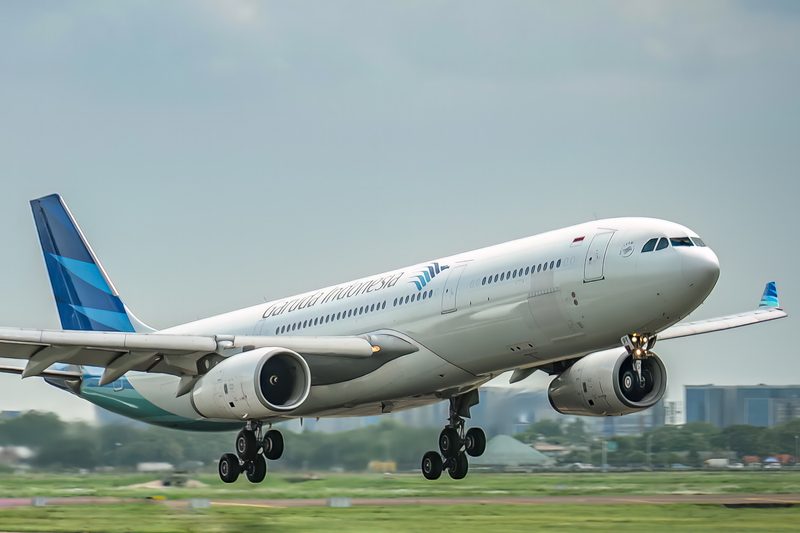
A Garuda Indonesia Airbus A330-900neo operating a pilgrimage flight from Jeddah (JED) to Medan Kualanamu (KNO) spent nearly four additional hours airborne over southern India on May 8, tracing repeated holding patterns before finally being allowed to continue to Indonesia.
The aircraft, PK-GHI, was operating as GA4208 and ultimately remained in the air for roughly 12 hours and 39 minutes, far longer than the route would normally require. Flight-tracking data showed the widebody completing about 24 loops while waiting near the southern Indian airspace system.
For aviation readers, the key question is not whether the airplane could hold that long. It clearly could. The more important question is why the crew chose to remain airborne rather than diverting.
Read our stories in your inbox
Two aviation newsletters. Zero fluff.
The Flight Was Trapped By A Temporary Airspace Closure
The most widely reported explanation is that a large section of airspace over the Bay of Bengal had been temporarily restricted by India, reportedly in connection with a missile-test window.
That matters because this was not a weather hold, airport congestion issue, or technical malfunction. It was an airspace-access problem. The flight had already progressed normally for several hours from Saudi Arabia toward Southeast Asia before encountering a part of the route structure that was no longer available.
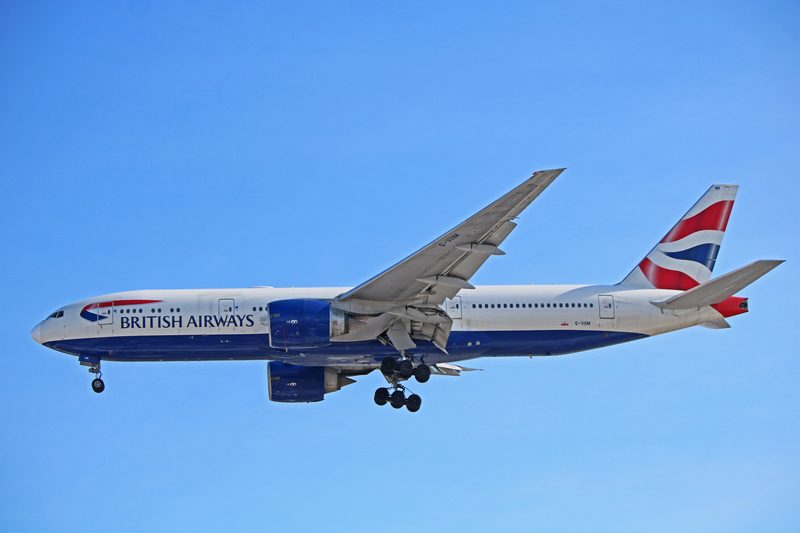
When a major international corridor closes suddenly, the problem is not just “go around it.” Long-haul traffic moves through pre-cleared airways coordinated across multiple control regions, and once one of those corridors disappears, the alternatives can become operationally difficult very quickly.
Why The Crew Did Not Simply Divert
At first glance, four hours of holding sounds extreme enough that a diversion might seem obvious.
But for a long-haul pilgrimage flight, diversion is rarely simple. An unscheduled landing would have raised a long list of complications: fuel planning, airport handling, crew-duty time, immigration and passenger processing, slot availability, and the need to re-clear the onward route later. For a flight carrying a full passenger load over a long distance, a diversion can turn one delay into a much larger operational breakdown.
If the airline believed the restricted corridor would reopen within a manageable window, remaining airborne may have been the least disruptive option available.
The A330-900neo Was A Good Aircraft For This Situation
Garuda was operating the flight with the Airbus A330-900neo, and that matters.
The A330neo is designed for long-range efficiency, and compared with older widebodies it is better suited to absorbing an unexpected endurance challenge like this. That does not mean holding for nearly four and a half hours is normal. It is not. But it does mean the aircraft had the fuel efficiency and long-haul capability to make the option operationally possible where another type might have been pushed into a diversion sooner.
In this case, the airplane’s economics and endurance likely helped give the crew more room to wait.

This Was Highly Unusual Even By Long-Haul Standards
Holding patterns happen every day in commercial aviation. What makes this event stand out is the duration.
A few loops in a congested terminal area are routine. Nearly four and a half hours of holding for a long-haul passenger flight is not. That is why the tracking screenshots spread so quickly across aviation circles. Even for pilots and dispatchers used to delay and reroute events, this was unusual enough to raise immediate questions.
The simplest answer is that the crew appears to have been caught at the intersection of a major airspace restriction and a long-haul operating environment where diverting was unattractive and waiting remained viable.
The Bigger Lesson Is About Geopolitics, Not Just One Flight
This incident is also a reminder of how fragile some international route structures remain.
Flights between the Middle East, South Asia, and Southeast Asia increasingly depend on narrow bands of politically usable airspace. When one of those corridors is restricted, whether for military, security, or geopolitical reasons, the consequences can be far larger than passengers realize. Aircraft do not just shift a little left or right. Entire operational plans can be thrown off.
That is what this Garuda flight demonstrates so clearly. A single airspace restriction was enough to add hours to a routine long-haul sector without any problem onboard the aircraft itself.
Bottom Line
Garuda Indonesia flight GA4208 did not spend four extra hours circling over southern India because of a technical issue or weather disruption. The available reporting points instead to a temporary closure of a critical airspace corridor over the Bay of Bengal, likely linked to a military test window, which left the crew with a difficult decision: divert, or wait.
They chose to wait, and the Airbus A330-900neo had the endurance to make that choice work. The result was one of the more unusual long-haul flight paths seen this year, and a vivid illustration of how quickly geopolitics can reshape commercial aviation in real time.