LOT Polish Airlines (LO) finished 2025 with the kind of momentum legacy carriers in Central and Eastern Europe have been chasing for years: 11.7 million passengers, up 9.4% year-on-year, alongside a steady drumbeat of new routes and a modernization program that is now the largest fleet expansion in the airline’s history.

For an airline whose business model is built around funneling regional demand into Warsaw Chopin (WAW)—and increasingly around a multi-airport strategy across Poland—the 2025 result isn’t just a traffic headline. It’s evidence that LOT is scaling in the two places that matter most operationally: network breadth (more origins, more O&D) and fleet structure (more seats at lower unit cost, with a clearer path to product consistency).
Read our stories in your inbox
Two aviation newsletters. Zero fluff.
Traffic growth with route discipline: nine launches in 2025
LOT’s 2025 network expansion wasn’t about flashy, one-off long-haul adds. It was about thickening the map across Europe and leisure markets—exactly the kind of flying that improves hub connectivity and produces more stable year-round flows into WAW.
New 2025 routes included:
-
Lisbon (LIS)
-
Thessaloniki (SKG)
-
Keflavík/Reykjavík (KEF)
-
Marrakech (RAK)
-
Stavanger (SVG)
-
Rovaniemi (RVN)
-
Malta (MLA)
Two details here matter to airline professionals:
-
The mix is deliberate. LIS, ORY, and BCN are high-utility markets that support both point-to-point demand and hub feed; KEF/RAK/RVN are seasonal and leisure-weighted but can be very productive when paired with efficient narrowbodies and strong ancillary capture.
-
Poland’s “multi-airport” angle is real. KRK and Gdańsk (GDN) are no longer just domestic spokes feeding WAW—they’re being positioned as credible origin airports for outbound European flying, which spreads risk and captures local demand without forcing every itinerary through the hub.
2026 network step-change: WAW–SFO and WAW–BKK enter the plan
LOT has already signaled that 2026 will bring a meaningful long-haul inflection, enabled by fleet growth. The most significant addition is the new Warsaw (WAW)–San Francisco (SFO) service, slated to start in May 2026, followed later in the year by Warsaw (WAW)–Bangkok (BKK).
From a planning perspective, WAW–SFO is a classic “strategic long-haul” move: it adds nonstop access to a major global business market and expands LOT’s U.S. footprint without relying on connections via Frankfurt (FRA), London (LHR), or Paris (CDG). It also plays to the strength of WAW as a connecting hub—pulling traffic not only from Poland, but from across Central/Eastern Europe where one-stop itineraries via WAW can compete effectively on elapsed time and schedule.
On the short-haul side, LOT has also outlined additional 2026 route growth beyond WAW, including:
-
From Kraków (KRK) to Madrid (MAD), Barcelona (BCN) and Rome Fiumicino (FCO)
-
From Gdańsk (GDN) to Istanbul (IST), Brussels (BRU), Oslo (OSL) and Bergen (BGO)
That kind of non-hub expansion is a strong signal that LOT is trying to grow “true local demand” in parallel with hub connectivity—useful in a market where WAW is dominant, but not the only engine of traffic growth.
The fleet story: 55 firm aircraft, 44 options—and three different missions to cover
LOT’s most consequential 2025 development wasn’t a single route launch. It was the start of what the carrier describes as its largest fleet modernization program ever, anchored by 55 firm aircraft orders with options for 44 more.
What makes this particularly interesting is how the aircraft mix addresses three distinct problems at once:
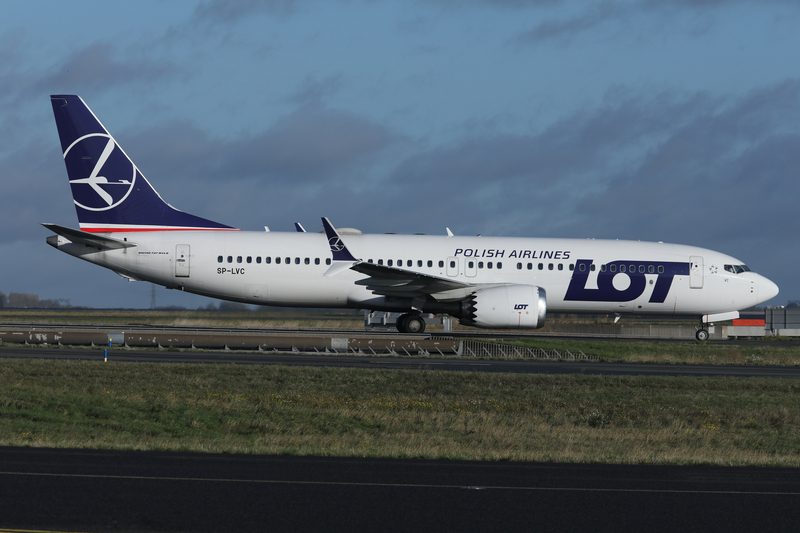
1) Near-term narrowbody scale: Boeing 737 MAX 8 deliveries accelerate
Deliveries of the Boeing 737 MAX 8 began around the turn of the year, and LOT expects 13 MAX 8s to be in service by mid-2026. For the airline, this is a capacity and cost lever:
-
The MAX 8 provides improved fuel burn and range flexibility versus older 737NG aircraft.
-
It supports higher utilization—especially valuable on Europe-wide flying where block times and rotations are optimized around WAW’s bank structure.
-
It creates an opportunity for consistent cabin standards on short/medium haul as more frames enter the fleet.
LOT has also been using these deliveries as a product reset moment—rolling out updated interiors on incoming MAX aircraft to align the onboard feel more closely with its premium ambitions.
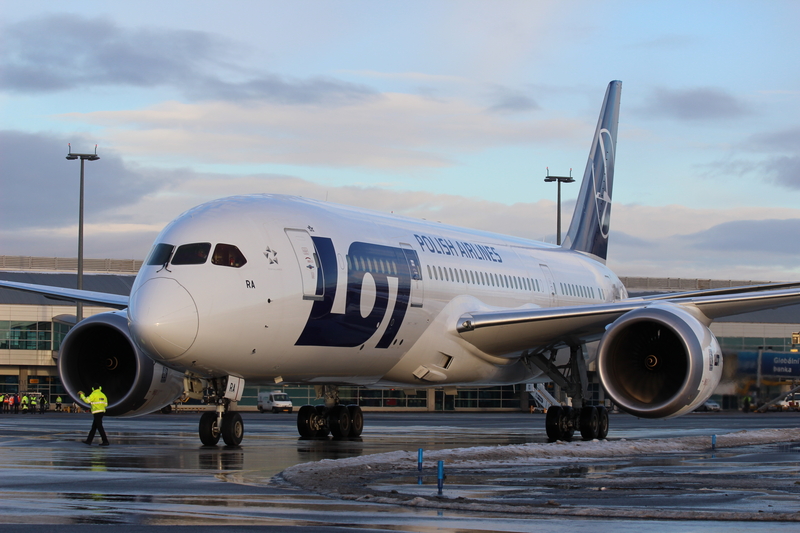
2) Long-haul reinforcement: two additional Boeing 787-8s planned for late 2026
LOT’s long-haul growth hinges on having enough widebody capacity to expand without degrading schedule integrity. The plan to add two Boeing 787-8 Dreamliners in Q4 2026 matters because it supports growth while protecting resilience.
For routes like WAW–SFO and WAW–BKK, the 787 family is the right tool: modern long-range performance, strong belly cargo capability, and passenger-friendly economics that work in markets where a daily widebody needs both local demand and connecting feed to stay efficient year-round.
3) Regional fleet reset: Airbus A220 to replace aging regional aircraft over time
LOT is preparing for the introduction of the Airbus A220, intended to become the backbone of its regional fleet in the coming years. This is a strategic shift: the A220 is purpose-built for thinner routes where you want jet economics, modern passenger comfort, and enough range to open new city pairs that are hard to sustain with larger narrowbodies.
Operationally, the A220 also addresses a common European hub-carrier pain point: you can add frequency and network depth without flooding the market with capacity, which helps protect yields while still improving schedule utility.
Product investment: lounges, cabins, and the “premium signal” for a hub carrier
LOT has paired fleet renewal with upgrades to the customer experience—an important piece of the puzzle when you’re trying to compete for premium traffic at a transfer hub. Refreshed lounges at Warsaw (WAW) and design consistency across ground and air products are not cosmetic details; they’re how a carrier turns connecting traffic into repeat business.
Industry recognition has followed, including being named Best Airline in Eastern Europe at the Skytrax World Airline Awards and achieving a 4-star Skytrax rating—external validation that LOT’s product strategy is moving beyond “regional legacy carrier” toward “competitive connecting airline.”
Bottom Line
LOT’s 2025 performance—11.7 million passengers (+9.4%), nine new routes, and a widening footprint beyond Warsaw (WAW) into airports like Kraków (KRK), Gdańsk (GDN) and Radom (RDO)—reads like a carrier building durable scale, not chasing short-term spikes. The bigger story is the fleet: 55 new aircraft on firm order (44 options), near-term growth via 737 MAX 8s, long-haul reinforcement via additional 787-8 Dreamliners, and a future regional reset built around the Airbus A220. With WAW–San Francisco (SFO) launching in May 2026 and WAW–Bangkok (BKK) following later, LOT enters 2026 with a clearer aircraft roadmap—and the network ambition to match it.
Keep reading FlyMag
Get the Daily Brief in the morning or the Route Watch weekly recap on Fridays. Or both.
Share this story
Composed for each network — click to share, or copy the composed text for your own timing.