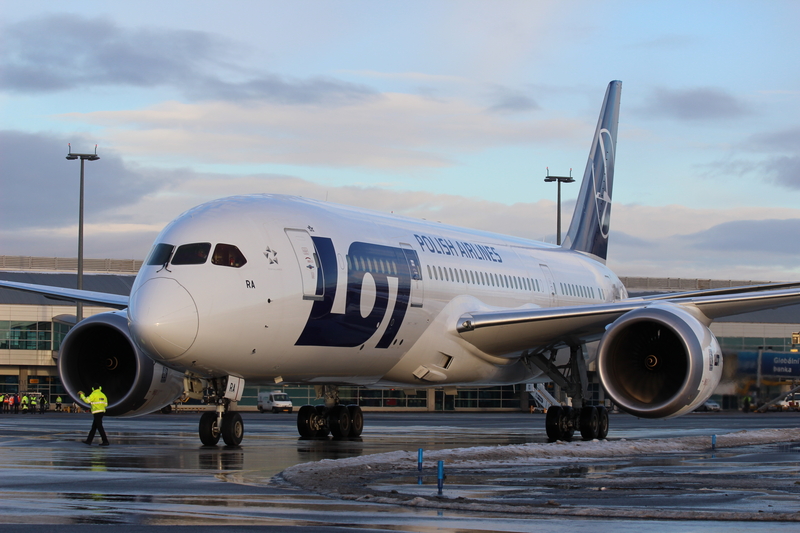
LOT Polish Airlines (LO) is deploying two special, one-time repatriation services to bring Polish tourists home from the Indian Ocean region after widespread flight disruption linked to the recent Middle East airspace instability.

The carrier will operate:
-
Colombo (CMB) – Warsaw (WAW) on March 10, 2026
Read our stories in your inbox
Two aviation newsletters. Zero fluff.
-
Malé (MLE) – Warsaw (WAW) on March 10, 2026
These are not regular scheduled additions—they are purpose-built recovery flights coordinated with Polish travel agencies to assist travelers whose return itineraries collapsed as airlines rerouted, paused, or canceled services due to the rapidly evolving security environment affecting flight corridors between Europe, the Gulf, and South Asia.

Why Sri Lanka (CMB) and the Maldives (MLE) were hit so hard
Neither Sri Lanka nor the Maldives sits inside the conflict zone. But their air connectivity to Europe relies heavily on the Gulf hub system—connections through airports such as Doha (DOH), Dubai (DXB/DWC), and Abu Dhabi (AUH), plus routings that often cross airspace now subject to restrictions or increased risk.
When that corridor breaks, travelers in places like CMB and MLE can become stranded quickly for two reasons:
-
Limited nonstop lift to Europe: There are fewer direct options, and they sell out fast during mass disruption.
-
Fewer alternate routings: Detours around restricted areas lengthen flight times, strain crew duty limits, and reduce schedule reliability—especially for airlines already operating tight rotations.
That’s exactly the scenario repatriation flights are designed for: restore a reliable, direct path back to the home country when the “normal” connecting network can’t absorb the demand.
Aircraft and operational expectations: widebody logistics, long-haul planning
LOT has not publicly specified the aircraft type in the announcement, but a nonstop WAW–CMB or WAW–MLE mission strongly suggests widebody equipment—most plausibly a Boeing 787 Dreamliner from LOT’s long-haul fleet.
From an airline ops standpoint, these flights require careful planning even when they’re “one-off”:
-
Crew legality and rest: A repatriation rotation often includes nonstandard duty patterns and additional contingency buffers.
-
Fuel and alternates: Long-haul sectors may require different routing than usual depending on overflight permissions and airspace constraints.
-
Passenger processing and baggage: Tour operators typically have travelers with checked baggage and family groups—high-touch handling compared to typical business-heavy long-haul flying.

How seats will be allocated: tour operators first, limited individual availability
LOT says the majority of seats will go to passengers booked through tour operators, which is typical when disruption impacts package holiday flows. A limited number of seats may be available to individual travelers if capacity allows.
Ticket sales will be handled exclusively via authorized travel agents, including:
-
Weco-Travel
-
eTravel
-
LOT Travel
For travelers, that means you shouldn’t expect these flights to appear as normal inventory in LOT’s public booking engine. The distribution is being managed to ensure the affected groups—the ones whose returns were canceled—are prioritized and processed efficiently.
What to watch next: additional flights depend on demand and corridor stability
LOT and Poland’s Ministry of Foreign Affairs will provide further updates jointly if additional repatriation flights are added. Whether more flights are needed will largely depend on:
-
how quickly Gulf hubs and surrounding air corridors normalize,
-
how many stranded passengers remain in the region after the March 10 flights,
-
and whether partner airlines can restore enough scheduled capacity to clear remaining backlogs.
Bottom Line
LOT Polish Airlines is operating special repatriation flights on March 10 from Colombo (CMB) and Malé (MLE) to Warsaw (WAW) to bring home Polish tourists stranded after region-wide flight disruptions. Seats will be allocated primarily through tour operators and sold only through authorized travel agents, reflecting a controlled recovery operation rather than a standard schedule expansion.
For passengers affected in Sri Lanka and the Maldives, these one-off flights provide the most valuable thing in a disrupted network: a direct, dependable route home when connections through the Gulf can’t be counted on.
Keep reading FlyMag
Get the Daily Brief in the morning or the Route Watch weekly recap on Fridays. Or both.