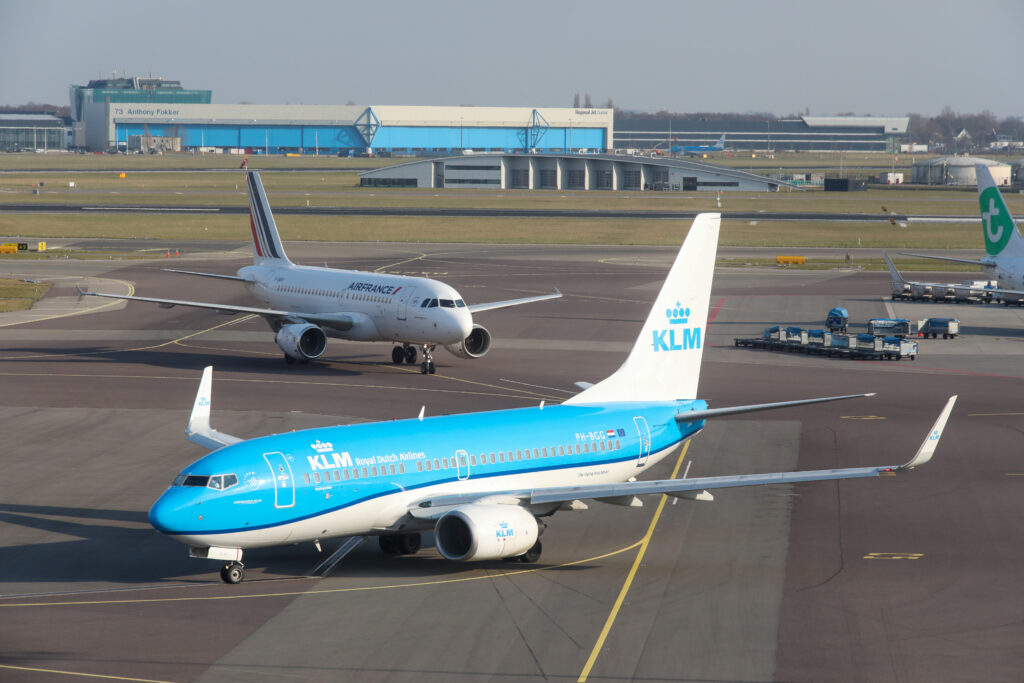
King Willem-Alexander’s final scheduled Boeing 737 flight for KLM was a charming royal aviation footnote on the surface. In reality, it marked something much bigger for the Dutch flag carrier.
The King completed his last scheduled KLM Boeing 737 flight on March 11 and will now retrain on the Airbus A321neo, according to the Dutch Royal House. For an airline audience, that is more than a human-interest story. It is a symbolic marker for one of the most significant short-haul fleet transitions now underway in Europe.
KLM is not simply introducing a new aircraft type. It is reshaping its entire European fleet structure. Mainline KLM is moving away from its Boeing 737 Next Generation family and toward the Airbus A320neo family, while KLM Cityhopper is simultaneously modernizing around the Embraer 195-E2. Together, those changes are redrawing how the airline will size, schedule, and operate short-haul flying from Amsterdam Schiphol Airport (AMS) for years to come.
Read our stories in your inbox
Two aviation newsletters. Zero fluff.
The King’s Last 737 Flight Was Also KLM’s Quiet Goodbye To An Era
Willem-Alexander has long had genuine aviation credibility rather than ceremonial interest. He has held pilot qualifications for decades and became widely known in airline circles when it emerged publicly in 2017 that he had been flying KLM services as a guest pilot to remain current. Before moving onto the Boeing 737, he had also flown the Fokker 70 for KLM Cityhopper, which makes his career in the cockpit oddly well aligned with KLM’s own fleet history.
That is what makes this moment land so neatly.

His final scheduled KLM Boeing 737 flight on March 11 was not merely a personal fleet transition. It came at exactly the point when KLM itself is beginning to say goodbye to the narrowbody type that has defined much of its European operation for decades. The King will now transition to the Airbus A321neo because KLM is transitioning to the Airbus A321neo.
For readers who know fleet planning, that matters. Symbolism in aviation is usually manufactured after the fact. In this case, the symbolism is real.
KLM’s Airbus Shift Is Not Incremental
The decisive break came in December 2021, when Air France-KLM selected the Airbus A320neo family for KLM and Transavia’s European fleets, ordering 100 aircraft with rights for 60 more. That was not a small top-up order or a hedge. It was a strategic platform decision.
For KLM mainline, the logic was clear. The Boeing 737-700, 737-800, and 737-900 fleet was aging, and the group wanted an aircraft family that could improve fuel burn, reduce emissions, lower noise, and support a better cabin proposition on intra-European routes. The Airbus A320neo family also gives KLM more flexibility in matching capacity to different markets, especially with the larger A321neo joining the operation first.
The first KLM Airbus A321neo entered service in 2024, and from there the transition became visible in both directions. Airbus deliveries increased, while Boeing retirements began in earnest. KLM confirmed in December 2025 that its first Boeing 737-800 had left the fleet, calling it the start of the phaseout of the 737 on European routes.
That is the point at which a fleet renewal stops being theoretical. Once aircraft start leaving, the transition has real momentum.
Why The A321neo Matters So Much To KLM
The Airbus A321neo is not just a replacement aircraft. It changes the shape of KLM’s short-haul economics.
Compared with the Boeing 737NG family, the A321neo offers improved fuel efficiency, lower noise, and greater seat capacity, depending on configuration. For a carrier operating out of slot-constrained Schiphol, that capacity piece is especially important. When growth is limited by airport constraints, larger and more efficient aircraft become one of the few reliable ways to add productive capacity.
That makes the A321neo a particularly strong fit for KLM. The aircraft allows the airline to carry more passengers per movement on busier European sectors while improving environmental performance and lowering unit costs. In practical terms, it is the kind of aircraft that helps an airline do more with the slots it already has.
It also brings a more modern onboard product. While short-haul interiors are rarely glamorous, cabin freshness matters, especially at a network airline competing for both business and leisure passengers across dense European markets.
The Boeing 737 Has Been A Defining Aircraft For KLM
That is why this transition feels consequential. The Boeing 737NG fleet has been central to KLM’s European identity for years.
The 737-800 in particular has been the workhorse, with the 737-700 and 737-900 filling out the narrowbody operation. These aircraft have linked Amsterdam Schiphol Airport (AMS) with major European capitals, Mediterranean leisure destinations, and key feeder markets that support KLM’s long-haul bank structure. For many passengers and crew, the 737 has been the default KLM narrowbody experience.
Fleet changes are common in aviation, but some carry more cultural weight than others. The move from Fokkers to Embraers was significant. The move from Boeing 737NGs to Airbus A320neo-family aircraft feels just as important, if not more so, because of the scale and visibility of the 737 operation within KLM.
KLM Cityhopper’s Fleet Renewal Is Just As Important
The Airbus transition gets the spotlight because mainline fleet changes always do. But KLM Cityhopper’s Embraer strategy is just as important operationally.
In 2019, KLM announced an order for 25 Embraer 195-E2 aircraft, with options for 10 more, for Cityhopper. The reasoning was straightforward and sound. The airline needed something larger than the Embraer 190, but still optimized for thinner European routes and high-frequency feeder flying into AMS. The E195-E2 was a natural answer.
That aircraft sits in a sweet spot for a hub carrier like KLM. It offers more seats than the E190, better economics, lower noise, and improved efficiency, but without forcing the airline to jump all the way up to Airbus narrowbody capacity on sectors that do not need it.
That matters enormously at Schiphol. Not every route can or should be flown with the same aircraft size. A healthy short-haul network needs precision. The E195-E2 gives Cityhopper that precision.
The E195-E2 Is Becoming Even More Central To The Network
KLM Cityhopper is also leaning further into the type.
The airline confirmed in December 2025 that all Embraer 195-E2 aircraft would be upgraded to a 136-seat layout by June 2026, up from 132 seats. The modification is being achieved by reducing galley space and reworking the onboard setup rather than changing the role of the aircraft itself. In other words, KLM is extracting more productivity from an aircraft it already sees as strategically important.
That is a classic network-carrier move. It suggests confidence in the platform and a willingness to fine-tune capacity where demand and cost discipline justify it.
For Cityhopper, the E195-E2 is not a side note. It is becoming the backbone of the regional operation. And because KLM Cityhopper plays such a critical role in feeding the long-haul network at AMS, that has implications well beyond Europe.
Mainline Airbus And Regional Embraer Create A More Precise Fleet Structure
This is where the story becomes more interesting than a simple aircraft replacement program.
KLM is not swapping one fleet for another in isolation. It is redesigning the full short-haul system from both ends at once.
On the higher-capacity side, the Airbus A321neo gives mainline KLM a more efficient tool for busy European trunk routes and dense feeder markets. On the lower-capacity side, the Embraer 195-E2 gives Cityhopper a better-sized aircraft for thinner routes, frequency-sensitive sectors, and markets that need strong economics without narrowbody scale.
That combination should leave KLM with a more granular fleet structure than it had before. Instead of relying on an aging 737 family at mainline and older Embraer types regionally, it is moving toward a cleaner two-part short-haul strategy: Airbus where scale matters, Embraer where precision matters.
For an airline operating under environmental scrutiny, airport constraints, and intense European competition, that is not just modernization. It is structural repositioning.
Why This Fleet Reset Matters Beyond The Aircraft Themselves
Fleet change is never only about the metal.
For KLM, this transition touches nearly everything: pilot training, crew qualification, maintenance planning, spare parts inventories, schedule design, gate compatibility, turnaround procedures, and cost structure. Moving a mainline narrowbody fleet from Boeing to Airbus is a major organizational event. It changes the airline operationally as much as commercially.
The King’s move from the 737 to the A321neo puts a very human face on that process. He is going through in miniature what the airline itself is doing at scale: leaving behind a familiar aircraft, retraining, and moving into a new phase.
That is why the story resonated beyond the novelty of a monarch flying scheduled airline sectors. It captured a real fleet inflection point in a way that few airline transitions ever do.
Bottom Line
King Willem-Alexander’s last Boeing 737 flight for KLM was a memorable royal aviation moment. But for anyone watching fleet strategy, it also captured a far bigger shift.
KLM mainline is moving away from its Boeing 737NG fleet and toward the Airbus A320neo family, with the A321neo leading that transition from Amsterdam Schiphol Airport (AMS). At the same time, KLM Cityhopper is building around the Embraer 195-E2 and increasing its capacity to better support regional and feeder flying.
Together, those moves amount to a full rethink of KLM’s short-haul operation.
So yes, the King’s farewell to the 737 was a nice anecdote. But it was also exactly what it looked like: the end of one KLM narrowbody era, and the beginning of another.
Keep reading FlyMag
Get the Daily Brief in the morning or the Route Watch weekly recap on Fridays. Or both.