An Air Canada Express flight from Newark to Halifax made a safe emergency diversion to Boston on Wednesday after the captain suffered a serious medical issue during flight, forcing the first officer to assume command of the aircraft.

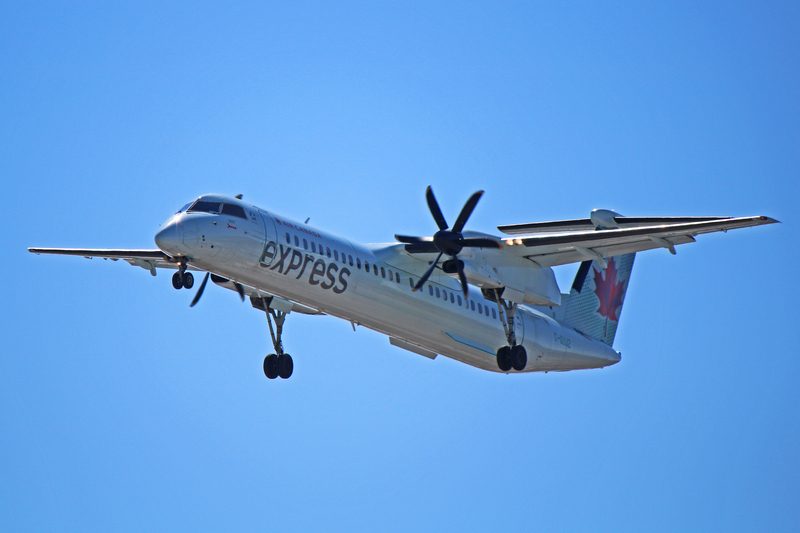
Flight AC7664 was operating from Newark Liberty International Airport (EWR) to Halifax Stanfield International Airport (YHZ) when the crew diverted to Boston Logan International Airport (BOS). The aircraft, a De Havilland Canada Dash 8-400 registered C-GPOE, was being flown by Canadian regional carrier PAL Airlines on behalf of Air Canada.
The aircraft landed safely at Boston Logan (BOS) at around 2:00 p.m. local time. Emergency responders met the flight on arrival, and the captain was taken to a Boston hospital for medical treatment. Air Canada said there were 61 passengers on board.
Read our stories in your inbox
Two aviation newsletters. Zero fluff.
The incident was highly unusual, not because a diversion was required, but because the medical emergency reportedly unfolded in a way that required cabin crew and passengers to assist after the captain was removed from the flight deck.
What Happened On AC7664
AC7664 departed Newark (EWR) for Halifax (YHZ) on June 24 as a routine transborder regional flight. The route is a typical mission for the Dash 8-400, a fast twin-turboprop designed for short- and medium-haul regional sectors where frequency, operating cost, and airport flexibility matter more than jet speed.
During the flight, the captain experienced what Air Canada described as a medical issue. The airline said the captain was removed from the flight deck in accordance with safety procedures, after which the first officer took control of the aircraft and diverted to Boston Logan (BOS).
Passengers later described sudden aircraft movement and a tense situation in the cabin. Some accounts described the captain’s condition as appearing seizure-like, though that has not been confirmed as a medical diagnosis by the airline or authorities. That distinction is important. From an aviation reporting standpoint, the confirmed fact is pilot incapacitation due to a medical issue; the exact medical cause has not been publicly established.
Once the captain was out of the cockpit, the situation became both a flight deck emergency and a cabin-management challenge. Flight attendants and several passengers reportedly helped keep the incapacitated pilot secure while the first officer continued flying the aircraft and prepared for the diversion into Boston (BOS).
The First Officer’s Role Was Critical
The successful outcome underscores why commercial aircraft are crewed, trained, and certified around redundancy.
In a two-pilot cockpit, both pilots are qualified to operate the aircraft. While the captain has command authority, the first officer is fully trained to fly, navigate, communicate, manage abnormal procedures, coordinate with air traffic control, and land the aircraft if the captain becomes unable to continue.
That is exactly what happened on AC7664. After the captain was removed from the flight deck, the first officer became the operating pilot and diverted to Boston Logan (BOS), a major airport with long runways, emergency services, airline support, and strong medical access.
For a flight operating between Newark (EWR) and Halifax (YHZ), Boston (BOS) was a logical diversion point. It sits along the general northeast corridor between the New York area and Atlantic Canada, has extensive emergency-response capability, and is accustomed to handling irregular operations from domestic, transborder, and international flights.
The operational priority in a pilot incapacitation event is simple: stabilize the aircraft, secure the cockpit, declare or communicate the emergency as needed, choose the safest suitable airport, and land without rushing the aircraft into a poorly managed approach. The first officer’s safe landing suggests those fundamentals were handled correctly.
The Aircraft: A PAL Airlines Dash 8-400
The aircraft involved, C-GPOE, is a De Havilland Canada Dash 8-400, also widely known by its earlier Bombardier Q400 branding. In flight-tracking and technical systems, the type is commonly identified as DH8D.
The Dash 8-400 is one of the most capable regional turboprops in commercial service. It is powered by two Pratt & Whitney Canada PW150A turboprop engines driving six-bladed propellers, and it was designed to offer jet-like regional performance while retaining turboprop efficiency on shorter sectors.
De Havilland markets the Dash 8-400 as the highest-capacity turboprop available, with seating configurations of up to 90 passengers depending on the operator. In Air Canada Express service, Dash 8-400 aircraft are operated by regional partners including Jazz and PAL Airlines, with PAL’s aircraft generally used on Eastern Canada, Atlantic Canada, Quebec, and selected transborder routes.
For the Newark (EWR)–Halifax (YHZ) market, the aircraft type makes sense. The Dash 8-400 has the range for the route, lower trip costs than many regional jets, and strong performance into airports where regional operations are common. Its relatively modest cabin size also fits thinner transborder markets better than a mainline Airbus A220, Airbus A320, Boeing 737, or Boeing 737 MAX.
PAL Airlines’ Role In The Air Canada Express Network
PAL Airlines is not Philippine Airlines. In this case, PAL refers to the Canadian regional airline based in St. John’s, Newfoundland and Labrador.
PAL Airlines operates selected flights under the Air Canada Express brand, helping Air Canada maintain regional connectivity in Eastern Canada and beyond. The partnership has become increasingly important as North American carriers continue to manage regional pilot availability, aircraft utilization, and thinner short-haul markets.
Under this model, the customer-facing flight is sold as Air Canada, carries an Air Canada flight number, and connects into Air Canada’s network, but the aircraft and crew may be provided by a regional partner. That is common across North America. Similar structures exist at United Express, Delta Connection, and American Eagle.
For passengers, the distinction is often invisible until they look closely at the operating carrier. For aviation professionals, it matters because crew training, operational control, aircraft ownership, maintenance programs, dispatch procedures, and capacity-purchase agreements all shape how the service is delivered.
A Rare But Planned-For Emergency
Pilot incapacitation events are rare, but they are specifically addressed in airline training. Crews are trained to recognize when a pilot can no longer safely perform duties and to follow procedures that protect the cockpit, aircraft, passengers, and incapacitated crew member.
The unusual aspect of AC7664 is that the situation appears to have extended beyond the cockpit. Passengers said the captain had to be physically restrained after being removed from the flight deck. A registered nurse onboard reportedly assisted, and other passengers helped cabin crew keep the situation under control while the first officer focused on flying the aircraft.
That kind of cabin involvement is not normal, and it is not something any airline wants to rely on. However, in a confined regional aircraft cabin, the crew may have limited options if a person is medically distressed and at risk of injuring themselves or others.
It is also worth noting that medical experts generally advise against restraining someone believed to be having a seizure unless there is an immediate safety risk. On an aircraft, however, the environment is not a normal public setting. Narrow aisles, hard surfaces, cockpit-security concerns, and the need to protect flight operations can change the practical response in the moment.
Why Boston Logan Was The Right Diversion
Boston Logan (BOS) offered several advantages once the decision was made to divert.
The airport has multiple long runways, full aircraft rescue and firefighting capability, major medical response access, and the ability to handle a regional turboprop without disrupting operations for an extended period. It is also close enough to the aircraft’s route of flight to avoid continuing unnecessarily toward Halifax (YHZ) with one pilot incapacitated and a medical emergency active in the cabin.
For a Dash 8-400, Boston Logan’s runway environment presents no performance issue under normal conditions. The aircraft is designed for regional operations and can use much shorter fields than BOS provides. The more important factor was the airport’s emergency infrastructure and the ability to get the captain to medical care quickly.
The aircraft landed safely and was met by emergency crews. Passengers were later accommodated so they could continue their journeys to Halifax (YHZ).
A Professional Outcome Under Abnormal Conditions
While passenger accounts describe a frightening cabin environment, the aviation outcome was exactly what the system is designed to produce: the aircraft remained controllable, the remaining pilot diverted to a suitable airport, emergency services were ready, and everyone on board arrived safely.
It is easy to focus on the drama of passengers helping restrain an incapacitated pilot. But the larger aviation story is the performance of the crew and the importance of layered safety. Two-pilot flight decks, pilot incapacitation procedures, flight attendant training, air traffic control support, and airport emergency response all contributed to the safe outcome.
For airline professionals, AC7664 is a reminder that serious emergencies do not always involve mechanical failure, weather, runway excursions, or aircraft damage. Sometimes the most critical failure point is human health, and the system still has to work.
Bottom Line
Air Canada Express flight AC7664 from Newark (EWR) to Halifax (YHZ) diverted safely to Boston Logan (BOS) after the captain suffered a medical issue and was removed from the flight deck.
The PAL Airlines-operated De Havilland Canada Dash 8-400, registered C-GPOE, landed without incident after the first officer assumed control. Passengers and cabin crew reportedly helped manage the medical emergency in the cabin, while emergency responders met the aircraft on arrival in Boston.
The incident was serious, unusual, and clearly distressing for those onboard. It also showed why cockpit redundancy and crew training matter. One pilot became incapacitated, but the aircraft still landed safely, passengers were protected, and the emergency response chain worked as intended.