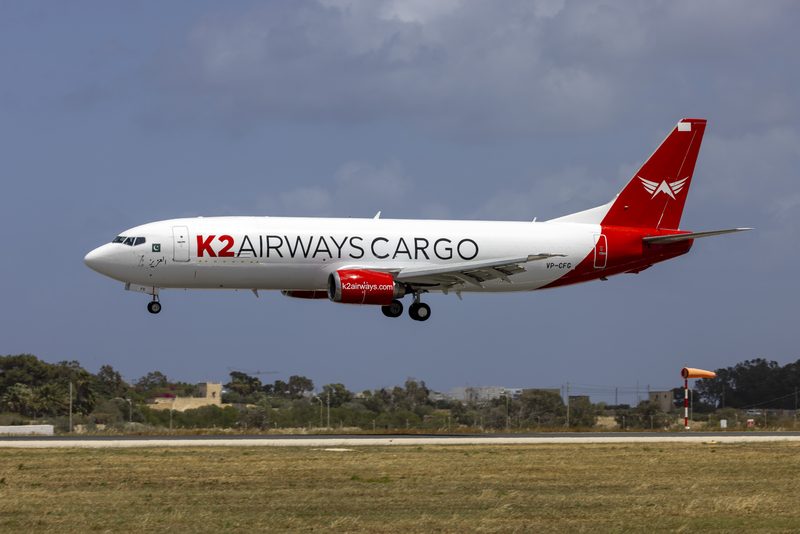
Search teams have recovered wreckage believed to be from the K2 Airways Boeing 737-400 freighter that disappeared over the Arabian Sea while flying from Sharjah International Airport (SHJ) to Jinnah International Airport Karachi (KHI) on July 7.
The aircraft, registered AP-BOI, was operating as K2 Airways Cargo flight KTA1732 with five crew members on board when it lost radar and radio contact west of Karachi. Pakistan’s Airports Authority said the crew had reported a navigation-system issue at 21:18 local time and was receiving guidance from Karachi Area Control Centre. At 21:21, radar showed the aircraft rapidly descending and making a heading change before contact was lost approximately 155 nautical miles west of Karachi.
The discovery of floating wreckage confirms that the search has moved from a missing-aircraft operation into a crash-recovery effort. But the most important work is still ahead. The main fuselage, flight recorders, and the five crew members have not yet been located.
Read our stories in your inbox
Two aviation newsletters. Zero fluff.
Wreckage Found South of Ormara After 12-Hour Search
Pakistan’s Airports Authority said the Pakistan Navy and Pakistan Maritime Security Agency located and identified wreckage about 53 nautical miles south of Ormara after roughly 12 hours of deep-sea search and rescue operations. The debris was recovered from the Arabian Sea and photographed by search crews.
The location is significant. Ormara sits on Pakistan’s Makran coast in Balochistan province, west of Karachi. AP reported that the aircraft disappeared from radar nearly 300 km southwest of Karachi, with debris later recovered roughly 100 km off Ormara.
That distance from shore immediately complicates recovery. Floating debris can drift far from the actual impact point because of wind, waves, and currents. AP quoted a retired Pakistani rear admiral warning that recovered floating debris does not necessarily identify the precise crash site.
That matters because investigators need the main wreckage field, not just floating debris, to understand what happened.
Five Crew Members Remain Missing
K2 Airways said five people were on board: two pilots, two engineers, and one support staff member. The airline identified them as Capt. Mohammad Rizwan Idrees, First Officer Faisal Mehmood Jatoi, load master Muhammad Toufique Khan, and engineers Arif Siddiqui and Muhammad Hamid.

As of the latest reports, none of the crew members has been found. K2 Airways said it continues to cooperate with Pakistani aviation authorities and other government agencies while expressing hope for the missing crew.
The human dimension is now central to the story. Reuters reported that families of the missing crew are waiting for updates while search teams continue operations at sea. The crew’s status has not been officially declared.
The Aircraft: A Converted Boeing 737-400 Freighter
The aircraft involved was a Boeing 737-400 converted freighter. Reuters described it as a 27-year-old Boeing 737-400 freighter, while K2 Airways identified the aircraft as AP-BOI.
The 737-400 is part of the Boeing 737 Classic family, powered by CFM56 engines and originally developed as a passenger narrowbody. Many 737-400s have since been converted into freighters because the type offers useful payload capability, a large enough fuselage for regional cargo work, and operating economics that can still make sense for express freight, e-commerce, mail, and charter cargo missions.
A converted 737-400 freighter is very different from a modern Boeing 737 MAX or a newer production freighter. It is an older airframe modified for cargo service, typically with a main-deck cargo door, reinforced floor structure, cargo loading system, smoke detection, and other freighter-specific changes.
That does not make the aircraft unsafe by itself. Older converted freighters are widely used around the world. But it does mean investigators will pay close attention to the aircraft’s maintenance history, recent work performed in Sharjah, cargo loading, system status, and any prior defects.
Reuters reported that the aircraft had spent 10 days in Sharjah for repairs before the return flight to Karachi and was awaiting a spare part from the United States, according to the co-pilot’s family. That detail will likely become part of the technical investigation, although it does not establish a cause.
Flight Data Shows a Troubling Final Profile
Flightradar24 reported that preliminary ADS-B data showed the aircraft losing altitude, climbing again, and then entering a second sudden and dramatic descent. The final received data point was at 16:21 UTC, placing the aircraft at about 1,100 feet above mean sea level.
That profile is deeply concerning, but it should be interpreted carefully. ADS-B data over water can be incomplete, and early flight-tracking information is not a substitute for official recorder data, ATC radar, cockpit voice recordings, flight data, or wreckage analysis.
The reported navigation problem is also important, but it is not a confirmed cause. Aircraft can experience navigation-system anomalies and remain controllable. Crews can receive radar vectors from air traffic control, cross-check other systems, and continue or divert depending on the situation. The unanswered question is what happened between the reported navigation issue and the sudden descent three minutes later.
That is the window investigators will now focus on.
The Flight Recorders Are Critical
The search for the cockpit voice recorder and flight data recorder will be central to the investigation.
The cockpit voice recorder could reveal the crew’s workload, communications, warning sounds, checklists, and any cockpit discussion after the navigation-system issue was reported. The flight data recorder could show altitude, attitude, speed, flight-control inputs, engine parameters, autopilot status, navigation data, system faults, and the exact descent profile.
Without those recorders, investigators will have to rely more heavily on radar data, ADS-B data, ATC recordings, maintenance records, recovered wreckage, and any floating debris that can be tied to specific aircraft systems.
Reuters reported that navy and maritime security teams are now searching for the flight recorders, but the recovery could be extremely difficult because the seabed in parts of the search area may range from about 2,500 to more than 3,500 meters deep. Strong currents, poor visibility, rough underwater terrain, and changing sea conditions could complicate the effort.
Rough Seas Are Slowing the Search
Searchers are working in challenging conditions. AP reported that Pakistan naval search and rescue teams battled rough seas as the operation entered its second day, with the main fuselage and crew still missing. Officials said strong winds, rough seas, and shifting currents were scattering debris across a wide area.
Those conditions matter because this is not a runway accident or a crash near an airport. It is an offshore crash with a likely debris field spread by sea conditions. Recovery teams must search above and below the surface, often in poor visibility, while trying to locate wreckage that may have sunk quickly.
If the main wreckage is in very deep water, the operation may require specialized sonar, remotely operated vehicles, deep-sea recovery equipment, and naval or commercial salvage capability.
That could turn this into one of Pakistan’s most difficult aviation recovery operations in recent memory.
Why the Navigation Report Must Be Treated Carefully
The crew’s navigation-system report is a confirmed part of the timeline, but it is not a conclusion.
Pakistan’s Airports Authority said the crew reported a navigation-system issue and was being guided by Karachi Area Control Centre. Three minutes later, the aircraft was observed rapidly descending with a heading change.
That sequence raises many questions, but it does not answer them. A navigation-system issue could be related to avionics, GNSS signal interference, inertial reference problems, flight-management data, display disagreement, or another cockpit alert. It could also be unrelated to whatever caused the final descent.
Investigators will need to determine whether the aircraft was under autopilot control, whether the crew had reliable attitude and airspeed information, whether any flight-control or engine anomalies occurred, whether cargo loading was a factor, and whether maintenance work before departure had any connection to the event.
Until that evidence is recovered, the professional position is straightforward: the cause remains unknown.
A Serious Blow to a Young Cargo Operator
K2 Airways is a small Pakistani cargo operator, and AP-BOI was a major part of its cargo operation. Losing a single freighter can be a severe operational and financial blow for a small airline, especially when the aircraft type is central to its business plan.
Regional cargo carriers often operate older converted narrowbodies because they offer a practical balance of capacity and cost. A 737-400 freighter can support short- and medium-haul cargo flows between Pakistan, the Gulf, Central Asia, and nearby markets. It is large enough to carry meaningful freight but smaller and less expensive than a widebody freighter.
That is why this accident will matter beyond the immediate tragedy. Investigators, regulators, insurers, cargo customers, and other operators will all be watching closely to understand whether the crash points to an isolated event, a maintenance-specific issue, an operational problem, or something else entirely.
What Happens Next
The immediate priorities are search, recovery, and evidence preservation. Search teams will continue trying to locate the main wreckage and the missing crew. Investigators will work to map debris, secure recovered parts, review ATC recordings, examine maintenance documentation, and analyze available radar and ADS-B data.
If the flight recorders are recovered, they will likely provide the clearest path toward understanding the final minutes of KTA1732. If they are not recovered quickly, investigators may still be able to build a partial picture from radar returns, floating wreckage, maintenance records, and system components recovered from the sea.
For now, the official public record remains limited: the aircraft reported a navigation problem, received ATC assistance, rapidly descended with a heading change, disappeared from radar, and wreckage has now been found offshore.
Bottom Line
Search teams have found wreckage believed to be from K2 Airways Cargo flight KTA1732, the Boeing 737-400 freighter that disappeared over the Arabian Sea while flying from Sharjah (SHJ) to Karachi (KHI) on July 7.
The debris was located about 53 nautical miles south of Ormara after approximately 12 hours of search operations. But the main fuselage, flight recorders, and five crew members remain missing, and rough seas, strong currents, poor visibility, and deep water are making the recovery effort difficult.
The aircraft’s reported navigation-system issue is an important fact, but it is not a proven cause. The investigation will depend heavily on the recovery of the recorders and main wreckage. Until then, KTA1732 remains a developing accident investigation with one confirmed reality: a regional cargo flight that should have ended in Karachi instead ended in a difficult deep-sea search off Pakistan’s coast.