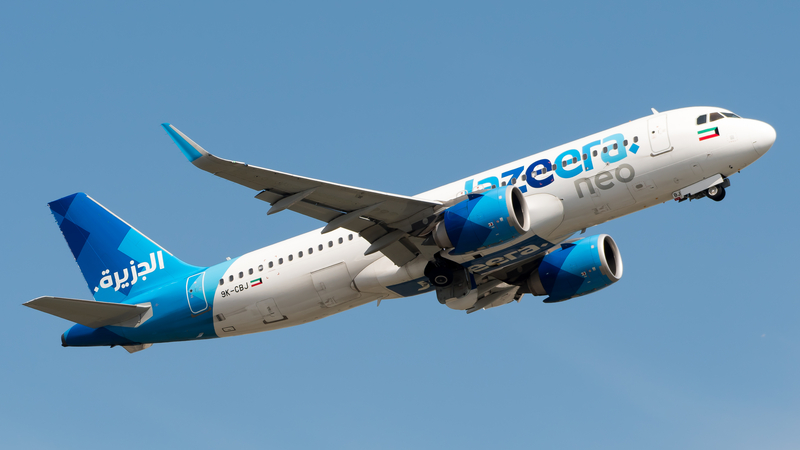
Kuwait’s Jazeera Airways (J9) has found a way to keep flying even while Kuwaiti airspace remains closed: it has restarted Umrah charter operations by operating direct Saudi Arabia–Russia flights from Jeddah (JED) and Madinah (MED)—bypassing Kuwait entirely.
The restart began March 3, 2026, and it’s a striking example of how airline recovery playbooks change when the constraint isn’t demand or aircraft availability, but simply whether you can legally and safely access your home airspace.
Why Jazeera is flying Saudi–Russia instead of Kuwait–Saudi
Under normal conditions, Jazeera’s Umrah charter flows would be built around Kuwait as a staging point—aircraft originating at Kuwait City (KWI), then working the pilgrimage pattern into Saudi gateways such as Jeddah (JED) and Madinah (MED).
Read our stories in your inbox
Two aviation newsletters. Zero fluff.
But with Kuwait’s airspace closed since February 28, aircraft that were already outside the country effectively became “marooned” at outstations. Jazeera’s solution has been to pivot those aircraft to where the demand and infrastructure exist, and operate charters directly between:
-
Saudi Arabia’s Umrah gateways (JED/MED), and
-
Russian origin markets, where pilgrim demand remains strong and charter flying can be coordinated quickly.
From an operations standpoint, this isn’t simply a route change—it’s a network inversion. The airline is temporarily behaving like an outstation-based charter operator: crews, maintenance coordination, ground handling, and fuel uplift are all being managed away from the home base, with aircraft cycling through Saudi stations instead of Kuwait.
The aircraft: A320 family workhorses, already positioned outside Kuwait
Jazeera is using A320-family aircraft that were outside Kuwait when the closure took effect. The aircraft identified in service on the Saudi–Russia Umrah pattern include:
For airline professionals, the A320 choice makes sense. The family is the charter sweet spot: enough seats to make group flying economical, narrowbody turn times that suit high-frequency charter rotations, and a performance envelope that can handle the long but manageable stage lengths between Saudi Arabia and key Russian cities without requiring widebody economics.
Why Jeddah (JED) and Madinah (MED) are the right anchors for Umrah flying
For Umrah traffic, Jeddah (JED) and Madinah (MED) are the two airports that matter most operationally:
-
JED is the principal air gateway for pilgrims headed toward Makkah and the western region.
-
MED serves pilgrims visiting Madinah, and often functions as either the inbound or outbound point depending on package routing.
Charter operators like Jazeera typically design these flights around group itineraries—fixed-day travel, coordinated ground transport, and batch processing at the airport—so reliability and ground support at the Saudi end can matter more than the exact schedule convenience at the origin.
The constraint that forced the pivot: Kuwait’s airspace closure
The wider context is that civil aviation access in parts of the Gulf remains heavily constrained, with Kuwait’s airspace closed alongside other neighboring FIRs during the ongoing regional conflict environment.
For a Kuwait-based airline, that creates a very specific operational trap:
-
Aircraft outside Kuwait can’t return home to reset.
-
Aircraft inside Kuwait can’t be launched to outstations.
-
Crew movement becomes more complex (especially if crews normally commute through Kuwait).
-
Maintenance planning has to be improvised—either through line maintenance agreements at outstations or by minimizing defect exposure until the fleet can be brought back under normal control.
Jazeera’s decision to run Umrah flying from Saudi bases is essentially a “use what we have where we have it” solution—keeping aircraft utilized, serving an intact demand segment, and avoiding the dead cost of parked narrowbodies in a volatile operating window.
Kuwait Airways adds a parallel recovery move: a 777 repatriation charter to Dammam (DMM)
Jazeera’s charter restart comes alongside a separate, notable step by Kuwait Airways (KU): the carrier reactivated a Boeing 777-300ER to operate a repatriation charter from London Heathrow (LHR) to Dammam (DMM).
DMM is a practical choice when Kuwait City (KWI) cannot be used. It provides a high-capability gateway in Saudi Arabia’s Eastern Province—close enough to support onward movement by road while offering the widebody handling infrastructure needed for a heavy long-haul arrival. In crisis logistics, “the nearest usable airport” often becomes the best airport.
What happens next: how long can a “Saudi-based” charter model last?
The sustainability of this arrangement depends on three variables:
-
How long Kuwaiti airspace remains closed
-
Whether Jazeera can keep crews and maintenance support stable at JED/MED
-
Whether charter demand and ground logistics remain predictable enough to justify continuing operations away from KWI
If closures persist, expect more “temporary base” behavior across the region: aircraft repositioned to periphery airports, ad hoc charter flying designed to clear passenger backlogs, and schedules that look more like crisis logistics than normal commercial planning.
Bottom Line
Jazeera Airways’ restart of Umrah charter flights—operating direct services from Jeddah (JED) and Madinah (MED) to Russia using stranded A320-family aircraft—is a textbook example of how airlines adapt when their home airspace becomes unavailable. Rather than waiting for Kuwait (KWI) to reopen, Jazeera is keeping aircraft productive and serving a high-demand pilgrimage segment from where the fleet already sits.
At the same time, Kuwait Airways’ LHR–DMM repatriation charter shows the broader regional pattern: when Gulf hubs are constrained, airlines are building recovery operations around reachable alternates with strong infrastructure and viable onward ground connections.
Keep reading FlyMag
Get the Daily Brief in the morning or the Route Watch weekly recap on Fridays. Or both.