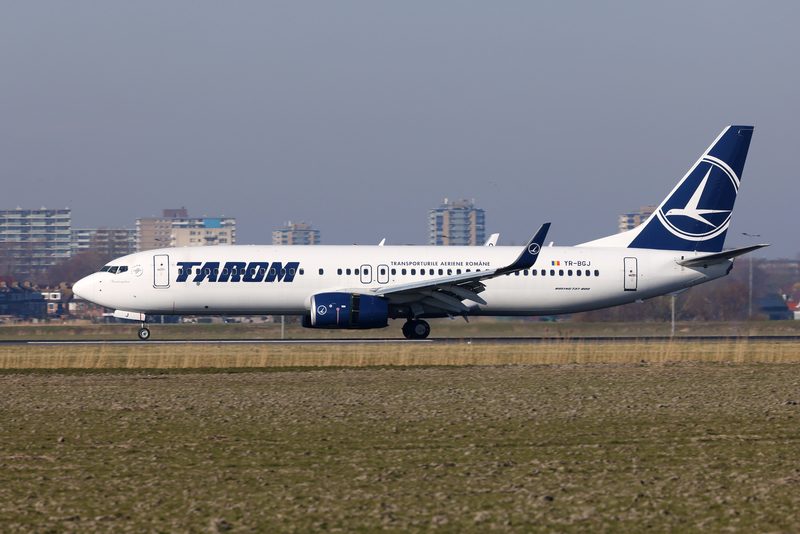
A serious cockpit event aboard a TAROM Boeing 737 has returned to the spotlight after the release of findings tied to the investigation, with the case underscoring one of commercial aviation’s most closely monitored risks: pilot fatigue.

The incident occurred on TAROM’s service from Amsterdam Schiphol Airport (AMS) to Bucharest Henri Coandă International Airport (OTP), when the first officer became progressively unwell before ultimately collapsing in flight. What makes the episode especially significant is that the pilot had reportedly admitted he had not slept the previous night, turning what might otherwise have been viewed as a medical emergency into a broader operational and safety discussion about fitness for duty, fatigue reporting, and cockpit resource management.
For airline professionals, this was not just an isolated onboard health event. It was a serious degradation of flight deck capability on a routine European sector operated by one of the continent’s most familiar narrowbody aircraft types.
Read our stories in your inbox
Two aviation newsletters. Zero fluff.
The Incident Began Before The Return To Bucharest
The most important detail in this case is that the warning signs did not begin at cruise.
According to reporting on the investigation, the first officer had already said he felt unwell during the earlier outbound sector from Bucharest Henri Coandă International Airport (OTP) to Amsterdam Schiphol Airport (AMS). Even so, he reportedly believed he was fit enough to continue with the return service to OTP, while taking the precaution of not using the controls.
That point is operationally important. In airline cockpit practice, any pilot who voluntarily steps back from active flying duties is already acknowledging that something is not normal. Even if the aircraft can legally and practically continue with one pilot as pilot flying and the other in a reduced role, that is still not the intended baseline for a standard scheduled passenger flight. It means the crew complement is already operating with less resilience before the aircraft even leaves the stand.
On the return leg from Amsterdam Schiphol Airport (AMS), the first officer’s condition reportedly deteriorated further around 50 minutes after departure. As the Boeing 737 continued southeast toward Bucharest Henri Coandă International Airport (OTP), his health worsened until, about two hours and 40 minutes into the flight, he lost consciousness.
That forced the captain into a much more demanding situation than a normal short-haul sector should ever require.

Why Pilot Incapacitation Is So Serious On A Boeing 737
The aircraft involved was one of TAROM’s Boeing 737-family jets, the backbone of the carrier’s short- and medium-haul European operation. The Boeing 737 remains one of the most widely used narrowbody aircraft in commercial service, valued for its operating economics, dispatch reliability, and suitability on sectors such as OTP-AMS and AMS-OTP.
In TAROM’s network, the 737 is a natural fit for the Romanian flag carrier’s scheduled European flying. Aircraft in the 737-700 and 737-800 category are designed for sectors of this length, balancing capacity, range, and operational flexibility. On a route such as Amsterdam Schiphol Airport (AMS) to Bucharest Henri Coandă International Airport (OTP), the type offers airlines a dependable platform for high-frequency service with relatively quick turn times and proven performance across Europe’s major airports.
But like any two-pilot transport-category aircraft, the Boeing 737 is built around a two-crew operating concept.
That does not mean the aircraft cannot be flown safely by one pilot in an emergency. It can. What it does mean is that all normal layers of crew cross-checking, workload sharing, checklist discipline, radio coordination, flight path monitoring, and decision support are immediately reduced when one pilot becomes incapacitated.
In a cruise environment, the captain may still have time and space to stabilize the situation. But as the aircraft progresses toward descent, the workload rises. Arrival planning, weather review, STAR selection, approach briefing, altitude and speed management, radio handoffs, checklist execution, landing performance review, and coordination with cabin crew and emergency services can all converge in a short period. On a Boeing 737, none of these tasks are individually unusual. Together, while simultaneously managing a collapsed crewmember, they become a significant human-factors challenge.
The Cockpit Detail That Stands Out Most
One of the most striking details to emerge from reporting on the event is that the first officer reportedly moved his seat back so that, if he fainted, he would be less likely to fall onto the controls.
For aviation readers, that is a revealing and highly credible operational detail.
It suggests the pilot was conscious enough to understand that his condition might worsen, and that he appreciated the physical hazard an incapacitated crewmember can create on a narrowbody flight deck. In a Boeing 737 cockpit, an unconscious pilot slumping forward could interfere with the control column or obstruct cockpit movement at exactly the wrong moment. By moving the seat aft, the pilot was, at minimum, trying to reduce the chance that his collapse would directly compromise aircraft control.
That detail does not reduce the seriousness of the event. If anything, it highlights just how close the cockpit had come to a more severe scenario.
A Routine European Sector Became A Single-Pilot Workload Event
From the outside, Amsterdam Schiphol Airport (AMS) to Bucharest Henri Coandă International Airport (OTP) is a routine intra-European sector. It is not ultra-long-haul, it does not require augmented crews, and it would normally be viewed as a standard narrowbody mission.
That is precisely why this incident matters.
Short- and medium-haul flying is often underestimated in fatigue discussions because the block times are relatively modest. In reality, these operations can be extremely demanding. Early report times, irregular sleep, fast aircraft turns, multiple daily sectors, night or dawn departures, roster compression, and repeated circadian disruption all contribute to fatigue exposure. A three-hour flight can sit inside a much longer and more taxing duty pattern.
In this case, once the first officer collapsed, the captain had to continue the flight and coordinate the emergency response into Bucharest Henri Coandă International Airport (OTP). That means the event was no longer just about one pilot feeling unwell. It had become a live operational scenario in which the remaining pilot had to preserve safety margins while absorbing the full burden of flight deck management.
That includes decision-making under pressure, communications with ATC, management of the approach and landing profile, and ensuring the aircraft could be handed over immediately to medical responders after arrival.
The Arrival At OTP Was Handled As A Serious Emergency
After the captain declared the emergency, medical support was arranged to meet the aircraft on landing at Bucharest Henri Coandă International Airport (OTP).
Reports indicate ambulances were waiting when the Boeing 737 arrived, and medical personnel boarded quickly through the forward door to reach the incapacitated first officer. Passengers, meanwhile, were asked to disembark using the rear stairs. Operationally, that is an efficient response. It clears the cabin while preserving direct front-end access to the cockpit area for emergency responders.
To many passengers, the event may have looked calm and procedural by the time the aircraft reached the gate. In aviation terms, though, that sort of orderly arrival is usually the result of effective crew performance under stress rather than evidence that the incident itself was minor.
This was a serious event because the most important problem had already occurred in flight: the loss of one of the two required flight crew members during a live passenger operation.
Fatigue Is The Core Safety Issue
The defining element in this case is the reported admission that the first officer had not slept the night before the flight.
That immediately shifts the discussion from a simple medical emergency into one of fatigue risk and operational judgment.
Fatigue remains one of the most difficult threats in airline operations because it is both common and deceptive. A pilot may still appear functional, still report for duty, and still believe he is capable of performing normally, even while experiencing reduced alertness, impaired reaction time, weaker decision-making, and diminished situational awareness. Unlike a clear technical defect, fatigue does not always announce itself in obvious terms until performance has already degraded.
That is why modern airline safety systems place such emphasis on rest rules, roster construction, fatigue reporting culture, and the need for crews to remove themselves from duty when adequate rest has not occurred.
In practical terms, the lesson from this TAROM Boeing 737 event is simple. A pilot who has had no meaningful sleep is not just tired. He may be operating with materially reduced capacity in one of the most safety-critical roles in transportation.
TAROM’s Reported Mitigations Show How Seriously The Case Was Treated
The measures reportedly introduced after the incident provide additional insight into how seriously the case was viewed.
According to the reporting, the pilot involved would temporarily not operate flights without the presence of a captain, would be limited to sectors no longer than two hours, would not be assigned night flying, and would not be paired with the same captain from the incident flight.
Those are not cosmetic steps. They reflect targeted risk controls.
Limiting sectors to two hours reduces exposure to prolonged en route workload and shortens the window in which a similar deterioration could occur. Removing night duties addresses fatigue and circadian concerns directly. Tightening pairing conditions suggests the operator wanted more oversight and a more controlled crew environment while managing the aftermath of the event.
For airline managers and safety specialists, these mitigations point to a company trying to reduce risk through roster and pairing decisions rather than treating the episode as an isolated health scare with no wider implications.
The Flight Also Highlights The Real Demands Of Narrowbody Operations
There is sometimes a tendency outside the industry to assume that fatigue is mainly a long-haul problem. Events like this show otherwise.
Narrowbody flying on aircraft such as the Boeing 737 can be every bit as operationally demanding in a different way. European schedules often rely on precise timings, fast turnarounds, early departures, and dense utilization. That creates an environment where even a single poor sleep period can have outsized operational consequences.
For TAROM, the route between Bucharest Henri Coandă International Airport (OTP) and Amsterdam Schiphol Airport (AMS) is an important European link. These are major airports at either end of a scheduled passenger corridor that depends on consistency, crew reliability, and routine execution. When a serious cockpit event occurs on a sector like this, it resonates across the industry precisely because it disrupts a type of flight many carriers perform every day without incident.
It is also a reminder that newer aircraft do not remove old human-performance risks. TAROM is in the process of fleet modernization, with Boeing 737 MAX 8 aircraft expected to join operations. While that will bring improvements in efficiency and fleet economics, no fleet renewal program can replace the importance of crew fitness, rest discipline, and sound go/no-go judgment before departure.
Bottom Line
The TAROM event on the Amsterdam Schiphol Airport (AMS) to Bucharest Henri Coandă International Airport (OTP) sector was far more than a medical episode at 35,000 feet. It was a serious Boeing 737 cockpit event involving fatigue, progressive pilot incapacitation, and the sudden loss of normal two-crew flight deck capability.
The captain brought the aircraft safely to OTP and emergency services were in place on arrival, but the broader lesson is what matters most. A routine narrowbody sector can become a serious operational event very quickly when pilot readiness is compromised before departure. For airlines, regulators, and flight crews, this case is a sharp reminder that fitness for duty is not a formality. It is one of the most important safety barriers in the entire aviation system.
Keep reading FlyMag
Get the Daily Brief in the morning or the Route Watch weekly recap on Fridays. Or both.