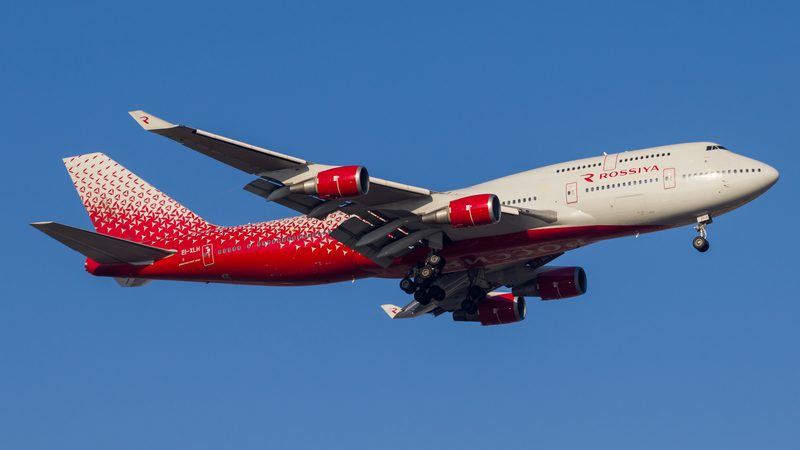
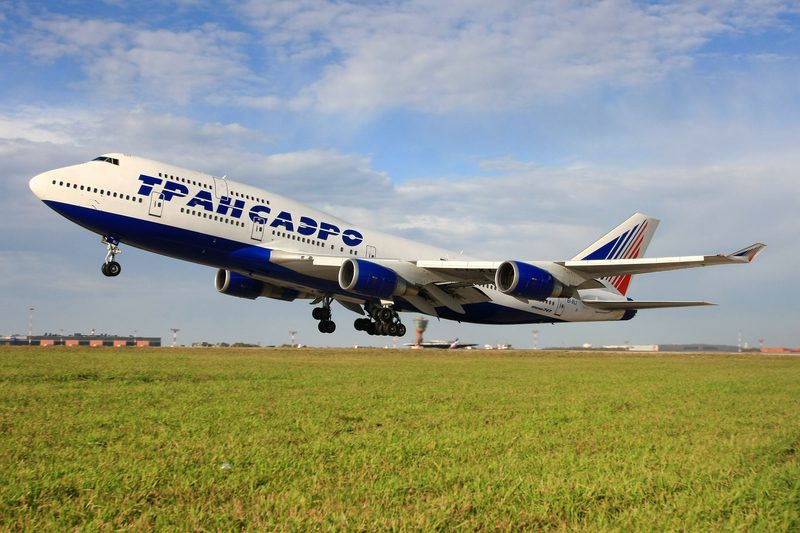
A Rossiya Airlines Boeing 747-400 operating the Magadan–Moscow trunk route rejected takeoff at Magadan–Sokol (GDX) after a compressor surge on its No. 1 (left outboard) engine. Video circulated online shows a brief burst of flame and sparks as the aircraft continues accelerating—an image that looks alarming to passengers, even when the underlying event is a known turbine phenomenon.

The crew elected to reject the takeoff at speed, and the aircraft subsequently departed the paved runway surface, coming to rest in snow near the approach lighting. No injuries were reported, but the incident temporarily halted operations at GDX while authorities began checks and the aircraft was recovered.
The aircraft involved was RA-73290, a Boeing 747-446 built in 2001 and powered by four GE CF6-80C2-series engines. In Rossiya’s high-density configuration, the 747-400 is a capacity heavy-hitter—exactly the kind of aircraft that’s hard to replace at short notice on one of Russia’s longest domestic corridors.
Read our stories in your inbox
Two aviation newsletters. Zero fluff.
What happened: a high-speed rejected takeoff and the physics that follow
The event occurred at approximately 06:00 local time on January 22, 2026, during the takeoff roll for Rossiya flight FV6290, marketed under an Aeroflot code on the same corridor to Moscow (typically Sheremetyevo, SVO). As the aircraft accelerated, officials reported a malfunction consistent with a compressor surge on the left-side outboard engine, prompting the crew to reject the takeoff.
A high-speed rejected takeoff in winter conditions is one of the more unforgiving scenarios in line operations. Once heavy braking begins, the aircraft’s ability to stay on the centerline becomes a balancing act between:
-
Braking effectiveness on a potentially contaminated surface
-
Directional control as speed decays and aerodynamic control reduces
-
Remaining runway length, especially if the reject occurs late in the acceleration sequence
-
Runway edge conditions, where snowbanks and reduced contrast can narrow the usable margin
At GDX, the single concrete runway (10/28) is long—about 3,452 meters—but winter runway environments in the Russian Far East can still be brutal. When a widebody like a 747-400 transitions from takeoff thrust to maximum braking, the energy involved is enormous. Even with excellent crew technique, a late reject can quickly become a runway excursion if traction and stopping distance don’t line up.
Compressor surge 101: why flames can appear without a “fire” onboard
A compressor surge (often tied to a compressor stall) is essentially a breakdown in smooth airflow through the engine’s compressor stages. When airflow becomes unstable, the pressure ratio collapses and the engine can “cough” violently—sometimes producing audible bangs, vibration, and, in some cases, visible flame at the exhaust.
That flame doesn’t automatically mean the engine is on fire in the classic sense. It can be unburned fuel igniting in the exhaust stream or a transient combustion instability triggered by disturbed airflow. Cold-weather operations can add risk factors—icing, snow ingestion, and rapidly changing airflow conditions—though investigators will determine what actually drove this specific event.
From an operational standpoint, the key point is that a surge at high power on the takeoff roll is treated seriously. Crews are trained to make decisive calls, and airlines typically take a conservative view afterward.
Conflicting narratives: “runway overrun” vs. “no runway limits exceeded”
As often happens in fast-moving incidents, the early official messaging varied in how it described the aircraft’s final position.
Authorities reported the aircraft exited the runway area and came to rest near approach lighting, and airport operations were paused for recovery and inspection. Rossiya, however, pushed back against the characterization of a full runway overrun—stating that the aircraft did not cross runway limits, while acknowledging contact or close proximity between the nose gear and an airfield light during the stopping sequence.
For safety professionals, this distinction matters less than the practical outcome: the takeoff was rejected, the aircraft left the intended paved operating area to some degree, and recovery operations were required before the runway environment could be fully returned to normal.
How many people were onboard?
Occupant counts also differed by source early on—common when reports mix “passengers” with “total onboard.”
Two figures were widely cited:
-
One set of officials stated 335 passengers were onboard.
-
Federal aviation authorities later stated 353 total occupants, including 15 crew and 338 passengers.
Either way, this was a heavily loaded departure, consistent with the role the 747-400 plays in Russia’s domestic widebody lift—moving large volumes across long stage lengths in a single rotation.
Operational ripple effects: why a single 747 disruption can hit hard
Even without injuries, an event like this can create outsized disruption for a carrier—especially when the aircraft is a high-capacity widebody operating a long domestic sector.
Start with the aircraft itself. A compressor surge during takeoff generally triggers a conservative technical response that may include:
-
Engine inspections (often including borescope work)
-
Vibration and performance checks
-
Additional test runs before return to service
-
Review of any possible foreign object ingestion or ice/snow impact
Then add the environment. A runway excursion into snow can introduce secondary concerns: potential damage from snowbanks, debris exposure, gear or belly contact risk, and the need to inspect runway edge lighting and approach systems.
Finally, consider the network math. A single 747-400—particularly one configured for very high seat counts—represents a large block of capacity. If it goes AOG at an outstation like GDX, it can’t be “covered” easily with spare widebodies. That forces airlines into last-minute substitutions, ferry planning, passenger accommodations, and knock-on disruptions downstream.
In this case, officials indicated passengers were accommodated and a replacement aircraft was arranged once the airport reopened and recovery operations were completed.
The bigger backdrop: keeping older widebodies reliable in harsh conditions
This incident also lands at a moment when Russia’s airlines are under sustained pressure to keep aircraft serviceable with restricted access to standard Western supply and support channels. Even when operators find lawful alternatives for parts and maintenance pathways, the logistics are slower and the engineering burden is higher.
Layer on sub-Arctic winter operations at airports like Magadan–Sokol (GDX)—where snow, ice, and extreme cold are routine—and dispatch margins become a constant management exercise. When a dramatic engine event goes viral, it doesn’t just trigger technical action; it hits public confidence, crew workload, and operational risk tolerance all at once.
Bottom Line
A Rossiya Airlines Boeing 747-400 (RA-73290) rejected takeoff at Magadan (GDX) after an apparent compressor surge on the No. 1 engine, then slid into snow near approach lighting during the high-speed stop. No injuries were reported, but the event temporarily disrupted airport operations and raises familiar questions about winter reliability, engine behavior under harsh conditions, and the operational fragility that comes with keeping aging widebodies flying on long domestic missions—especially when replacements and parts pipelines are constrained.
Keep reading FlyMag
Get the Daily Brief in the morning or the Route Watch weekly recap on Fridays. Or both.