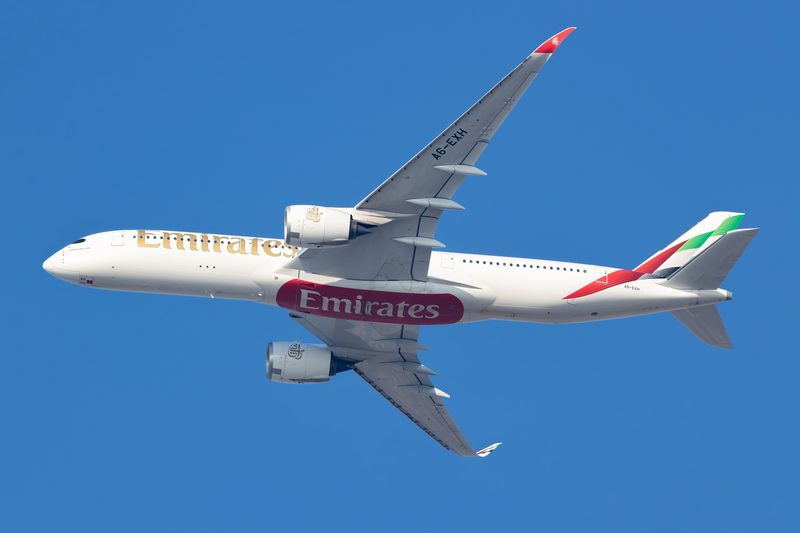
Emirates is bringing back four suspended U.S. routes this week, restoring service from Dubai International Airport (DXB) to Los Angeles International Airport (LAX), Miami International Airport (MIA), Orlando International Airport (MCO), and George Bush Intercontinental Airport (IAH) after the disruption caused by the Iran war.

That matters because these are not fringe routes. Once the restart is complete, Emirates will again serve 12 U.S. airports and operate 96 weekly departures to the United States, returning the carrier’s American network to the same overall size it had before the outbreak of war in late February.
The Four Routes Return In Two Steps
The relaunch begins on May 1, when Emirates resumes flights from Dubai Airport (DXB) to Los Angeles (LAX), Miami (MIA), and Orlando (MCO). Houston (IAH) follows on May 2.
Read our stories in your inbox
Two aviation newsletters. Zero fluff.
That staggered return is notable because it shows Emirates is rebuilding carefully rather than simply switching the entire network back on overnight. For a long-haul operator, route restarts involve much more than aircraft availability. Crew rotations, maintenance planning, airport readiness, and hub-bank coordination all have to be aligned before the service is commercially and operationally stable.
Frequencies Start Smaller Before Returning To Daily
Emirates is not bringing these routes back at full strength on day one.
Miami (MIA) returns first at four weekly flights using the Boeing 777-300ER. Houston (IAH), Los Angeles (LAX), and Orlando (MCO) each restart with three weekly departures. Those three routes are then due to return to daily service later in May, with Miami also stepping back up to a full daily pattern.
That is a sensible way to restore a network. The airline gets service back into the market quickly, but without immediately overcommitting capacity before the operation has fully stabilized.

Miami’s Return Is More Important Than It Looks
Of the four resumptions, Miami International Airport (MIA) is arguably the most strategically interesting.
That is because the Miami route continues onward to El Dorado International Airport (BOG) in Bogotá, making it one of Emirates’ most unusual and distinctive long-haul services. It is not just a Florida route. It is also part of the airline’s wider Americas strategy, linking Dubai with both South Florida and northern South America through a single aircraft rotation.
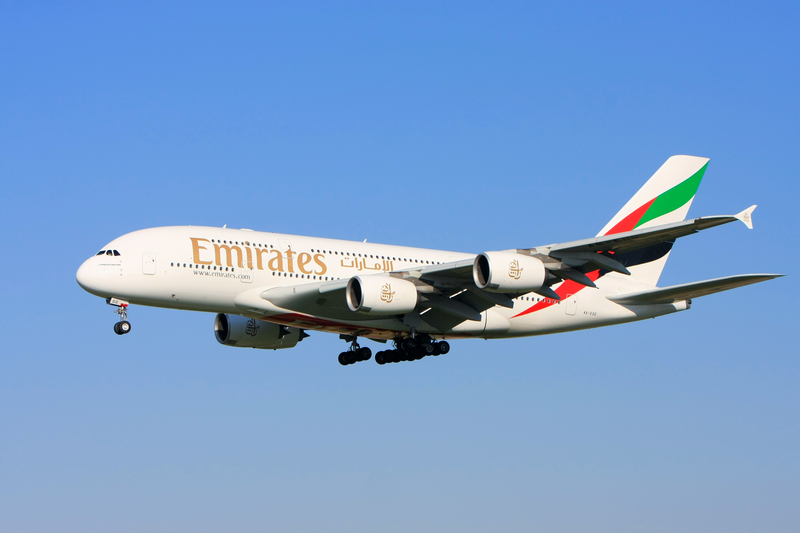
For Emirates, restoring Miami therefore means restoring more than one city pair. It brings back one of the network’s more distinctive fifth-freedom-linked operations.
Los Angeles Returns Longer Than Before
Los Angeles (LAX) is the one route where the recovery comes back with a significant operational penalty.
Because Emirates is still avoiding Iranian airspace, the Dubai–Los Angeles service now carries much longer scheduled block times than it did before the war. The westbound sector is timed at up to 17 hours 15 minutes, while the return can reach 17 hours. That is materially longer than the equivalent routing before the conflict.
That matters because longer routings increase fuel burn, reduce aircraft utilization, and add cost to one of the airline’s most important ultra-long-haul markets. The route remains viable, clearly, but it is a more expensive and operationally heavier mission than it was before the war disrupted the Gulf region.

The Aircraft Choices Show How Emirates Sees Each Market
The equipment assignments are also revealing.
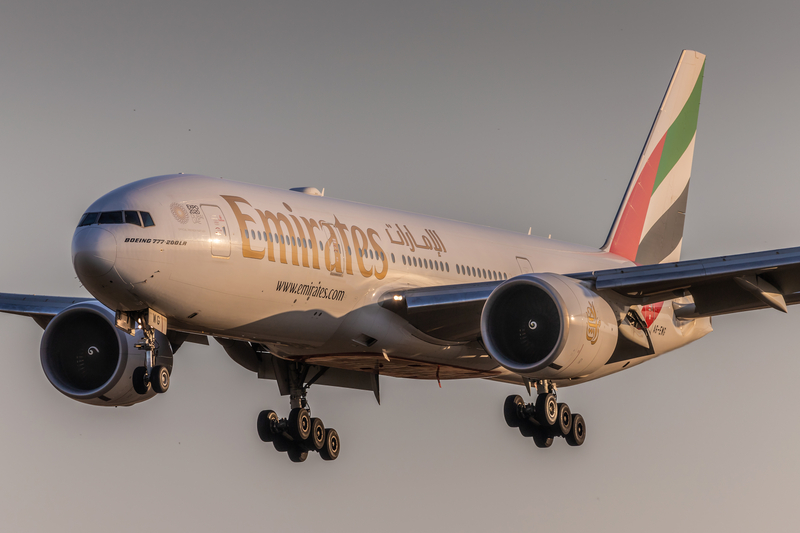
Houston (IAH) and Los Angeles (LAX) return on the 484-seat, four-class Airbus A380, while Miami (MIA) comes back on the 328-seat, four-class Boeing 777-300ER. Orlando (MCO) returns on the 354-seat, three-class Boeing 777-300ER.
That tells you Emirates is still differentiating these markets carefully. Los Angeles and Houston remain full flagship-A380 destinations, while Miami and Orlando are being matched to 777s that better fit their current traffic profile and scheduling needs.
Emirates’ U.S. Network Is Whole Again In Practical Terms
By the first weekend of May, Emirates is back to a U.S. schedule that looks like a proper full network rather than a reduced wartime skeleton.
On Saturday, May 2, the airline is scheduled to operate 14 departures to the United States, which effectively restores the structure of its pre-war American operation even if some individual routes are still ramping back up.
For a hub carrier like Emirates, that is hugely important. The U.S. network is not just about local traffic to Dubai. It is a key part of the airline’s global connection model, feeding South Asia, Africa, Southeast Asia, and the Middle East through Dubai Airport (DXB).
Bottom Line
Emirates’ return to Los Angeles (LAX), Miami (MIA), Orlando (MCO), and Houston (IAH) this week is the clearest sign yet that the airline’s U.S. network has recovered from the war-driven suspensions that began in late February. The recovery is phased and slightly cautious at first, but once complete it takes the airline back to 12 U.S. airports and 96 weekly departures.
The main wrinkle is that the network is back, but not entirely unchanged. Los Angeles now carries significantly longer block times because of Iranian airspace avoidance, and the restart is being managed carefully rather than all at once. Even so, for Emirates, this is a major restoration milestone: the American map is effectively whole again.
Keep reading FlyMag
Get the Daily Brief in the morning or the Route Watch weekly recap on Fridays. Or both.