The emergency evacuation of 147 elite showjumping horses from Doha to Liège this week was not just a dramatic logistics story. It was a reminder that in aviation, geopolitical shocks can upend even the most specialized and carefully choreographed operations in a matter of hours.
The horses were originally in Qatar for the Doha Equestrian Tour at Al Shaqab in Doha. But with regional tensions escalating and Qatari airspace closed, the animals could not simply be flown out from Hamad International Airport (DOH) as originally expected. Instead, they were moved roughly 217 miles, or 350 kilometers, by road from Doha to Riyadh’s King Khalid International Airport (RUH), where two Qatar Airways Cargo Boeing 777 freighters then carried them onward to Liège Airport (LGG) in Belgium.
That rerouting alone tells the story. When an equine evacuation has to become a cross-border, multi-stage emergency logistics mission, the aviation system is no longer operating in anything close to normal conditions.
Read our stories in your inbox
Two aviation newsletters. Zero fluff.
The Airlift Was Built Around The Boeing 777F’s Strengths
The aircraft choice was crucial.
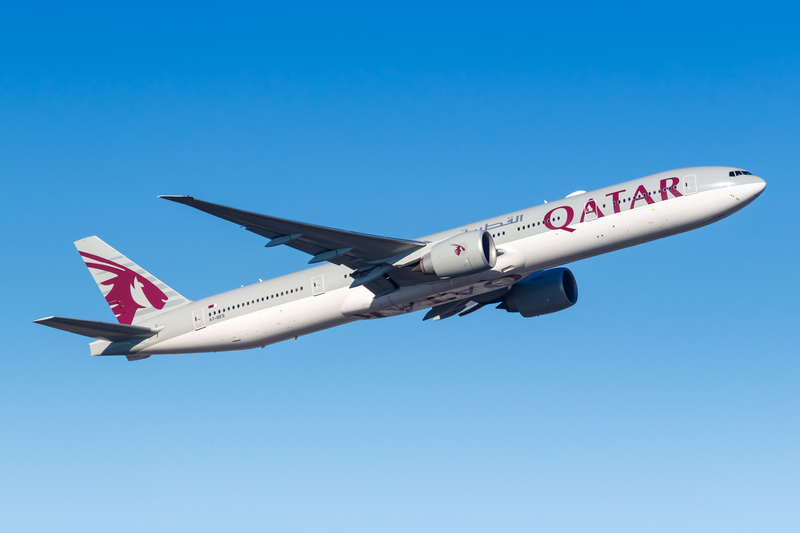
Qatar Airways used the Boeing 777F, one of the world’s most capable long-haul freighters and a type particularly well suited to highly specialized cargo missions. The 777F offers substantial payload, wide main-deck loading capability, and the kind of range and reliability needed for urgent international operations. In this case, it gave the airline enough lift to move 147 horses across two sectors rather than forcing a more fragmented evacuation.
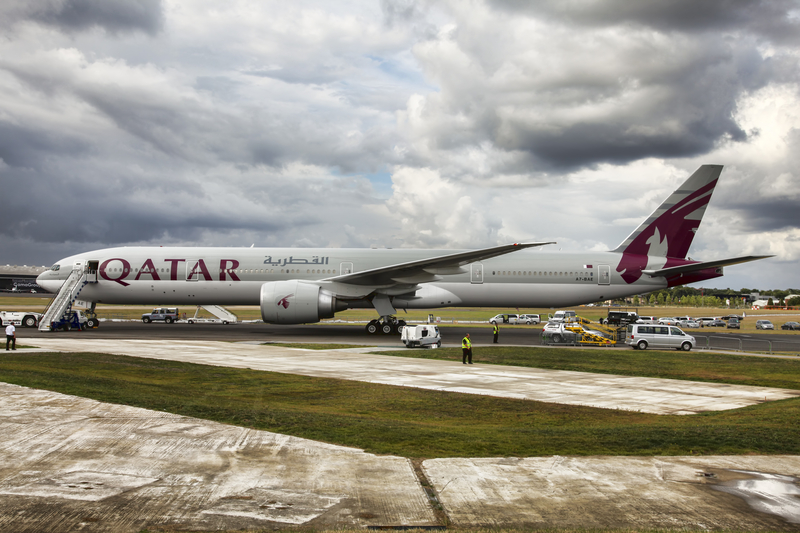
One aircraft carried 74 horses and the other 73, with veterinarians and grooms traveling alongside them. That is a meaningful payload not just in weight, but in complexity. Live animal transport is among the most demanding categories in cargo aviation because the “cargo” is highly sensitive, mobile, stress-prone, and vulnerable to noise, heat, delay, and disruption.
That makes the 777F a particularly strong platform for missions like this. It is not just about capacity. It is about controllability and operational confidence.
This Was A Ground-Air Operation, Not Just A Flight
One of the most revealing parts of the story is that the horses did not depart from Doha at all.
Because Qatari airspace was closed, the evacuation had to be reengineered as a hybrid ground-and-air operation. The horses were transported by road from Doha to Riyadh (RUH), then loaded onto the freighters for the six-hour flight to Liège (LGG).
That road transfer is a major detail, not a side note.
Moving high-value showjumping horses overland under emergency conditions requires extraordinary care before the aircraft is even involved. These are not ordinary livestock movements. These are elite sport horses, often worth substantial sums individually, and many are accustomed to highly controlled routines. Any unexpected delay, temperature fluctuation, or stress event can have serious welfare and performance implications.
By the time the horses reached RUH, the air operation still had to work perfectly. In effect, the flight stage was only one part of a larger, tightly managed evacuation chain.
Why Liège Was The Natural Destination
Liège Airport (LGG) was an unsurprising choice, and a smart one.
LGG has long been one of Europe’s most important cargo gateways and is especially well regarded in specialist freight circles for handling time-sensitive, high-value, and complex shipments. It is the sort of airport where urgent charter cargo missions can be absorbed more efficiently than at many passenger-heavy hubs.
For live-animal logistics, that matters. A horse airlift does not end when the aircraft lands. It requires rapid unloading, veterinary oversight, careful onward transport, and facilities that can handle valuable and sensitive equine arrivals without unnecessary delay.
Liège’s role in the operation therefore makes perfect sense. This was not simply the nearest European airport. It was one of the most operationally credible ones for this kind of mission.
Jet Stalls Remain One Of Air Cargo’s Most Specialized Tools
The horses were carried in padded jet stalls placed inside the cargo hold, with each stall typically accommodating up to three horses.
For readers outside specialist cargo, jet stalls are one of those parts of the industry that rarely get attention unless something unusual happens. But they are essential to equine aviation. These units are designed to keep horses upright, stable, and secure during loading, taxi, takeoff, flight, and landing. The padding, layout, and supervision all matter because horses are extremely sensitive to unfamiliar motion and confined environments.
In practice, transporting horses by air is a blend of aviation procedure and animal management. Temperature control, hydration, feeding, monitoring, and stress reduction are all part of the mission. The cargo may be loaded into a freighter, but the operation functions more like a flying stable than a standard airlift.
That is why these missions require trained handlers, veterinarians, and specialized planning rather than just available capacity.
This Was Also A Network Resilience Story
Beyond the horses themselves, the evacuation highlighted something broader about air cargo resilience.
When one airspace closes, logistics do not simply stop. They reroute, often at great complexity and cost. In this case, the closure of Qatari airspace effectively displaced the airlift from DOH to RUH, forcing the operation into Saudi Arabia before the cargo flights could even begin.
That kind of rerouting is difficult enough for ordinary freight. For live animals, it is exponentially harder.
The success of the mission therefore says a great deal about the flexibility of the stakeholders involved, including Qatar Airways Cargo, the Doha Equestrian Tour organizers, airport authorities, veterinarians, handlers, and local transport partners. It also underlines how quickly specialized air cargo can become an emergency-response tool when geopolitical events disrupt ordinary movement.
Elite Horse Transport Is A Serious Aviation Business
It is easy for stories like this to be framed as novelty. That misses the point.
Equine transport is a serious, high-value niche within global air cargo. Major racing, breeding, and showjumping circuits depend on the ability to move horses internationally with precision and confidence. Aircraft selection, route planning, airport handling, veterinary compliance, and welfare management all directly affect whether these events and industries can function.
In that sense, the Doha-to-Liège evacuation was not just about saving a group of horses from a conflict-adjacent disruption. It was about preserving continuity for a global sport ecosystem that depends heavily on reliable aviation infrastructure.
When those systems break, even temporarily, the consequences are immediate.
The Timing Revealed The Vulnerability Of Event-Based Air Logistics
Another key point is timing.
These horses were not being repositioned in the abstract. They were already in Doha for competition when the situation deteriorated. That is what made the operation urgent. Event-based logistics are often tightly scheduled, especially in elite sport, where animal movements, rider schedules, veterinary paperwork, competition timetables, and onward transport all line up precisely.
Once that chain is disrupted, the margin for delay can disappear quickly.
The reported suspension of competition at Al Shaqab and the shift in focus toward other 2026 events, including Miami Beach, underlines that reality. The horses had to move because waiting was no longer operationally or politically comfortable.
Bottom Line
The evacuation of 147 elite showjumping horses from Doha to Liège was one of the most specialized and revealing cargo operations of the week.
With Qatari airspace closed, the animals had to be trucked from Doha to Riyadh (RUH) before two Qatar Airways Cargo Boeing 777F flights could carry them to Liège (LGG). The mission worked because every part of the logistics chain — road transfer, airport handling, live-animal loading, inflight care, and European reception — held together under pressure.
For aviation professionals, the real significance goes beyond the dramatic headline. This was a case study in how cargo aviation, especially live-animal freight, adapts when geopolitical disruption suddenly removes the normal operating map.
And in that respect, the horses were not just passengers in an emergency. They were proof of how flexible, and how fragile, specialized air logistics can be.
Keep reading FlyMag
Get the Daily Brief in the morning or the Route Watch weekly recap on Fridays. Or both.