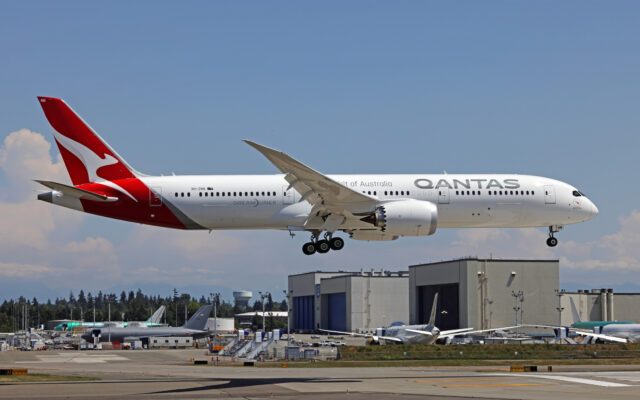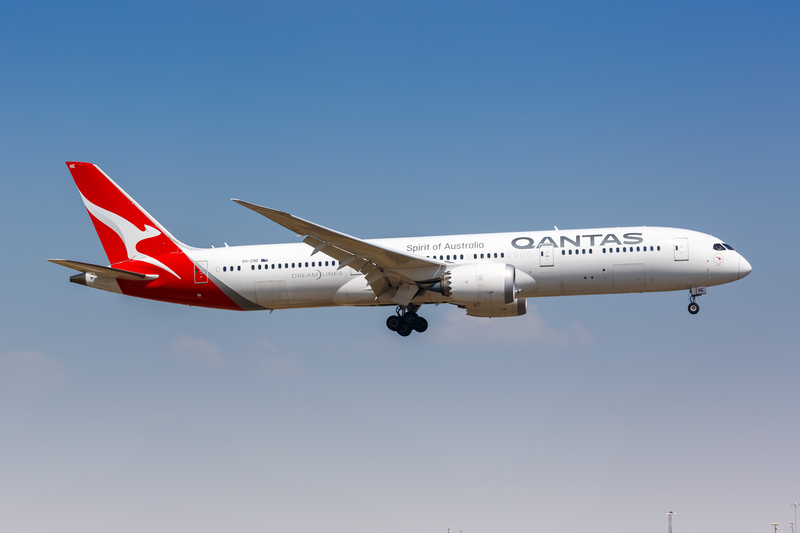
A Qantas long-haul flight from Melbourne Airport (MEL) to Dallas/Fort Worth International Airport (DFW) was forced to divert to Faa’a International Airport, Papeete (PPT) after a passenger allegedly became violent onboard and bit a cabin crew member during the disturbance.

The flight involved QF21, operated by Boeing 787-9 VH-ZNB. By the time the incident escalated, the aircraft had already spent roughly seven hours crossing the Pacific, making the diversion to Tahiti a major operational interruption rather than a simple delay.
For aviation readers, the key point is not just that the passenger was unruly. It is that the behavior appears to have crossed from disruptive into physical assault, which immediately changes how an airline must respond.
Read our stories in your inbox
Two aviation newsletters. Zero fluff.
The Diversion Happened Deep Into The Flight
This was not an early turnback shortly after departure.
QF21 had already been airborne for hours and was well into one of Qantas’ longest sectors when the problem became serious enough to force a diversion. That matters because diversions on ultra-long-haul flights are costly and disruptive even under relatively minor circumstances. When a crew chooses to divert a 787 over the South Pacific, it usually means the onboard situation has crossed a very high threshold.
That appears to be exactly what happened here.
The Passenger Was Reportedly Intoxicated And Became Violent
Public reporting and social media footage suggest the passenger appeared intoxicated, argued aggressively with cabin crew and other travelers, and at one point allegedly bit a crew member who was trying to intervene.
That is the critical detail. Airlines deal with rude, noisy, or mildly disruptive passengers every day. The line changes completely when physical violence enters the situation, especially on a long-haul international flight where the options for managing risk are limited once the aircraft is far from destination and still many hours from home.
At that point, the issue is no longer customer behavior. It becomes a safety and security event.
Tahiti Was The Logical Diversion Point
Once the incident escalated, diverting to Papeete (PPT) was the practical answer.
On a Pacific crossing between Australia and Texas, there are not many suitable diversion points. The crew needed an airport capable of receiving a Boeing 787-9, handling passengers, and providing local law enforcement support immediately on arrival. Tahiti fit that requirement, and local police removed the passenger once the aircraft landed.
That is exactly how these events are meant to be handled. The crew’s job is to get the aircraft to the nearest appropriate airport where the threat can be removed safely and legally.

Qantas Has Banned The Passenger
Qantas has since banned the passenger from flying with the airline.
That is unsurprising. In the modern airline environment, carriers increasingly take a hard line on physical aggression toward crew, and biting a flight attendant falls into the category of conduct that can effectively end a customer’s relationship with an airline immediately.
The ban also serves a broader purpose. Airlines want these cases to be seen not just as embarrassing onboard incidents, but as events with real and lasting consequences.
This Was A Cabin Safety Event, Not Just A Publicity Story
The circulation of onboard video has made the incident highly visible online, but the aviation significance lies elsewhere.
The important fact is that the crew of a fully loaded 787 had to manage an escalating threat while operating one of the longest kinds of flights in the network. On short-haul routes, disruptive passengers are serious enough. On ultra-long-haul sectors, they are more dangerous because the time to destination is much longer, the alternative airports are fewer, and the operational burden of diversion is much higher.
That is why airlines take these cases so seriously even when no one else onboard is badly hurt.
The Broader Industry Problem Has Not Gone Away
This incident also fits a wider global pattern.
Carriers around the world continue to deal with disruptive passengers, often involving alcohol, aggression, or refusal to obey crew instructions. What makes this case stand out is the combination of physical violence, the very long-haul context, and the diversion to a mid-Pacific airport.
For the industry, it is another reminder that cabin disruption is not a solved post-pandemic problem. It remains one of the clearest operational and safety risks airlines still face.
Bottom Line
Qantas flight QF21 from Melbourne (MEL) to Dallas/Fort Worth (DFW) diverted to Papeete, Tahiti (PPT) after a passenger allegedly became violent and bit a crew member. The Boeing 787-9 VH-ZNB was deep into the Pacific crossing when the diversion was made, making the decision a major operational event rather than a minor disruption.
For Qantas, the safest option was to land, hand the passenger over to police, and protect the rest of the cabin. That is exactly what happened. The incident is another reminder that on long-haul flying, the hardest disruptions are often not technical at all — they are human.
Keep reading FlyMag
Get the Daily Brief in the morning or the Route Watch weekly recap on Fridays. Or both.