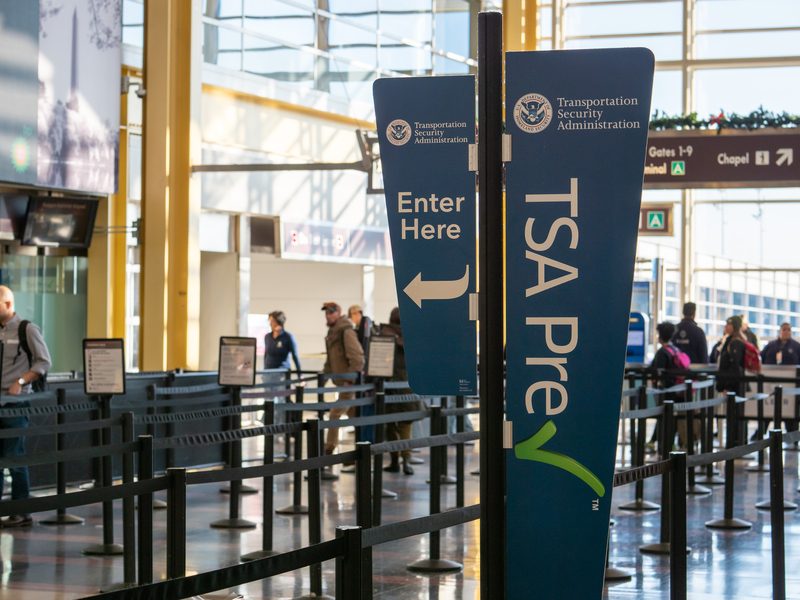
Denver International Airport (DEN) has launched a public gift card drive to support Transportation Security Administration employees who are continuing to work without pay during the ongoing Department of Homeland Security funding lapse. The airport is asking travelers, airport workers, and the public to donate $10 and $20 grocery and gas gift cards, with collection points established in the Jeppesen Terminal and the Final Approach cell phone lot.
At one level, the initiative is straightforward. It is meant to help frontline federal workers manage immediate everyday expenses while they continue reporting for duty. But at a major hub like Denver, the move also carries broader operational meaning. Security staffing is not peripheral to the airport’s performance. It is central to how smoothly the entire passenger journey functions, especially during a busy travel period.
Why The Program Matters
The structure of the gift card drive is practical and deliberate. Grocery and gas cards address two of the most immediate pressures unpaid employees face: commuting to work and keeping food on the table. By focusing on smaller denominations, Denver International has made the program easy for the public to participate in while ensuring the cards are useful for routine, everyday purchases.
Read our stories in your inbox
Two aviation newsletters. Zero fluff.
There is also an important symbolic dimension. TSA officers are among the most visible federal employees at any airport, yet they are often treated as part of the background of the travel experience rather than as essential personnel holding the operation together. Denver’s public support sends a different message. It makes clear that the airport views TSA employees as core operational partners, not simply as a separate federal workforce assigned to the checkpoint.
That kind of recognition matters during a shutdown. Financial pressure is one issue, but morale is another. Public support can help reinforce that these workers are valued at a time when they are being asked to continue performing critical duties without current pay.

Edelweiss Pulls Back on Long-Haul Growth as U.S. Cuts and Oman Exit Reset the Network
Why TSA Employees Are Still Working Without Pay
The broader issue is the partial shutdown affecting the Department of Homeland Security. Because the TSA falls under DHS, airport screening continues even when appropriations lapse. Aviation security is considered essential, so TSA officers are required to report to work even when paychecks are interrupted.
That creates a uniquely difficult position. These employees are not choosing whether to keep working; they are obligated to do so. While they are generally compensated retroactively once funding is restored, that does not help with immediate household cash-flow needs. Rent, fuel, groceries, childcare, and other daily expenses do not pause simply because Congress has not finalized appropriations.
This is why support efforts such as Denver’s gift card drive resonate. They are not replacing wages, and they are not solving the political problem behind the shutdown. But they do provide some near-term relief for workers caught between mandatory service and delayed compensation.
Why This Is Especially Important At DEN
The timing is significant. This is unfolding during a high-demand period when spring travel volumes are building, and airports have less flexibility to absorb staffing issues at security checkpoints. At a facility as large and busy as Denver International, even modest screening disruptions can quickly ripple through the passenger experience.
DEN is one of the largest and busiest airports in the United States, with substantial origin-and-destination traffic as well as connecting flows. That means checkpoint performance has an outsized effect on terminal operations. Longer waits at security can lead to missed flights, congestion inside the terminal, and mounting pressure on airlines and airport staff alike.
From that perspective, the airport’s gift card drive is not only compassionate. It is also operationally sensible. Anything that helps reduce strain on TSA employees during a shutdown helps support staffing continuity at the checkpoint, and that matters enormously in a peak travel environment.
Denver’s Relationship With TSA Appears To Run Deep
Denver International’s response also suggests a relationship with its TSA workforce that goes beyond formal coordination. The airport has made a visible effort to publicly support federal employees rather than treating the issue as someone else’s problem. That matters because airports and TSA personnel are deeply interconnected in day-to-day operations, even though they sit under different organizational structures.
At a major airport, security is one of the clearest points where passenger experience, efficiency, and federal oversight all meet. Modern checkpoint performance shapes traveler perception almost as much as the airline product itself. When the security operation struggles, the entire airport feels it.

Denver’s public support therefore reflects a broader operational reality. TSA may be a federal agency, but at the airport level, its employees are part of the ecosystem that keeps flights moving and terminals functioning.
Bottom Line
Denver International Airport’s gift card drive for unpaid TSA employees is a relatively simple initiative, but it speaks to a much larger issue. The airport is collecting grocery and gas gift cards to support frontline officers who are still reporting to work despite the shutdown-related interruption in pay.
For travelers, it is a reminder that airport operations depend on far more than aircraft movements and airline schedules. They also depend on thousands of workers whose jobs are essential to keeping the system safe and functioning. At DEN, the checkpoint is one of the most important parts of that system, and supporting the people who staff it is both a practical and meaningful step.
Keep reading FlyMag
Get the Daily Brief in the morning or the Route Watch weekly recap on Fridays. Or both.