United Airlines is adding three new seasonal international routes for the 2026/2027 winter season, strengthening its network to Colombia and the Caribbean from three of its major U.S. hubs.

The Star Alliance carrier will launch new nonstop service from Houston George Bush Intercontinental Airport (IAH) and Washington Dulles International Airport (IAD) to Rafael Núñez International Airport (CTG) in Cartagena, Colombia. United will also add a new Saturday-only winter route from Denver International Airport (DEN) to Providenciales / Howard Hamilton International Airport (PLS) in the Turks and Caicos Islands.
The additions are not large in frequency, but they are strategically clean. United is using narrowbody aircraft from strong hubs to reach high-demand warm-weather markets during the peak winter leisure period, while also adding another Colombian destination to a Latin America network that has been expanding quickly.
Read our stories in your inbox
Two aviation newsletters. Zero fluff.
Cartagena Becomes United’s Newest Colombian Destination
The most important addition is Cartagena (CTG), which becomes United’s 156th international destination and its 69th destination in Latin America.
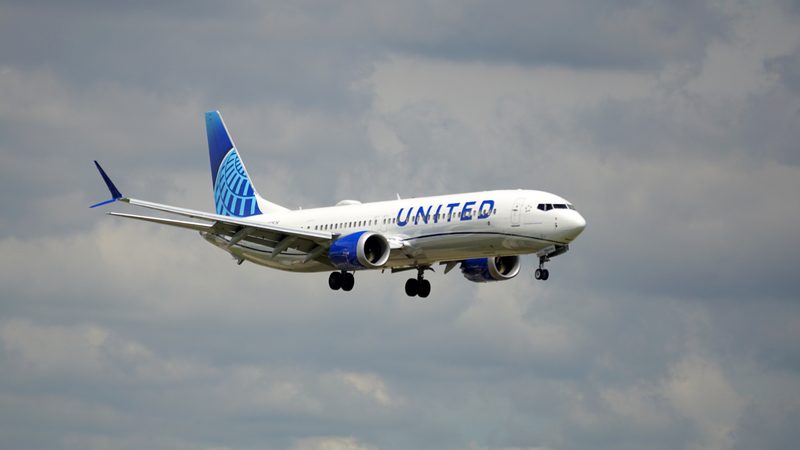
United will launch Houston (IAH)–Cartagena (CTG) on December 17, 2026, followed by Washington Dulles (IAD)–Cartagena (CTG) on December 19, 2026. Both routes are scheduled to operate four times weekly and will be flown with the Boeing 737 MAX 8.

For United, Cartagena is a logical next step in Colombia. The airline already serves Bogotá (BOG) and Medellín (MDE), giving it coverage of Colombia’s capital and one of the country’s largest business and leisure markets. Cartagena (CTG) adds something different: a high-profile Caribbean leisure destination with strong international tourism appeal, premium vacation demand, cruise traffic, and growing interest from U.S. travelers.
Rafael Núñez International Airport (CTG) is the main airport serving Cartagena and Colombia’s Caribbean coast. It sits close to the city, which is one of Cartagena’s advantages as a destination. Unlike some leisure airports where the airport-to-resort transfer becomes part of the trip, CTG is unusually convenient for travelers heading to the historic walled city, Bocagrande, Getsemaní, and nearby coastal hotels.
The new service also reduces dependence on one-stop itineraries over Bogotá (BOG), Panama City (PTY), Miami (MIA), or other connecting points. For U.S. travelers, that matters. Cartagena is well known, but nonstop access has not always matched the city’s demand profile.
Houston Gives Cartagena A Natural Latin America Gateway
Houston (IAH) is the more obvious of the two Cartagena routes.
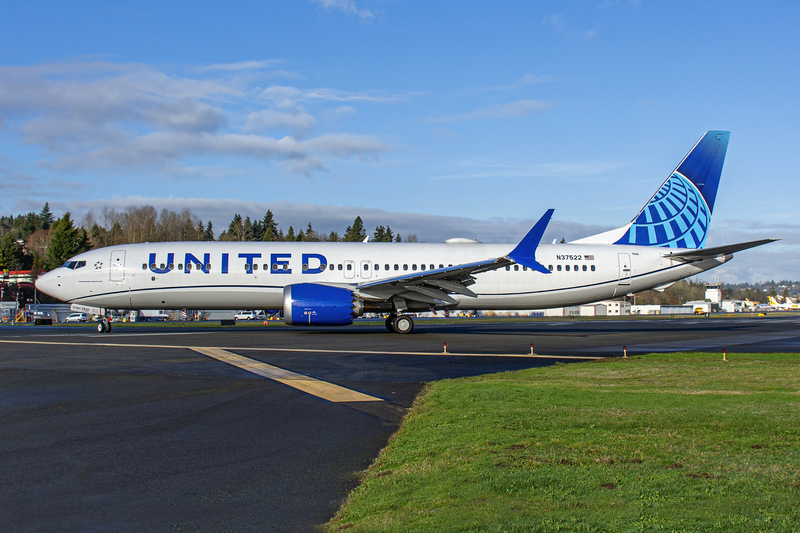
United’s Houston hub is one of the airline’s strongest gateways to Latin America. From George Bush Intercontinental (IAH), United can connect Cartagena (CTG) with a broad U.S. network across Texas, the Midwest, the West Coast, and the South. The route also sits naturally alongside United’s existing Colombian and Caribbean flying from Houston.
The Houston (IAH)–Cartagena (CTG) sector is short enough for a Boeing 737 MAX 8 to operate comfortably, while still long enough that nonstop service creates a meaningful convenience advantage over connecting itineraries. The MAX 8 is also the right gauge for a four-weekly seasonal route. It offers mainline capacity, a premium cabin, and good fuel efficiency without requiring the larger economics of a widebody aircraft.
United’s Boeing 737 MAX 8 aircraft are typically configured with 166 seats, including 16 United First seats and 150 economy seats, with a large Economy Plus section within the economy cabin. That layout is useful for a leisure-heavy route because it gives United more revenue segmentation than an all-economy narrowbody. The airline can sell premium seats to higher-yield travelers while still offering enough standard economy capacity to compete in a price-sensitive vacation market.
For Cartagena (CTG), the Houston route could also work beyond pure leisure. Houston has energy, business, cargo, and Latin America traffic flows that are different from the traditional East Coast-Colombia market. That gives the route more depth than a simple beach add.
Washington Dulles Adds East Coast Reach
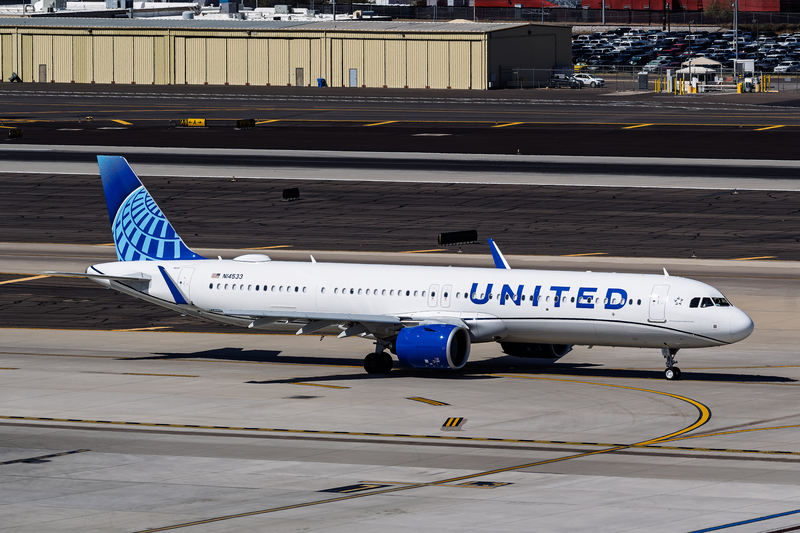
The Washington Dulles (IAD)–Cartagena (CTG) route is equally interesting, but for different reasons.
Dulles (IAD) gives United access to the Washington, D.C. region, Northern Virginia, Maryland, and a broad East Coast connecting base. It is also a hub with strong international feed, government-related travel, diplomatic traffic, and affluent leisure demand.
Cartagena (CTG) is not a traditional government market in the way Bogotá (BOG) can be, but it fits Dulles well as a winter leisure route. Washington-area travelers have strong demand for Caribbean and Latin American destinations during the northern winter, and United’s IAD hub can support markets that would be harder to operate from a smaller point-to-point airport.
Using the Boeing 737 MAX 8 from Dulles (IAD) also gives United a practical operating setup. The aircraft has the range for the mission, the cabin mix to support both premium and leisure demand, and enough seat count to make four-weekly service meaningful without requiring daily operation from day one.
The route also strengthens United’s presence against American Airlines’ Miami (MIA) Latin America gateway and Delta’s growing focus on premium leisure markets. United is not trying to duplicate Miami. Instead, it is using its own hubs to create direct access to selective destinations where its network can produce traffic.
Denver Gets Its First Nonstop Providenciales Link
The third new route is Denver (DEN)–Providenciales (PLS), which begins December 19, 2026, and is scheduled to operate once weekly on Saturdays through April 24, 2027.
This is a classic winter leisure move, but from a hub where it carries extra significance. Denver (DEN) is one of United’s most important domestic hubs, and it gives the airline access to a large western U.S. catchment that does not have the same nonstop Caribbean coverage as the East Coast.
Providenciales / Howard Hamilton International Airport (PLS) is the main international gateway to the Turks and Caicos Islands. The airport has a single terminal and a 9,199-foot runway, more than enough for United’s Boeing 737 MAX 9 operation under normal conditions.
The route will be operated with the Boeing 737 MAX 9, a larger aircraft than the MAX 8 used on Cartagena. United’s MAX 9s seat 179 passengers, including 20 seats in United First and 159 economy seats. That makes the aircraft a good fit for a long leisure sector from Denver, where United can sell premium vacation demand while also carrying connecting passengers from across the western United States.
The scheduled eastbound flight time from Denver (DEN) to Providenciales (PLS) is about five hours. That is long for a narrowbody leisure route, but well within the MAX 9’s mission profile. The MAX 9’s efficiency and range make it useful for exactly this kind of hub-to-Caribbean flying: too thin for a widebody, too long and premium-sensitive for a smaller regional aircraft, and well suited to Saturday leisure patterns.
Why Providenciales Matters To United’s Denver Hub
Providenciales (PLS) gives United another warm-weather destination from Denver (DEN), but it also helps Denver’s international portfolio mature.
Denver International Airport said Providenciales (PLS) will become a new international destination for DEN and the fifth Caribbean destination served nonstop by United from Denver. The airport also said PLS brings Denver’s total nonstop international markets to 35.
That is important because Denver (DEN) is no longer just a domestic connecting fortress. United has been building more international depth from the airport, using its scale in Colorado to support longer-haul and leisure-oriented flying that historically would have been concentrated at coastal hubs.
For the Turks and Caicos Islands, the Denver route opens access to a different U.S. source market. The territory is already well connected to the East Coast and parts of the Midwest, but a Denver nonstop extends its reach farther west. It also creates easier one-stop access over DEN from cities across Colorado, Utah, California, the Pacific Northwest, and parts of the Mountain West.
That kind of access matters for a destination built around high-value tourism. The Turks and Caicos Islands are not a mass-market, low-yield Caribbean destination in the same way as some larger leisure markets. Providenciales is associated with luxury resorts, villas, diving, second-home ownership, weddings, wellness travel, and premium vacation demand. Those are exactly the kinds of travelers United wants to capture through its MileagePlus base and premium cabin inventory.
The Boeing 737 MAX Is Central To The Expansion
All three routes will be operated by Boeing 737 MAX-family aircraft, which shows how important the type has become to United’s medium-haul international network.
The Boeing 737 MAX 8 on Houston (IAH)–Cartagena (CTG) and Washington Dulles (IAD)–Cartagena (CTG) gives United a 166-seat aircraft with strong range, improved fuel burn compared with older 737NG aircraft, larger overhead bins, seatback entertainment on many aircraft, and a cabin that supports both premium and leisure demand.
The Boeing 737 MAX 9 on Denver (DEN)–Providenciales (PLS) gives United more capacity, with 179 seats and a larger First Class cabin. That extra gauge is useful from Denver, where United can draw on a broader connecting base and where Saturday leisure demand can be more concentrated.
These routes are a good example of why U.S. carriers value new-generation narrowbodies. Not long ago, many routes of this length or profile would have required careful tradeoffs between range, payload, and passenger comfort. The MAX family gives airlines more flexibility to connect interior U.S. hubs with Latin America and the Caribbean without needing widebody aircraft or multiple daily frequencies.
For United, that flexibility is especially powerful because it has large hubs in Houston (IAH), Washington Dulles (IAD), and Denver (DEN), each with a different geographic role.
A Seasonal Strategy With Room To Grow
United is launching these routes seasonally, which is the right approach.
Cartagena (CTG) and Providenciales (PLS) both benefit from northern winter demand, when U.S. travelers are looking for warm-weather destinations. Starting with four-weekly Cartagena service and weekly Providenciales service allows United to test the market without putting too much capacity into shoulder periods.
If the routes perform well, United has options. It could extend the season, add frequencies, shift days of operation, or eventually move Cartagena toward a longer operating window. The airline could also use performance data to decide whether one hub is stronger than the other for CTG, or whether both Houston (IAH) and Dulles (IAD) can support repeat winter service.
The same is true for Denver (DEN)–Providenciales (PLS). Weekly Saturday flights are a conservative entry point. If demand is strong, additional peak-season frequencies would be the natural next step, especially around holidays, school breaks, and spring travel periods.
The key will be yield, not just load factor. A full aircraft is not enough if fares are weak. These routes need the right mix of paid premium traffic, MileagePlus loyalty demand, tour and vacation traffic, and connecting passengers.
United’s Latin America Network Keeps Filling In
The Cartagena addition continues a busy year for United in Latin America and the Caribbean.
United has identified Cartagena (CTG) as its fourth new destination in the region in 2026, following Caracas (CCS), Tuxtla Gutiérrez (TGZ), and St. Croix (STX). That mix says a lot about the airline’s strategy. United is not only adding major capitals or business destinations. It is also filling in secondary leisure and visiting-friends-and-relatives markets where its hubs can create enough traffic to support nonstop service.
Cartagena (CTG) is particularly valuable because it adds a second type of Colombian demand to United’s network. Bogotá (BOG) is the capital and business center. Medellín (MDE) is a major metropolitan and tourism market. Cartagena (CTG) is the country’s most recognizable Caribbean leisure gateway.
Together, those three Colombian cities give United a broader and more balanced Colombia portfolio. That can help the airline compete more effectively for U.S.-Colombia traffic, especially against carriers with strong South Florida and Latin America networks.
Bottom Line
United’s new routes to Cartagena (CTG) and Providenciales (PLS) are not just winter sun additions. They are targeted network plays from three hubs with very different strengths.
Houston (IAH)–Cartagena (CTG) fits naturally into United’s Latin America gateway strategy. Washington Dulles (IAD)–Cartagena (CTG) gives the airline a strong East Coast and Mid-Atlantic leisure link to Colombia’s Caribbean coast. Denver (DEN)–Providenciales (PLS) extends United’s Caribbean reach from the Mountain West and gives Turks and Caicos a new western U.S. access point.
The aircraft choices also make sense. The Boeing 737 MAX 8 gives United the right capacity and premium mix for four-weekly Cartagena service, while the larger Boeing 737 MAX 9 is a strong fit for the longer Denver (DEN)–Providenciales (PLS) sector.
For travelers, the headline is simple: more nonstop access to two high-demand warm-weather destinations. For United, the bigger story is network precision. The airline is using its hubs, MAX fleet, and seasonal demand patterns to add international routes that are small in frequency but potentially strong in profitability.
Keep reading FlyMag
Get the Daily Brief in the morning or the Route Watch weekly recap on Fridays. Or both.