The United States has eased part of its sanctions framework involving Conviasa, creating a limited path for aircraft support work involving Venezuela’s state-owned airline.
For aviation enthusiasts, the immediate question is obvious.
Could this eventually bring Conviasa’s rare Airbus A340 fleet to the United States?
Read our stories in your inbox
Two aviation newsletters. Zero fluff.
The short answer is: not soon.
The longer answer is more interesting. The new U.S. authorization does not approve Conviasa flights to American airports. It does, however, make it easier for U.S. companies and individuals to support aircraft maintenance, parts, software, inspections and airworthiness-related work.
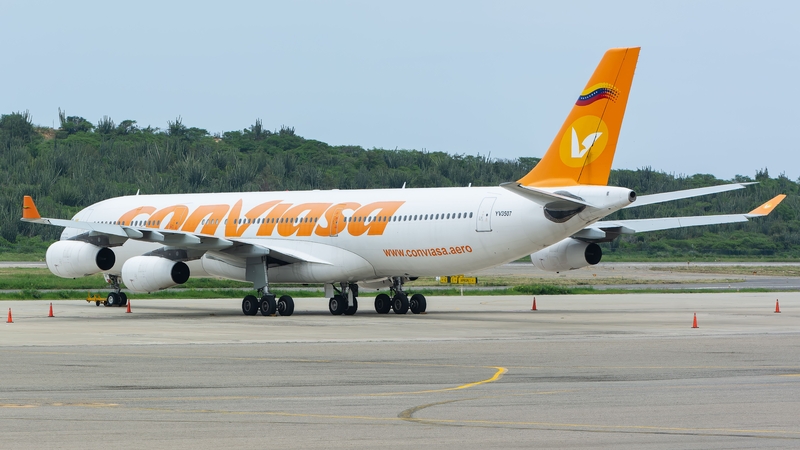
That matters because Conviasa operates one of the most unusual long-haul fleets in the world. It still flies aircraft from the four-engine Airbus A340 family, including the rare A340-200 and the stretched A340-600.
At a time when most airlines have retired the A340 in favor of more efficient twinjets, Conviasa remains a throwback to a very different long-haul era.
What The U.S. Actually Changed
The key document is OFAC General License No. 59, issued by the U.S. Treasury Department’s Office of Foreign Assets Control on June 18, 2026.
The license authorizes certain transactions involving Conviasa, its majority-owned entities, and aircraft in which Conviasa has an interest.

But the scope is specific.
The authorization covers goods, technology, software and services connected to aircraft maintenance, repair, upgrade, refurbishment, improvement, safety and airworthiness.
That includes items such as aircraft parts, software updates, inspections, testing, technical support, logistics, customs clearance and payment processing tied to those activities.
In practical terms, this could help Conviasa maintain or restore aircraft that have been difficult to support under sanctions.
However, it does not mean Conviasa can suddenly sell tickets to Miami, New York or any other U.S. city.
This Is Not A Route Approval
The new OFAC license is an aviation support authorization. It is not an operating permit.
That distinction is important.
A foreign airline that wants to operate to the United States still needs economic authority from the U.S. Department of Transportation. It also needs safety authority from the Federal Aviation Administration, along with compliance with U.S. security, customs and border requirements.
DOT says foreign airlines need both DOT economic authority and FAA safety authority before starting U.S. commercial service.
Conviasa has another complication. Venezuela remains under the FAA’s International Aviation Safety Assessment program as a Category 2 country.
The FAA assigned Venezuela a Category 2 rating in 2019, saying the country did not comply with ICAO safety oversight standards.
That rating focuses on the country’s civil aviation authority, not the individual airline.
Still, it matters greatly.
A Category 2 rating limits the ability of airlines from that country to establish new U.S. service with their own aircraft and crews. Therefore, even with sanctions relief, Conviasa faces a major regulatory hurdle before any U.S. route becomes realistic.
Why Conviasa Is So Interesting To Aviation Fans
Conviasa is interesting because of what it flies.
The airline is one of the last scheduled passenger operators of the Airbus A340. It is also unusual because it has operated multiple A340 variants at the same time.
According to ch-aviation fleet data, Conviasa’s fleet includes two A340-200s, one A340-300 and three A340-600s. Not all are active, but the fleet mix alone makes the airline a global rarity.
The A340-200 is especially uncommon. Airbus built only a small number of the short-fuselage, long-range variant. It was designed for routes where range mattered more than seat count.
The A340-600 is a different machine entirely.
It is one of the longest passenger aircraft ever built and was designed to compete in the high-capacity long-haul market. The type was originally used by major international carriers including Virgin Atlantic, Lufthansa, South African Airways and Iberia.
Conviasa’s A340-600s are especially recognizable because some came from airlines with premium long-haul cabins already installed. That has made them popular with aviation enthusiasts seeking unusual widebody trips.
An Old Fleet Shaped By Sanctions
Conviasa’s A340 fleet also reflects Venezuela’s broader aviation challenges.
Sanctions, financial pressure and limited access to newer aircraft have pushed the airline toward older equipment. That is not unusual in heavily restricted aviation markets.
The same pattern can be seen in parts of Iran, Syria and other markets where airlines have struggled to access new Western-built aircraft and official support channels.
Conviasa’s widebody fleet is old by global long-haul standards. Its A340-200s are more than three decades old. The A340-300 is also an older airframe. Even the youngest A340-600s are now well past the age at which many major airlines would have replaced them.
That does not make them unusable.
The A340 was built for long-haul flying and has a strong structural reputation. But older aircraft need maintenance access, parts availability and technical support. That is where the OFAC change could become important.
If Conviasa can access more legitimate support channels, it may be able to improve dispatch reliability, complete deferred maintenance and keep more aircraft airworthy.
That could strengthen the airline’s international operation, even if U.S. flights remain out of reach for now.
Where Conviasa Uses The A340 Today
Conviasa’s main hub is Simón Bolívar International Airport (CCS), serving Caracas.
From Caracas (CCS), the airline has used the A340 on longer and higher-demand international routes. Recent scheduling references show A340 flying to markets such as Havana, Managua and Mexico City Felipe Ángeles.
The Caracas (CCS)–Havana José Martí International Airport (HAV) route is one of the better-known Conviasa A340 services. Flight schedule data shows the Airbus A340-600 has been used on that city pair.
Conviasa has also operated to Mexico City Felipe Ángeles International Airport (NLU) and Managua Augusto C. Sandino International Airport (MGA).
These are not typical A340 markets by global airline standards.
Most airlines once used A340s for intercontinental trunk routes. Conviasa uses them in a more unusual way, shaped by fleet availability, sanctions, politics and regional demand.
That is part of what makes the airline so compelling to enthusiasts.
Could Conviasa Fly To Miami?
Miami would be the obvious U.S. market if Conviasa ever received all required approvals.
Mami International Airport (MIA) has long been the natural U.S. gateway for Venezuela. South Florida has strong Venezuelan community ties, business links and historical air service demand.
Before U.S.–Venezuela air links collapsed, Miami–Caracas was one of the most important markets between the two countries.
A future Caracas (CCS)–Miami (MIA) route would make commercial sense on paper. It is shorter than Conviasa’s current long-haul missions and would not require an A340 from a range standpoint.
That raises an interesting operational point.
If Conviasa returned to the U.S., it would not need to use an A340. The airline could use an Embraer E190, a narrowbody aircraft, or another type if available.
The A340 would be exciting for enthusiasts, but it would be excessive for a short sector like Caracas–Miami.
A longer route, such as Caracas (CCS)–New York (JFK), would make more sense for a widebody. Even then, regulatory and commercial hurdles would remain significant.
The U.S. Could Get A Third A340 Carrier, But Not Yet
At the moment, scheduled Airbus A340 service to the United States is extremely rare.
Lufthansa remains the main operator of the type into the U.S., using A340-300s and A340-600s from Frankfurt Airport (FRA). The A340-600 has been scheduled on routes such as Frankfurt (FRA) to New York John F. Kennedy International Airport (JFK) and Washington Dulles International Airport (IAD).
Edelweiss also remains an A340-300 operator. Its Zurich (ZRH) network has included U.S. leisure markets such as Tampa International Airport (TPA).
That means Conviasa could theoretically become a third regular A340 operator to the U.S. if all obstacles were cleared.
But that is a big “if.”
The OFAC license only addresses certain sanctions-related support activities. It does not resolve DOT authority, FAA safety oversight, TSA requirements, CBP processing, insurance, aircraft reliability, commercial distribution or political risk.
It also does not automatically remove Conviasa from the sanctions list.
So, while the idea of a Conviasa A340 at Miami (MIA) or New York (JFK) is fascinating, it remains more of an AvGeek possibility than an imminent network development.
Why The OFAC License Still Matters
Even without U.S. flights, the OFAC change is important.
Aircraft maintenance is global. Parts, software, documentation, technical support and inspection services often involve U.S. companies or U.S.-controlled technology.
When those channels are restricted, airlines operating Western-built aircraft face real problems.
The new authorization could allow Conviasa to access support that improves safety and aircraft availability. That could help the airline keep its A340s flying longer. It could also support its Embraer E190 fleet and other aircraft.
Conviasa’s own baggage information still lists the Airbus A340 and Embraer E190 as passenger aircraft types used by the airline.
For a carrier with an aging fleet, even limited access to parts and maintenance support can make a major difference.
In that sense, the U.S. move may be less about launching routes and more about stabilizing aircraft operations.
The A340’s Place In Modern Long-Haul Aviation
The Airbus A340 has become a niche aircraft.
When it entered service in the 1990s, the four-engine design made sense. ETOPS rules were more restrictive, and airlines valued the A340’s ability to fly long overwater and remote routes without relying on two-engine approvals.
That world has changed.
Modern twinjets such as the Boeing 787, Airbus A350 and Boeing 777-300ER can fly long-haul missions with much better fuel efficiency. As a result, the A340 has disappeared from most major airline fleets.
Yet the aircraft still has fans.
It is quiet, elegant and increasingly rare. The A340-600, in particular, remains one of the most visually distinctive widebodies ever built.
That is why Conviasa attracts attention. It is not simply another state-owned airline. It is one of the few remaining places where passengers can still fly scheduled services on an A340-200 or A340-600.
For enthusiasts, that is a strong draw.
Conviasa’s U.S. Future Depends On More Than Sanctions
The path to U.S. service would require several steps.
First, Venezuela would likely need to address FAA safety oversight concerns. Without a Category 1 rating, new Venezuelan-carrier service to the U.S. remains highly constrained.
Second, Conviasa would need the proper DOT authority for the service it wants to operate.
Third, the airline would need to satisfy U.S. security and border requirements. That includes airport security procedures, passenger vetting, cargo rules and station-level compliance.
Fourth, the commercial case would need to work.
Demand between Venezuela and the United States is real. However, years of disrupted service, political risk and limited banking and distribution channels would make a restart complex.
Finally, Conviasa would need aircraft it can reliably operate to U.S. standards.
That may be where General License 59 helps most. It may support the technical foundation needed before any serious U.S. operation can be considered.
Bottom Line
The United States has not opened the door to immediate Conviasa flights.
What it has done is more limited but still important. OFAC General License 59 allows certain U.S.-linked transactions involving Conviasa aircraft maintenance, repair, upgrades, software, safety and airworthiness.
That could help Venezuela’s flag carrier support its aging fleet, including its rare Airbus A340 aircraft.
For AvGeeks, the dream scenario is obvious: a Conviasa A340 arriving in the United States and adding a third regular A340 operator to American airports alongside Lufthansa and Edelweiss.
For now, that remains unlikely.
Conviasa still faces major regulatory, safety, sanctions, operational and commercial hurdles before it could operate to the U.S. The new license is a step toward aircraft support, not a route approval.
Still, it is a meaningful development.
If Conviasa can improve aircraft reliability and Venezuela can address the broader regulatory issues, the idea of a Venezuelan A340 returning to U.S. skies may no longer be completely impossible. It is just not close yet.