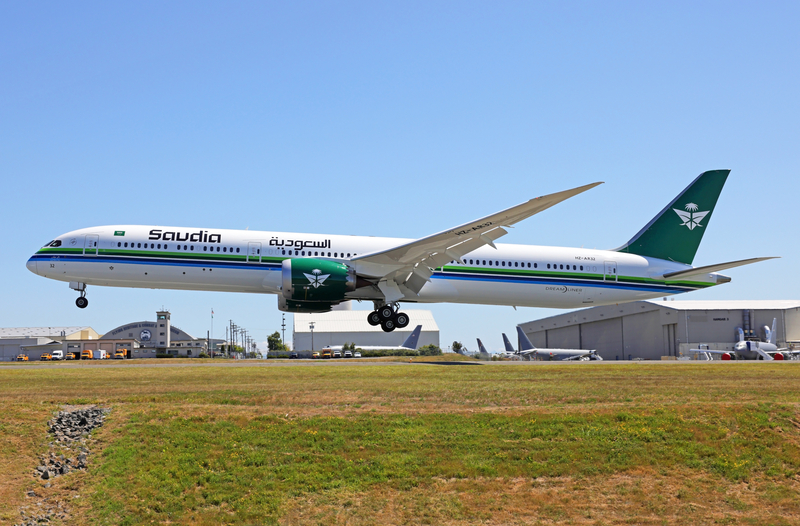
Saudia is pulling its London Heathrow Airport (LHR) to King Fahd International Airport (DMM) service less than six months after bringing the route back, ending what had been a notable attempt to expand its London footprint beyond Jeddah and Riyadh.
The route only returned in November 2025, giving Dammam a direct Heathrow link once again and briefly making it Saudia’s third Saudi Arabian point at LHR alongside Jeddah King Abdulaziz International Airport (JED) and Riyadh King Khalid International Airport (RUH). Now, however, the service is set to disappear from the schedule in mid-April, underlining just how quickly long-haul network decisions can reverse when a route fails to gain traction.
For Heathrow, where every slot matters, that is significant. Airlines do not keep underperforming services in place for long when those same movements can be used more profitably elsewhere.
Read our stories in your inbox
Two aviation newsletters. Zero fluff.
The Boeing 787-9 Was a Logical Choice
Saudia had been operating the route with the Boeing 787-9 Dreamliner, a widebody that is usually well suited to thinner long-haul markets. In the airline’s two-class layout, the aircraft carries 298 passengers, with 24 seats in Business Class and 274 in Economy.
From a fleet-planning perspective, the aircraft choice made sense. The 787-9 offers the range and efficiency needed for a market such as DMM-LHR without the heavier trip costs associated with larger widebodies. It is exactly the type of aircraft many carriers use when testing or rebuilding long-haul routes that sit below the demand profile of a major trunk service.
That is what makes the route’s failure more telling. The issue was not that Saudia deployed the wrong aircraft. It is that even a well-matched aircraft cannot rescue a route if underlying demand is too soft or too inconsistent.
The Numbers Point to a Weak Start
Early traffic figures suggest the route struggled from the outset. UK Civil Aviation Authority data, as reported by trade outlets, indicates that passenger loads were only around half full during the first months of operation.
That is a difficult place for any long-haul route to be, especially one serving Heathrow. A lightly filled Boeing 787-9 can still offer strategic value in some circumstances, particularly if premium yields are strong, but a route with weak overall loads becomes much harder to defend when the airport at one end is slot-constrained and commercially unforgiving.
Dammam is an important city and King Fahd International Airport (DMM) is famously vast in physical size, often cited as the world’s largest airport by area. But airport scale and route viability are not the same thing. A very large airport does not automatically produce the kind of premium, point-to-point, and connecting demand needed to sustain a Heathrow long-haul link.
Heathrow Slots Are Too Valuable to Waste
The more important story may be what happens next. Saudia is not simply walking away from those Heathrow movements. The three weekly slots freed up by the Dammam suspension are being returned to the Jeddah market, where Saudia will restore its JED-LHR schedule from 11 to 14 weekly flights.
That is a classic Heathrow optimization move. When a secondary long-haul market underperforms, airlines usually redeploy capacity to a route with deeper demand and stronger commercial foundations. In Saudia’s case, Jeddah is the obvious beneficiary. It is one of the carrier’s core gateways, it supports both local and connecting traffic, and it is far better positioned to absorb extra Heathrow capacity.
For airline professionals, this is often where the real story sits. The headline may be about a route ending, but the underlying logic is about slot productivity. Heathrow rewards density and proven demand, and Saudia is making the rational choice to concentrate more heavily where returns are more dependable.
Dammam Was Always the More Fragile Heathrow Bet
Compared with Jeddah and Riyadh, Dammam was always a more delicate proposition. It has regional importance and a business base, but it lacks the same scale of international profile and onward network utility. That does not make a Heathrow route impossible, but it does mean the margin for error is much narrower.
Launching the route in late 2025 gave Saudia a broader UK proposition and expanded its visibility in the Saudi market. But breadth only matters if it pays. Once the route started to show weak load factors, the case for keeping those Heathrow slots tied to DMM became much harder to defend.
This is particularly true in a market where airlines are constantly balancing prestige against performance. A Heathrow route may look strategically appealing on paper, but if the traffic base is not deep enough, the economics tend to win the argument very quickly.
A Reminder That Long-Haul Growth Still Has Limits
There is a wider lesson here. Saudi aviation is growing fast, and the country’s carriers are in expansion mode across multiple fronts. But rapid national growth does not mean every new long-haul route will succeed on its first attempt.
The Dammam-Heathrow market illustrates that clearly. Saudia had the aircraft, the slots, and a route that looked respectable from a network point of view. What it appears to have lacked was enough sustained demand to make the service work at a commercially acceptable level.
That is why the suspension matters. It is not just the loss of one route. It is a reminder that long-haul route development remains highly sensitive to local demand, slot value, and the opportunity cost of using scarce capacity in one market rather than another.
Bottom Line
Saudia’s withdrawal from the London Heathrow Airport (LHR) to King Fahd International Airport (DMM) route is a sharp but rational network correction. The Boeing 787-9 was an appropriate aircraft, the market had clear strategic appeal, and the route broadened Saudia’s London presence. But the early traffic performance appears to have been too weak to justify holding valuable Heathrow slots there.
By returning those slots to Jeddah King Abdulaziz International Airport (JED), Saudia is making a familiar legacy-carrier calculation: concentrate on the Saudi gateways that can reliably support scale, and retreat from the one that cannot, at least for now.
For Heathrow watchers, the message is straightforward. At a slot-constrained airport, even a high-profile long-haul route gets judged quickly, and sentiment rarely overrides economics.
Keep reading FlyMag
Get the Daily Brief in the morning or the Route Watch weekly recap on Fridays. Or both.