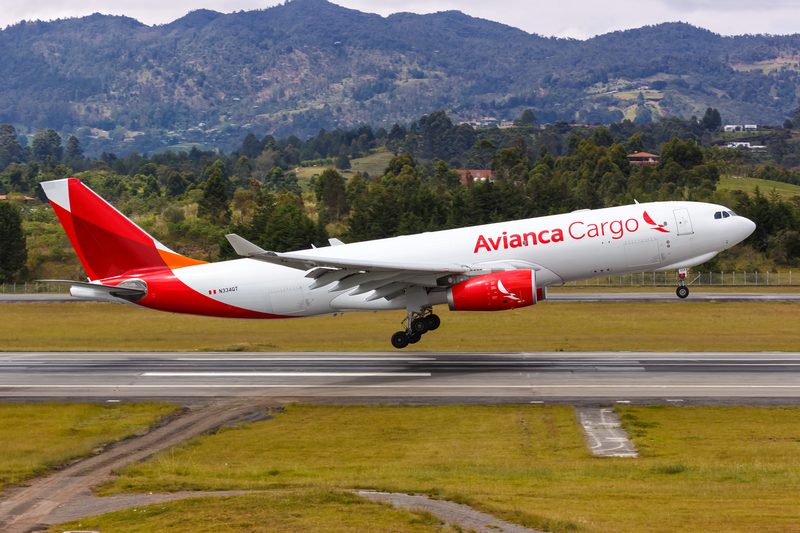
Avianca Cargo has launched a dedicated freighter service between Bogotá El Dorado International Airport (BOG) and Caracas Simón Bolívar International Airport (CCS), adding a meaningful layer of cargo capacity to one of northern South America’s most important rebuilding air corridors.
The first freighter flight operated on March 7, with weekly service using an Airbus A330 freighter offering up to 60 tonnes of capacity per flight. That is a substantial step up for a lane that, until now, had been relying primarily on belly cargo as passenger service between Colombia and Venezuela came back online.
For cargo professionals, that is the real story. This is not simply another regional freighter rotation. It is a sign that Avianca sees enough underlying trade demand between BOG and CCS to justify dedicated main-deck capacity, not just opportunistic freight riding in the holds of passenger aircraft.
Read our stories in your inbox
Two aviation newsletters. Zero fluff.
The Freighter Changes The Economics Of The Corridor
The difference between belly cargo and dedicated freighter lift is not just about volume. It is about reliability, shipment profile, and commercial flexibility.
Avianca says the new weekly A330 freighter is complemented by roughly 7 additional tonnes per week carried in the belly holds of its passenger flights on the same route. That means the main-deck freighter is doing the heavy lifting in every sense. It gives shippers access to far more usable capacity, especially for freight that is oversized, palletized, time-sensitive, or simply too important to depend on narrower passenger-aircraft belly space.
That matters on a route like Bogotá–Caracas. When a market is still rebuilding regular air connectivity, cargo customers typically want predictability as much as raw space. A dedicated freighter gives forwarders and shippers a firmer operating pattern and a more credible product for higher-priority shipments.
The Airbus A330 freighter is also a serious aircraft for this kind of mission. With a payload capability around the 60-tonne mark in Avianca’s announced use here, it brings a level of scale that immediately changes what the corridor can support. For a relatively short regional sector, that is a strong signal of confidence in demand.
Passenger Service Came First — Cargo Is Now Following
The cargo launch did not happen in isolation.
Avianca resumed daily passenger flights between BOG and CCS on February 12, restoring a long-standing link between Colombia and Venezuela after years of interruption. The airline has also opened sales for a second daily frequency beginning March 28, which will further deepen passenger and belly-cargo capacity on the route.
That sequencing makes sense. In many reopening markets, passenger service returns first because it is the fastest way to reestablish presence, prove operating viability, and rebuild customer confidence. Cargo then follows once the airline can see the traffic flows more clearly and decide whether belly space alone is enough.
In this case, Avianca appears to have concluded that it is not.
That is an important read-through for the market. It suggests the Bogotá–Caracas lane is not merely recovering in symbolic terms. It is recovering in a way that supports dedicated freight economics.
Bogotá–Caracas Is A Natural Cargo Corridor To Rebuild
From a geography and trade perspective, this lane makes obvious sense.
Bogotá is Avianca’s principal hub and one of the strongest cargo gateways in Latin America. Caracas, while no longer the air market force it once was, remains a critical commercial entry point for Venezuela. Restoring dedicated cargo connectivity between BOG and CCS helps rebuild a direct logistics bridge between two neighboring economies with longstanding commercial ties.
For importers and exporters, a nonstop freighter also reduces dependence on more fragmented logistics solutions. Without dedicated uplift, freight may be forced into a combination of trucking, transshipment, or waitlisted belly space, all of which introduce variability. A scheduled freighter improves planning and can make the lane more attractive again for higher-value and time-sensitive traffic.
That is especially relevant in a recovering bilateral market, where cargo often returns alongside broader commercial normalization.
This Is Also A Hub Play For Avianca Cargo
There is another strategic layer here as well.
Avianca Cargo is not just serving Caracas. It is serving Caracas through Bogotá. That distinction matters because BOG is not simply an origin point; it is a cargo hub with wider connectivity across the Americas and beyond. A dedicated BOG–CCS freighter can therefore function not only as a local trade bridge, but also as part of a broader network strategy that channels freight into Avianca’s larger system.
That gives the route more strategic weight than a simple point-to-point sector might suggest.
For a carrier like Avianca Cargo, hub strength is one of the main advantages it can bring to markets that are still stabilizing. The more it can connect CCS into a wider, dependable cargo network via Bogotá, the stronger its value proposition becomes.
The A330 Freighter Is The Right Aircraft For The Job
Aircraft choice matters on a route like this, and the A330 freighter is a strong fit.
It offers enough payload to make the flight commercially meaningful while still giving Avianca Cargo flexibility in how it develops the market. The aircraft is large enough to support a broad mix of freight categories, but not so oversized that the service immediately looks like an overreach. On a recovering intra-regional lane, that balance is important.
It also gives Avianca Cargo a cleaner separation between passenger-network recovery and cargo growth. Rather than forcing belly space to do all the work, the carrier can now segment traffic more intelligently: smaller and routine cargo flows can continue moving on passenger aircraft, while larger or more operationally demanding shipments can move on the freighter.
That is the kind of structure cargo customers tend to notice quickly.
There Is History Here, But This Still Feels New
There is understandable temptation to frame this as a return to older Colombia–Venezuela freight patterns, and there is some truth in that. Caracas has long been part of the wider cargo geography of northern South America, and Avianca Cargo’s roots through Tampa Cargo mean the airline is hardly new to Venezuela-linked freight flows.
But it would be more accurate to say this is a restoration with a new strategic context.
The Bogotá–Caracas market today is not simply picking up where it left off years ago. Trade conditions, political realities, airline networks, and shipper expectations have all changed. What Avianca is building now is not just a restarted lane. It is a restructured one, with modern freighter economics and a clearer hub-and-spoke cargo model centered on Bogotá.
That makes the service more consequential than a nostalgic reopening headline might imply.
Why This Matters Beyond One Route
The bigger relevance of the launch is what it says about regional cargo confidence.
Airlines do not place dedicated freighters into recovering markets casually. Even a weekly operation reflects a threshold judgment that demand is sufficient, yields are workable, and the route can support a stable operating rhythm. If the market responds well, frequency or capacity can grow. If it does not, the airline has still limited its exposure with a once-weekly structure.
So this service works as both a commitment and a test.
For the Colombia–Venezuela corridor, it is a meaningful commitment. For Avianca Cargo, it is also a measured way to probe how much dedicated demand exists now that passenger connectivity has returned and begun to expand.
Bottom Line
Avianca Cargo’s new Bogotá (BOG)–Caracas (CCS) freighter service is more than an incremental cargo addition. It restores dedicated main-deck lift to a corridor that has been rebuilding step by step, first through passenger service and now through scheduled freighter capacity.
The weekly Airbus A330 freighter adds up to 60 tonnes per flight, far exceeding the roughly 7 tonnes per week moving in the belly holds of Avianca’s passenger operation. That immediately changes the cargo profile of the route, giving shippers more dependable uplift and giving Avianca a stronger role in the recovery of bilateral air trade between Colombia and Venezuela.
For aviation and cargo professionals, the key takeaway is straightforward: Avianca is no longer treating Bogotá–Caracas as a route served only incidentally through passenger flying. With dedicated freighter capacity now in place, it is treating the corridor as a cargo market in its own right.
Keep reading FlyMag
Get the Daily Brief in the morning or the Route Watch weekly recap on Fridays. Or both.