Air Tanzania is setting its sights on London and the United States as the government-backed carrier prepares for another phase of fleet and network expansion.

Tanzanian Transport Minister Makame Mbarawa said the airline expects to receive additional aircraft, which would allow it to extend its international network beyond its current destinations in Africa, Asia, the Middle East, and Russia.
“We expect to receive more aircraft, and once they arrive, we will expand our services to more destinations around the world,” Mbarawa said. “Then we are going to fly everywhere, including London and the U.S., depending on the number of aircraft available.”
Read our stories in your inbox
Two aviation newsletters. Zero fluff.
The statement confirms the government’s long-term ambitions for Air Tanzania, but it does not amount to a formal route announcement. No London or U.S. airport has been identified, and the airline has not published proposed launch dates, frequencies, schedules, or aircraft assignments.
More importantly, acquiring additional aircraft is only one part of the equation. Air Tanzania is presently prohibited from serving both the European Union and the United Kingdom, while any U.S. operation would require an extensive approval process involving the U.S. Department of Transportation, Federal Aviation Administration, and other federal agencies.
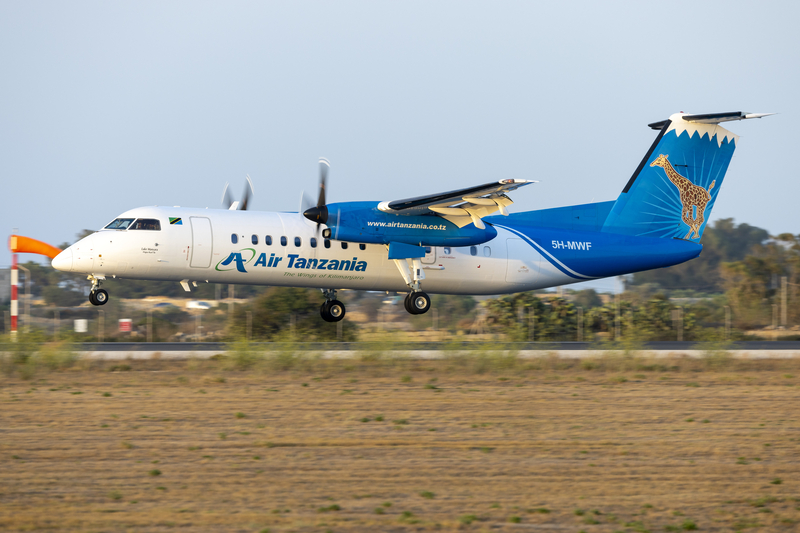
Air Tanzania Plans to Grow From 16 to 24 Aircraft
Air Tanzania currently describes itself as a 16-aircraft airline based at Julius Nyerere International Airport (DAR) in Dar es Salaam.
The state-owned carrier’s published fleet consists of regional turboprops, Airbus and Boeing narrowbodies, three Boeing 787-8 Dreamliners, and a dedicated Boeing 767-300F freighter.
| Aircraft | Fleet | Published Passenger Configuration | Primary Role |
|---|---|---|---|
| De Havilland Canada Dash 8-Q300 | 1 | Approximately 50 seats | Domestic and short regional routes |
| De Havilland Canada Dash 8-400 | 5 | 76 or 78 seats | Domestic and regional routes |
| Airbus A220-300 | 4 | 12 business, 120 economy | Regional and medium-haul services |
| Boeing 737 MAX 9 | 2 | 16 business, 165 economy | Regional and medium-haul services |
| Boeing 787-8 Dreamliner | 3 | 22 business, 240 economy | Long-haul passenger services |
| Boeing 767-300F | 1 | Cargo | Long-haul freight operations |
Air Tanzania’s three Boeing 787-8s are the only passenger aircraft in the current fleet designed for regular intercontinental operations to destinations as distant as London or the United States.
The airline lists a range of approximately 7,355 nautical miles for the 262-seat Dreamliner. That gives the aircraft ample capability for nonstop service between Julius Nyerere International Airport (DAR) and London, subject to payload, weather, routing, and reserve requirements.
A nonstop flight from Dar es Salaam to the eastern United States would be considerably more demanding. Although several potential routes could fall within the theoretical capabilities of the Boeing 787-8, published maximum range should not be confused with practical scheduled-airline performance.
Actual payload capability depends on winds, airspace restrictions, airport temperatures, cargo demand, diversion requirements, and the amount of fuel that can be carried at the planned takeoff weight. No U.S. destination has been named, so it is too early to determine whether Air Tanzania is considering New York John F. Kennedy International Airport (JFK), Washington Dulles International Airport (IAD), another East Coast gateway, or an intermediate-stop operation.
Eight More Aircraft Are Planned by 2030
The Tanzanian government plans to add eight aircraft to Air Tanzania’s fleet by 2030, increasing the total from 16 to 24.
An earlier short-term target called for the fleet to reach 19 aircraft during the 2025-2026 financial year. However, Air Tanzania’s official website continued to list 16 aircraft in July 2026, suggesting that at least part of the procurement program remains pending. (dailynews.co.tz)

The government has allocated TZS283.05 billion, approximately $109 million, to Air Tanzania under its latest transport spending plan.
Of that amount, TZS185.32 billion, or approximately $71.5 million, is intended for aircraft acquisitions, spare engines, and rehabilitation of maintenance facilities. Another TZS97.73 billion, approximately $37.5 million, is allocated to supporting infrastructure such as maintenance hangars, cargo facilities, and pilot-training equipment.
The number and types of aircraft to be acquired have not been clearly detailed in the latest public statements.
That distinction is important because simply increasing the fleet to 24 aircraft would not automatically support London and U.S. services. Additional Dash 8 turboprops or short-haul narrowbodies would strengthen the domestic feeder network, but Air Tanzania would need more long-haul aircraft—or considerably greater availability from its existing Dreamliners—to operate several new intercontinental routes reliably.
Three Dreamliners Leave Limited Operational Flexibility
Air Tanzania’s three Boeing 787-8s are already shared among its existing long-haul commitments.
A fleet of three aircraft can support multiple routes when frequencies are relatively low and schedules are carefully coordinated. It provides much less resilience when one Dreamliner enters heavy maintenance or becomes unavailable because of an unexpected technical problem.
Launching London service would add another long-duration rotation to the aircraft schedule. A daily route would consume substantially more fleet time than a three-times-weekly service and would require enough reserve capacity to protect passengers when an aircraft goes out of service.
A U.S. operation would be even more demanding because of its longer block time. Depending on the destination and schedule, a single round trip could keep an aircraft away from Dar es Salaam for more than a day.
This is why the exact composition of the planned eight-aircraft order matters. Additional Boeing 787s or another long-haul type would support Air Tanzania’s international ambitions directly. Regional aircraft would still be valuable, but they would primarily expand the feed required to fill the long-haul flights rather than operate them.
The airline’s Boeing 737 MAX 9s have a published range of approximately 3,550 nautical miles, while the Airbus A220-300s are listed at approximately 3,300 nautical miles. Neither type is a practical option for nonstop London or U.S. service from Julius Nyerere International Airport (DAR).
Air Tanzania Cannot Currently Fly to London
London may be geographically and commercially more attainable than the United States, but it faces an immediate regulatory barrier.
Air Tanzania was individually added to the European Union Air Safety List in December 2024 following safety concerns identified by the European Union Aviation Safety Agency. The restriction was subsequently broadened in June 2025 to cover every airline certified by the Tanzanian authorities.
European aviation officials cited shortcomings that included a lack of qualified personnel, ineffective oversight of flight operations and airworthiness, and failures by the national civil aviation authority and certified airlines to comply with international standards.
The latest European Commission update, issued in June 2026, continued to include all Tanzanian-certified airlines among carriers prohibited from operating in the European Union.
London, however, is no longer part of the European Union. The EU restriction alone would therefore not determine whether Air Tanzania could serve London Heathrow Airport (LHR) or London Gatwick Airport (LGW).
The United Kingdom maintains its own independent UK Air Safety List, and that list currently states that all airlines certified by the authorities responsible for aviation oversight in Tanzania are banned from operating commercial services to, from, and within the United Kingdom.
Air Tanzania therefore cannot launch a London route under the present regulatory framework, regardless of how many aircraft it acquires.
Tanzania and Air Tanzania would first need to demonstrate sufficient improvements for the United Kingdom to remove the country from its safety list. European authorities would conduct a separate review before restoring access to EU member states.
IOSA Registration Does Not Override Government Restrictions
Air Tanzania says it is registered under the International Air Transport Association’s Operational Safety Audit program, commonly known as IOSA.
IOSA registration can be commercially useful and demonstrates that an airline has undergone an audit covering areas such as flight operations, maintenance, dispatch, cabin operations, cargo, security, and organizational management.
It does not, however, replace regulatory oversight by a national aviation authority. It also does not compel the United Kingdom, European Union, or United States to grant an airline operating authority.
The EU’s broader action against Tanzania focuses partly on the ability of the Tanzania Civil Aviation Authority to supervise the country’s aviation industry. An airline may point to improvements within its own organization, but foreign regulators will also examine whether its home-country authority has enough qualified inspectors, effective procedures, enforcement powers, and technical capability to provide continuing oversight.
That means Air Tanzania’s path back to Europe depends on both the airline and Tanzania’s national aviation system.
U.S. Route Rights Already Exist
Unlike the London proposal, Air Tanzania’s interest in the United States is not obstructed by a restrictive bilateral aviation agreement.
The United States and Tanzania have an Open Skies air transport agreement that entered into force in June 2022. It permits unrestricted capacity and frequency, open route rights, liberal charter operations, and code-sharing opportunities between the two countries.
In practical terms, the agreement establishes the traffic rights required for a designated Tanzanian carrier to serve the United States. It does not give Air Tanzania automatic authority to begin flying.
Any foreign airline seeking to operate commercial services to the United States must obtain economic authority from the U.S. Department of Transportation and safety authority from the Federal Aviation Administration. The application process examines the airline’s ownership, management, finances, operating plan, home-country authorization, and ability to comply with U.S. regulations.
The FAA would also need to issue foreign-air-carrier operations specifications under Part 129. Those approvals govern matters such as authorized aircraft, airports, routes, maintenance arrangements, navigation capabilities, and operating procedures.
Additional clearances would be required from agencies responsible for aviation security, customs, immigration, and border processing.
Tanzania Does Not Have a Published FAA IASA Rating
The FAA’s International Aviation Safety Assessment program evaluates a country’s civil aviation authority rather than assigning a safety rating to an individual airline.
The assessment considers whether the authority meets International Civil Aviation Organization standards in areas including legislation, operating regulations, inspector qualifications, licensing, surveillance, airworthiness oversight, and the resolution of safety concerns.
The FAA’s currently published IASA results do not list Tanzania as either Category 1 or Category 2. That should not be interpreted as a Category 2 finding; it means Tanzania does not have a rating on the FAA’s public results sheet.
Before a Tanzanian airline could inaugurate scheduled service to the United States, the FAA would need to be satisfied that the relevant safety and oversight requirements were met. The concerns already identified by European and British authorities would almost certainly make regulatory readiness a central part of Air Tanzania’s U.S. expansion effort.
A Category 1 finding means a country’s oversight system meets ICAO standards. Category 2 means the FAA has concluded that the country does not provide oversight consistent with those standards.
Air Tanzania would therefore need more than a suitable aircraft and an available airport slot. Its home regulator would need to satisfy the FAA’s oversight expectations, while the airline itself would have to obtain all necessary economic, operational, safety, and security approvals.
Moscow Demonstrates Air Tanzania’s Long-Haul Strategy
Air Tanzania’s newest intercontinental route demonstrates both the capabilities of its Dreamliner fleet and the operational demands created by further expansion.
The airline inaugurated service from Julius Nyerere International Airport (DAR) to Moscow Vnukovo International Airport (VKO) on July 1, with the first flight arriving in Moscow on July 2.
The route operates three times weekly with a Boeing 787-8, but it is not a conventional Dar es Salaam–Moscow round trip. Air Tanzania uses a triangular routing:
Julius Nyerere International Airport (DAR)–Moscow Vnukovo International Airport (VKO)–Abeid Amani Karume International Airport (ZNZ)–Julius Nyerere International Airport (DAR).
Flight TC422 departs Dar es Salaam for Moscow, while TC423 returns from Moscow to Zanzibar before continuing to Dar es Salaam. The routing allows Air Tanzania to combine traffic from the country’s commercial capital with Russian leisure demand for Zanzibar.
The first flight reportedly carried 123 passengers to Moscow, while 144 passengers were booked for the outbound service to Tanzania.
Moscow Vnukovo International Airport (VKO) is outside the European Union and United Kingdom, allowing Air Tanzania to pursue the route under approvals granted by Russian authorities. Rosaviatsiya authorized the operation following consultations between the Tanzanian and Russian governments.
The route gives Air Tanzania a new tourism market, but it also places another three weekly long-haul rotations into a Dreamliner schedule supported by only three aircraft.
London Has a Stronger Short-Term Commercial Case
If the regulatory restrictions are resolved, London would likely be the more straightforward of Air Tanzania’s two proposed western markets.
The United Kingdom is an important source of tourists traveling to Zanzibar, Mount Kilimanjaro, and Tanzania’s national parks. London also generates business, educational, government, and visiting-friends-and-relatives traffic.
Air Tanzania could use its domestic and regional network at Julius Nyerere International Airport (DAR) to connect London passengers with destinations including Abeid Amani Karume International Airport (ZNZ), Kilimanjaro International Airport (JRO), Mwanza Airport (MWZ), and airports elsewhere in East and southern Africa.
A London route could also be operated at a relatively modest initial frequency. Three weekly flights would allow Air Tanzania to concentrate demand while limiting the amount of Dreamliner capacity committed to the market.
Airport selection would nevertheless matter. London Heathrow Airport (LHR) offers stronger premium traffic and connecting opportunities but has exceptionally constrained and expensive slots. London Gatwick Airport (LGW) may be more realistic for a leisure-oriented carrier, particularly if the service is built around Zanzibar and safari traffic.
Air Tanzania has not identified either airport in its latest announcement.
A U.S. Route Would Be a Much Larger Commercial Test
A nonstop U.S. service would represent a considerably greater commitment.
The route would require longer aircraft utilization, more fuel, augmented crew planning, extensive regulatory preparation, and enough premium and economy demand to support a widebody over a very long distance.
Air Tanzania could draw traffic from Tanzania and neighboring countries through Julius Nyerere International Airport (DAR), but its hub would need reliable connection banks and sufficient schedule depth to compete with established one-stop options.
Passengers traveling between Tanzania and the United States already have numerous connecting choices through hubs such as Addis Ababa Bole International Airport (ADD), Doha Hamad International Airport (DOH), Dubai International Airport (DXB), Istanbul Airport (IST), Amsterdam Airport Schiphol (AMS), and Paris-Charles de Gaulle Airport (CDG).
A nonstop flight would offer a clear time advantage, but Air Tanzania would need to demonstrate that the market could support the route without relying heavily on low-yield connecting passengers.
A limited three-times-weekly schedule could reduce the initial risk. However, lower frequency can also make a route less attractive to business passengers and create significant disruption when one flight is delayed or canceled.
Bottom Line
Air Tanzania’s interest in London and the United States reflects the rapid development of a carrier that operated only one aircraft a decade ago and now has a diverse 16-aircraft fleet, including three Boeing 787-8 Dreamliners.
The government plans to add eight aircraft by 2030 and has allocated substantial funding for aircraft, spare engines, maintenance facilities, cargo infrastructure, and training equipment. Those investments could give Air Tanzania the capacity needed to add further intercontinental destinations.
Aircraft availability is not the only obstacle.
Air Tanzania is currently unable to serve London because all Tanzanian-certified airlines are banned from operating in the United Kingdom. The airline also remains prohibited from serving the European Union, with regulators citing deficiencies in both airline operations and national safety oversight.
The United States and Tanzania already have an Open Skies agreement, but Air Tanzania would still need U.S. economic and safety authority, Part 129 operating specifications, security approvals, and satisfactory regulatory oversight from its home country.
The new three-times-weekly Boeing 787 route linking Dar es Salaam, Moscow Vnukovo, and Zanzibar shows that Air Tanzania can launch and operate ambitious long-haul services. It also demonstrates why additional widebody capacity will be necessary.
London may ultimately be the airline’s most commercially attainable western destination, while a U.S. route would be a far larger operational and financial test. Before either can become reality, Air Tanzania must expand not only its fleet, but also the regulatory credibility, maintenance resilience, and network depth required of a truly global carrier.