Nearly five years after Air Namibia’s final aircraft returned to base at Windhoek Hosea Kutako International Airport (WDH), hundreds of former employees say the airline’s shutdown still hasn’t fully landed—at least not financially.
This week, a group representing roughly 637–638 ex-Air Namibia staff formally petitioned Namibia’s Supreme Court in Windhoek, urging judges to fast-track a pending appeal tied to unpaid severance packages. The case—filed under SA 126/2024—has become a focal point for former crew and ground personnel who argue they are still waiting on money that should have been settled long ago.
A petition to accelerate the appeal, or end it entirely
At the heart of the petition is a familiar route-development obstacle—only this time it’s legal rather than commercial: time.
Read our stories in your inbox
Two aviation newsletters. Zero fluff.
The former employees are asking the Supreme Court to do one of two things:
-
Set down a hearing date for the appeal so the dispute can be argued and closed out, or
-
Dismiss the liquidators’ appeal, which would clear the way for the previous court order to be implemented.
Either outcome would remove what the employees describe as the major brake on final payments: the appeal process itself.
Former senior cabin controller Renier Bougard, acting as spokesperson for the group, has framed the issue as simple: former staff say the legal process has stretched far beyond what’s reasonable for workers who lost their jobs when the airline entered liquidation.
Why one Labour Court payout changed the tone overnight
What pushed the dispute back into the spotlight wasn’t just the long-running delay—it was a single payout.
Bougard points to a separate, recent decision in the Namibian Labour Court in February 2026, where one former employee reportedly obtained an order that resulted in being paid in full, with interest. To the ex-workers, that outcome is more than symbolic: it suggests that funds can be released, and it raises uncomfortable questions about why one claim can be resolved while the broader group remains stuck behind the appeal.
From the employees’ perspective, paying one worker after a Labour Court ruling while continuing to contest the High Court order for the larger group looks inconsistent. In practical terms, it also creates a new pressure point: once precedent shows that full payment can happen, the argument for continued delay becomes harder to defend in the court of public opinion.
The severance “math” at the center of the dispute
This is not merely a dispute over whether severance should be paid—it’s a dispute over how severance should be calculated.
When Air Namibia’s liquidation took effect in 2021, employees were automatically dismissed. A key disagreement followed: should severance be calculated on base salary alone, or on a broader “total cost to company” basis?
Former staff argue that severance should reflect the full employment package, including:
-
Basic salary
-
Allowances (such as housing and transport, where applicable)
-
Employer contributions to pension, social security, and medical aid
In August 2024, Namibia’s High Court ruled in favor of the employees on this principle—directing the liquidators to recalculate entitlements and pay outstanding amounts tied to December 2022 payments. The High Court decision effectively supported a broader definition of remuneration than the liquidators had applied.
From an airline-industry standpoint, this detail matters. “Cost to company” isn’t just an HR phrase—it can materially move the number on a severance ledger, especially when benefits and employer contributions are structured as a significant percentage of compensation. Multiply that across a workforce of 600+ people, and you’re quickly talking about a meaningful line item in a liquidation and distribution account.
A quick operational rewind: the airline that once anchored WDH and ERS
To understand why this dispute resonates so strongly in Namibia’s aviation ecosystem, it helps to remember what Air Namibia represented operationally.
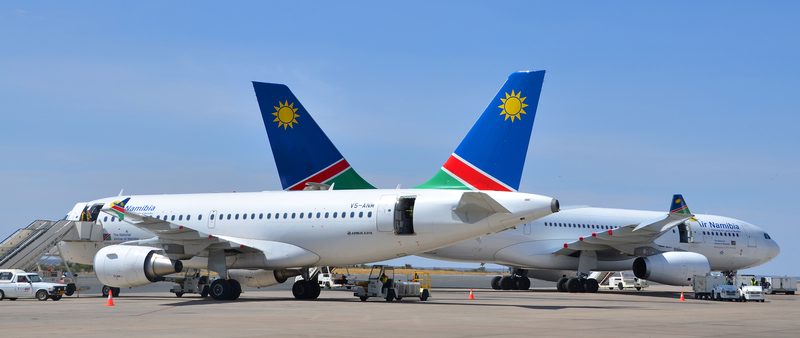
Air Namibia’s network was built around Windhoek Hosea Kutako (WDH) for international and regional flying, with Eros Airport (ERS) historically serving as an important domestic and secondary hub in Windhoek. Like many state carriers operating in small markets, it relied on a mixed fleet to match demand patterns:
-
Airbus A330-200 widebodies on long-haul flying, including services linking Namibia to Europe via hubs like Frankfurt (FRA). The A330-200 is a long-range, twin-aisle platform typically seated in the 200–250 range—well suited to thin long-haul markets where cargo, seasonality, and yields must be balanced carefully.
-
Airbus A319 narrowbodies for regional trunk routes. The A319’s economics can work well on medium-haul sectors where frequency and right-sizing matter more than sheer seat volume.
-
Embraer ERJ-135 regional jets for thinner domestic and short regional sectors. For markets that can’t support A319 capacity year-round, the ERJ-135’s smaller gauge (and fast turn capability) is often the difference between sustaining service and pulling out entirely.
When a carrier with that structure shuts down, the disruption isn’t limited to schedules and aircraft utilization. It directly impacts the talent pool that supports operations—flight deck, cabin crew, engineering, dispatch, commercial, and station functions. That’s why this severance fight has remained so visible in Windhoek (WDH): it’s about the workforce that kept Namibia connected.
What airlines and airports should watch next
For aviation professionals, the next phase is less about emotion and more about process.
If the Supreme Court sets an early hearing date for SA 126/2024, the timeline could finally become predictable—either the appeal succeeds (which would reshape what is owed) or it fails (which would reinforce the High Court framework and accelerate implementation).
If the appeal is dismissed, the mechanism becomes clearer: recalculated amounts would need to flow through the liquidation process, including the administrative steps tied to updating and confirming the liquidation and distribution account.
Either way, the dispute now sits at an inflection point. The combination of a High Court order, an ongoing appeal, and a Labour Court-triggered payout to an individual claimant is an unusual mix—and it’s exactly the kind of procedural complexity that can either break a stalemate or extend it.
Bottom Line
Air Namibia may have ended flight operations years ago, but the airline’s final chapter is still being written in courtrooms—not at Windhoek Hosea Kutako (WDH) gates.
With hundreds of former employees petitioning the Supreme Court to either expedite SA 126/2024 or dismiss the appeal outright, and with at least one recent Labour Court payout adding fresh urgency, the severance dispute is moving into a decisive phase. For the former workforce—and for an aviation community watching what comes next after Air Namibia—the outcome will set the tone not just for back pay, but for how Namibia manages aviation transitions in the future.
Keep reading FlyMag
Get the Daily Brief in the morning or the Route Watch weekly recap on Fridays. Or both.
Share this story
Composed for each network — click to share, or copy the composed text for your own timing.