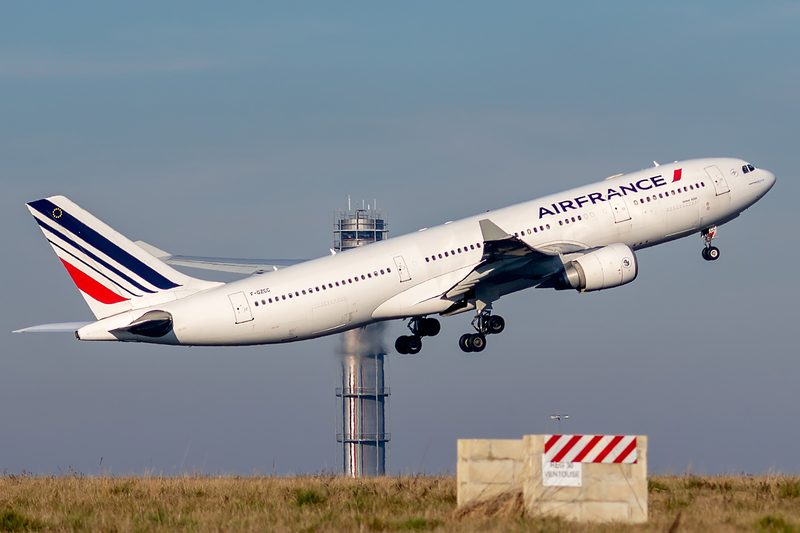
Air France’s farewell to the Airbus A330-200 is no longer just industry chatter. The airline has not issued a grand public retirement bulletin for the type, but its currently filed summer 2027 schedule makes the direction of travel clear: from Paris Charles de Gaulle Airport (CDG), the carrier is preparing to hand the A330-200’s remaining core missions to the Airbus A350-900 and Boeing 787-9. By the time that transition is complete, the A330-200 will have been part of the Air France long-haul story for roughly a quarter century.

That is a meaningful moment for the fleet. At Air France, the Airbus A330-200 has long filled a very specific role: a 224-seat twin-aisle widebody that was large enough for strategic long-haul markets, yet smaller than the airline’s higher-capacity Boeing 777 fleet. On the airline’s own specifications, the type measures 59 meters in length, has a 60.3-meter wingspan, and cruises at Mach 0.82. In other words, it has been the classic middleweight in the Air France long-haul lineup, particularly useful on African and Caribbean sectors from Paris Charles de Gaulle Airport (CDG).
The route map tells the story
The current network filing shows exactly how Air France plans to unwind the type. From Paris Charles de Gaulle Airport (CDG), services to Nnamdi Azikiwe International Airport in Abuja (ABV), Maya-Maya Airport in Brazzaville (BZV) continuing to Pointe-Noire Airport (PNR), Gnassingbé Eyadéma International Airport in Lomé (LFW), and Princess Juliana International Airport in St. Maarten (SXM) are filed to move to the Airbus A350-900.
Read our stories in your inbox
Two aviation newsletters. Zero fluff.
On the Boeing side, Douala International Airport (DLA), Dr. António Agostinho Neto International Airport in Luanda (NBJ), and Malabo International Airport (SSG) are set to shift to the Boeing 787-9. As currently filed, that means three weekly flights to Abuja (ABV), three weekly on the Brazzaville (BZV)–Pointe-Noire (PNR) routing, four weekly to Douala (DLA), four weekly to Lomé (LFW), three weekly to Luanda (NBJ), three weekly to Malabo (SSG), and a seasonally variable four to 10 weekly flights to St. Maarten (SXM).
For network planners, that split is revealing. Air France is not simply swapping out the A330-200 for one universal replacement. It is using two newer-generation widebodies in different ways. The A350-900 is being pointed at markets where more gauge or a stronger premium proposition makes sense, while the 787-9 gives the airline a newer and more efficient platform without always pushing capacity as aggressively as the larger A350.

This is a fleet upgrade, but not a one-size-fits-all one
The replacement aircraft are newer, quieter, and more efficient, but the commercial logic goes beyond age alone. Air France’s Boeing 787-9 is configured with 279 seats, including 30 in Business, 21 in Premium Economy, and 228 in Economy. The airline has also highlighted the Dreamliner’s larger windows, improved cabin humidity and air pressure, onboard Wi-Fi, and roughly 20% lower fuel consumption than previous-generation aircraft.
The Airbus A350-900 gives Air France two different tools. In one layout, the aircraft seats 324 passengers, with 34 in Business, 24 in Premium Economy, and 266 in Economy. In the newer layout, it seats 292 passengers, with 48 in Business, 32 in Premium, and 212 in Economy. Air France says the A350 consumes almost 25% less fuel than previous-generation aircraft and cuts noise by around 40%, while the newer-cabin variant adds the airline’s latest Business seat, Bluetooth connectivity, and updated onboard technology.
The seat math is where the story gets more interesting. Against the A330-200’s 224 seats, the 787-9 gives Air France roughly 25% more total capacity. The 292-seat A350-900 adds about 30%. The 324-seat A350-900 pushes that increase to nearly 45%. But premium-cabin growth is not automatic. The A330-200 carries 36 Business seats. The 787-9 has 30. The 324-seat A350-900 has 34. Only the 292-seat A350-900 lifts Business capacity meaningfully, at 48 seats. That means Air France can grow total capacity and improve fuel economics without necessarily flooding every market with more premium inventory. For a carrier that has to balance corporate demand, cargo mix, and route seasonality out of Paris Charles de Gaulle Airport (CDG), that is a much smarter lever than a blanket upgauge.
What Air France gains operationally
Once the A330-200 leaves the passenger fleet, Air France’s long-haul passenger operation effectively becomes a three-family structure built around the Boeing 777, Boeing 787-9, and Airbus A350-900. That is still a diverse intercontinental fleet, but it removes an aging and relatively small subfleet that carries its own maintenance, training, and spare-parts complexity.
That matters more than it may appear from the outside. Retiring a small legacy widebody group simplifies crew planning, line maintenance, component stocking, and product consistency. It also aligns with Air France’s broader fleet-renewal strategy, which the airline has repeatedly positioned as one of its main levers for lower fuel burn, lower CO2 emissions, and a quieter operation. In practical terms, the A330-200’s exit is not just about replacing old aircraft with new ones. It is about tightening the economics of the long-haul fleet while modernising the onboard product at the same time.
Bottom Line
Air France’s A330-200 retirement now looks less like a rumor and more like timetable reality. The important point is not simply that the aircraft is leaving, but how it is being replaced. From Paris Charles de Gaulle Airport (CDG), the airline is assigning the Airbus A350-900 where it wants more gauge or a stronger premium play, and the Boeing 787-9 where it wants disciplined growth with newer-generation efficiency.
That is a classic fleet-modernisation move. The Airbus A330-200 has been a dependable long-haul middleweight for Air France for nearly 25 years, but the next phase is clearly about simplification, lower operating cost, and a fresher customer proposition. For Air France, the goodbye to the A330 is not sentimental. It is strategic.

Keep reading FlyMag
Get the Daily Brief in the morning or the Route Watch weekly recap on Fridays. Or both.