Qantas Group’s Next Route Wave Puts Western Sydney, Colombo, Christchurch And Las Vegas In Focus
Qantas Group is preparing for a busy second half of 2026, with Jetstar and Qantas adding a mix of domestic, trans-Tasman, South Asian, and U.S. routes that show how the group is using both brands for very different parts of the market.

The headline development is at Western Sydney International Airport (WSI), where Jetstar will operate the airport’s first commercial passenger flight on October 25, 2026. That launch gives the Qantas Group an early foothold at Australia’s newest major airport, a 24-hour facility that could eventually reshape air travel across the Sydney basin.
But Western Sydney is only part of the story. Jetstar is also launching Melbourne (MEL)–Colombo (CMB), Perth (PER)–Christchurch (CHC), and Sydney (SYD)–Christchurch (CHC), while Qantas is preparing its first-ever scheduled nonstop between Sydney (SYD) and Las Vegas (LAS).
Together, the seven routes reflect a clear split in strategy. Jetstar is targeting low-fare growth, leisure demand, and new airport access. Qantas is using its long-haul Boeing 787-9 fleet to open a premium seasonal route that would have been much harder to support with older aircraft.
The Seven Routes
| Airline | Route | Start Date | Frequency | Aircraft |
|---|---|---|---|---|
| Jetstar | Western Sydney (WSI) – Gold Coast (OOL) | October 25, 2026 | 4x weekly | Airbus A320 |
| Jetstar | Western Sydney (WSI) – Melbourne (MEL) | October 25, 2026 | Up to 14x weekly | Airbus A320 |
| Jetstar | Western Sydney (WSI) – Brisbane (BNE) | October 25, 2026 | 3x weekly | Airbus A320 |
| Jetstar | Melbourne (MEL) – Colombo (CMB) | August 25, 2026 | 3x weekly | Boeing 787-8 |
| Jetstar | Perth (PER) – Christchurch (CHC) | October 27, 2026 | 3x weekly, seasonal | Airbus A321LR |
| Jetstar | Sydney (SYD) – Christchurch (CHC) | October 26, 2026 | 4x weekly | Airbus A320 |
| Qantas | Sydney (SYD) – Las Vegas (LAS) | December 29, 2026 | 3x weekly, seasonal | Boeing 787-9 |
Western Sydney Gives Jetstar The First-Mover Advantage
Jetstar will make history when flight JQ362 departs Western Sydney International Airport (WSI) for Gold Coast Airport (OOL) at 11:00 on October 25, 2026.

That flight will be more than a ceremonial first departure. It will mark the beginning of passenger operations at Australia’s first major greenfield airport in more than 50 years, and it gives Jetstar the chance to define early passenger habits at WSI before the airport becomes more crowded.
The initial Jetstar network from Western Sydney (WSI) is simple and logical: Melbourne (MEL), Brisbane (BNE), and Gold Coast (OOL). Those are three of the most important east-coast domestic markets in Australia, and all three are well suited to Jetstar’s low-cost model.
The airline will operate up to 14 weekly flights between WSI and Melbourne (MEL), four weekly flights to Gold Coast (OOL), and three weekly flights to Brisbane (BNE). All three routes will use Airbus A320 aircraft.
The Airbus A320 is the right aircraft for the job. Jetstar’s A320s provide narrowbody capacity for dense domestic routes without the cost or complexity of a larger aircraft. On WSI–MEL, WSI–BNE, and WSI–OOL, the sector lengths are short enough that aircraft turnaround time, utilization, airport costs, and schedule reliability matter more than range.

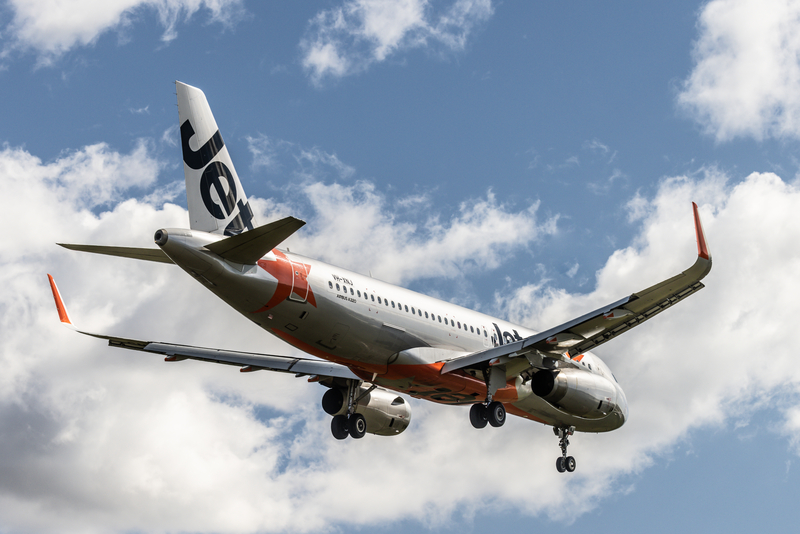
ID 334662484 © Filedimage | Dreamstime.com
Why WSI Matters To The Qantas Group
Western Sydney International (WSI) is not just another airport in the Sydney area.
Sydney Kingsford Smith Airport (SYD) remains Australia’s most important international gateway, but it is slot-constrained, curfew-restricted, and located on the eastern side of the metropolitan area. WSI changes the geography of Sydney aviation by giving western Sydney’s fast-growing population a closer airport with 24-hour operations and room to grow.
That is why Jetstar’s early presence matters. Low-cost carriers benefit from airport access, operational flexibility, and the ability to stimulate demand with fares. WSI gives Jetstar a cleaner growth platform than trying to squeeze all new capacity into SYD.
For Qantas Group, the strategy is also defensive. A new airport creates an opening for rivals, including Virgin Australia, international carriers, and future low-cost entrants. By committing Jetstar early, and QantasLink from 2027, the group is making sure it does not leave the new airport’s first customer base to competitors.

Qantas-branded passenger flying will follow on March 28, 2027, with QantasLink Embraer E190 service from WSI to Melbourne (MEL) and Brisbane (BNE). That gives the group a two-brand structure at the airport: Jetstar for low fares and QantasLink for a more premium regional-style product with business class and included baggage.
Melbourne–Colombo Opens A New Low-Cost Sri Lanka Link
Jetstar’s Melbourne (MEL)–Colombo (CMB) service is one of the most important international additions in the group’s schedule.
Beginning August 25, 2026, Jetstar will fly three times weekly between Melbourne Airport (MEL) and Bandaranaike International Airport (CMB), the main international airport serving Colombo and Sri Lanka. Jetstar says the route will offer more than 100,000 low-fare seats per year.
This is a notable market because Melbourne has a large Sri Lankan community, strong visiting-friends-and-relatives traffic, and growing leisure demand. Until now, SriLankan Airlines has been the dominant nonstop operator in the Melbourne–Colombo market. Jetstar’s entry adds a low-cost alternative and gives price-sensitive travelers a new option on a route where fares have often reflected limited nonstop competition.
The route will be operated by Jetstar’s Boeing 787-8 Dreamliner fleet, not a 787-9. Jetstar operates the smaller 787-8 variant, and the airline has been progressively refurbishing its Dreamliners with upgraded cabins, Wi-Fi, and a new crew rest area that allows flights of up to 16 hours.
That crew-rest modification is operationally important. Melbourne (MEL)–Colombo (CMB) is a long sector for a low-cost airline, and the ability to operate longer missions safely and efficiently gives Jetstar more long-haul flexibility.
The 787-8 Gives Jetstar Long-Haul Reach
Jetstar’s Boeing 787-8 is the backbone of its long-haul international operation.
The aircraft gives Jetstar the range to operate routes from Australia to Asia, Hawaii, and now Sri Lanka, while keeping operating economics more favorable than older widebodies. Jetstar’s fleet page lists the 787-8 with a range of 12,600 kilometers, making Melbourne (MEL)–Colombo (CMB) comfortably within its operating envelope.
The aircraft is also being refreshed. Jetstar has said the upgraded 787 program includes new Economy and Business Class cabins, Wi-Fi, and more Business Class seats on upgraded aircraft. Not every flight will necessarily have the refreshed aircraft during the transition, but the program is strategically important for Jetstar’s long-haul ambitions.
For the Colombo route, the cabin mix matters. VFR traffic can be price-sensitive, but long-haul passengers still care about comfort, baggage, seat selection, and schedule. A low fare may get passengers to book, but the onboard experience will influence whether the route builds long-term loyalty.
Perth–Christchurch Shows What The A321LR Can Do
Jetstar will also launch seasonal Perth (PER)–Christchurch (CHC) flights on October 27, 2026.
The route will operate three times weekly until March 27, 2027, using Airbus A321LR aircraft based in Perth. The schedule has the Perth (PER) departure leaving in the morning and arriving in Christchurch (CHC) in the evening, while the return departs Christchurch at night and arrives back in Perth late the same evening.
That is a substantial narrowbody route. Perth (PER)–Christchurch (CHC) is a long trans-Tasman sector, and it shows why the Airbus A321LR has become so useful for Jetstar.
The A321LR gives the airline more range than a standard A320 and more capacity than smaller narrowbodies, while avoiding the trip cost of a Boeing 787. For a seasonal leisure route between Western Australia and New Zealand’s South Island, that is exactly the kind of aircraft flexibility Jetstar needs.
The route also fits Perth’s growing role in Jetstar’s network. Jetstar has been building more activity from Western Australia, including a local cabin crew base, and PER–CHC gives the airline a direct South Island link that avoids east-coast connections.
For New Zealand tourism, the route is equally useful. It gives Christchurch another direct Australia link and gives South Island tourism operators a better way to reach Western Australian travelers during the southern summer.
Sydney–Christchurch Restores A Low-Fare Trans-Tasman Option
Jetstar is also returning to Sydney (SYD)–Christchurch (CHC) on October 26, 2026.
The route will operate four times weekly, on Mondays, Wednesdays, Thursdays, and Saturdays. The published schedule has JQ141 departing Sydney (SYD) at 12:30 and arriving in Christchurch (CHC) at 17:40, with JQ140 operating Christchurch (CHC)–Sydney (SYD) in the opposite direction.
This is a useful correction to some early summaries: the route is not 14 weekly. It is four weekly at launch.
That frequency still matters. Sydney–Christchurch is a strong trans-Tasman market, but it has been dominated by full-service carriers including Qantas, Air New Zealand, and Emirates. Jetstar’s return gives the route a low-fare competitor for the first time in years and increases price pressure on a market that serves both leisure and VFR demand.
Christchurch (CHC) has broad appeal for Australian travelers. It is the gateway to the South Island, with access to the Canterbury region, Queenstown connections, ski fields, national parks, wineries, road trips, and the wider alpine tourism market. For Christchurch travelers, Sydney remains one of Australia’s most important international and domestic gateways.
The A320 is a sensible aircraft for the route. It offers the right capacity for four-weekly service and keeps trip costs low enough to support Jetstar’s fare strategy.
Qantas Goes Long-Haul With Sydney–Las Vegas
The most eye-catching route in the group’s expansion is Qantas’ new Sydney (SYD)–Las Vegas (LAS) service.
Qantas will launch the first scheduled nonstop flights between Australia and Las Vegas on December 29, 2026. The route will operate seasonally until March 12, 2027, using the airline’s Boeing 787-9 Dreamliner.
The service will operate as QF55 from Sydney (SYD) to Harry Reid International Airport (LAS), with QF56 operating the return. QF55 is scheduled to depart Sydney at 21:00 and arrive in Las Vegas at 15:55 the same day, with a flight time of around 13 hours and 55 minutes. The return departs Las Vegas at 20:20 and arrives in Sydney at 06:35 two days later.
This is a premium seasonal play, not a year-round trunk route. Qantas is timing the service around major Las Vegas demand periods, including New Year, the Consumer Electronics Show, and the Rugby League Las Vegas Festival.
The route also builds on Qantas’ recent experience operating charter flights to Las Vegas for NRL-related travel. Those flights helped prove that there is real Australian demand for direct access to Nevada, especially when major events are involved.
The Qantas 787-9 Makes Las Vegas Possible
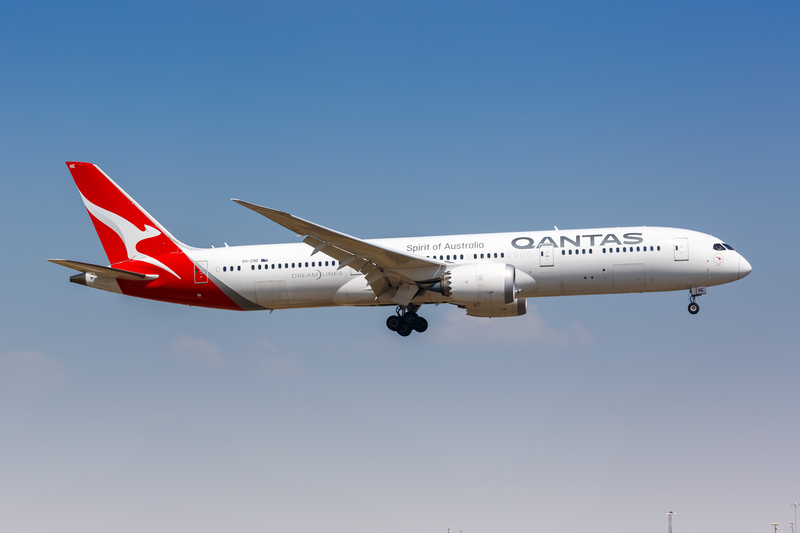
Qantas will use its Boeing 787-9 Dreamliner on Sydney (SYD)–Las Vegas (LAS).
The aircraft is configured with 236 seats: 42 Business, 28 Premium Economy, and 166 Economy. That is a relatively premium-heavy and low-density layout compared with many international 787 operators, and it is well suited to a long, high-profile leisure route where passengers may be willing to pay for comfort.
The 787-9 is central to Qantas’ long-haul network strategy. It has the range and fuel efficiency to operate routes that would be difficult or inefficient with older aircraft, and it allows Qantas to test seasonal long-haul markets without committing the capacity of an Airbus A380 or larger widebody.
Las Vegas is a good example. The route is long, but the market is event-driven and seasonal. A 236-seat 787-9 gives Qantas enough premium capacity to capture high-value demand while keeping overall seat count manageable.
The aircraft also offers the passenger benefits that matter on a nearly 14-hour flight: lower cabin altitude, larger windows, long-haul seating, inflight entertainment, Premium Economy, and lie-flat Business Class.
Why Las Vegas Works Now
Las Vegas is not a traditional Qantas gateway, but the route has a strong logic.
Australia is one of Las Vegas’ largest overseas visitor markets, and Qantas says the city was the top international Las Vegas market without a nonstop flight. Until now, Australian travelers have generally had to connect through Los Angeles (LAX), San Francisco (SFO), Dallas/Fort Worth (DFW), or another U.S. gateway.
The nonstop removes that connection and can save several hours of total journey time. That is particularly valuable for event travel, where passengers are often traveling on fixed dates and value schedule simplicity.
The route also works in the opposite direction. Las Vegas (LAS) gives U.S. travelers another direct path to Sydney during Australia’s summer season, and it gives Australians a new entry point to the U.S. Southwest, including the Grand Canyon, Utah national parks, Arizona, California, and Nevada.
For Qantas, Las Vegas becomes its 101st international destination and its eighth city across North and South America, joining Los Angeles (LAX), San Francisco (SFO), Honolulu (HNL), Dallas/Fort Worth (DFW), New York (JFK), Vancouver (YVR), and Santiago (SCL).
A Two-Brand Strategy In Action
The seven-route expansion shows the Qantas Group’s two-brand strategy clearly.
Jetstar is taking the volume and low-fare opportunities: Western Sydney domestic flying, low-cost Melbourne–Colombo, Perth–Christchurch, and Sydney–Christchurch. These routes are about price stimulation, new markets, and leisure demand.
Qantas is taking the premium long-haul opportunity: Sydney–Las Vegas with the 787-9. That route is about brand strength, event traffic, long-haul comfort, and higher-yield seasonal demand.
The group benefits because it can use different aircraft and brands for different jobs. Jetstar’s A320s are ideal for short domestic services from WSI. Its A321LRs open long narrowbody routes such as PER–CHC. Its 787-8s support low-cost long-haul flying such as MEL–CMB. Qantas’ 787-9s handle premium long-haul routes where a full-service product is part of the value proposition.
That fleet and brand flexibility is one reason the Qantas Group remains so powerful in the Australian market.
Western Sydney Could Be The Long-Term Game Changer
Of all the developments, Western Sydney (WSI) may have the largest long-term impact.
The initial Jetstar schedule is modest, but the airport’s 24-hour operation and available capacity make it strategically important. Sydney Kingsford Smith (SYD) is not going away, and it will remain the city’s main international airport for the foreseeable future. But WSI gives airlines a new growth option in a region with millions of residents who currently have to cross Sydney to reach the existing airport.
That could change travel behavior over time. If Jetstar can establish WSI as a reliable, low-fare alternative for western Sydney travelers, the airport could become a major domestic platform. If QantasLink succeeds from 2027, the group can add a premium layer. Freight operations also matter, with Qantas planning WSI cargo activity from the airport’s 24-hour cargo precinct.
The first routes are conservative, but that is sensible. Melbourne, Brisbane, and the Gold Coast are exactly the markets an airline would choose when testing a new airport’s passenger base.
Bottom Line
Qantas Group’s upcoming route launches are more than a list of new flights. They show how the group is using Jetstar and Qantas to pursue very different growth opportunities.
Jetstar will open Western Sydney International (WSI) with Airbus A320 flights to Gold Coast (OOL), Melbourne (MEL), and Brisbane (BNE), giving Australia’s newest major airport immediate low-cost domestic connectivity. It will also expand internationally with Melbourne (MEL)–Colombo (CMB) on the Boeing 787-8, Perth (PER)–Christchurch (CHC) on the Airbus A321LR, and Sydney (SYD)–Christchurch (CHC) on the A320.
Qantas’ contribution is the most ambitious long-haul route: Sydney (SYD)–Las Vegas (LAS), launching December 29, 2026, with the Boeing 787-9 Dreamliner.
There are some important corrections to the earlier route summary. Jetstar’s Colombo aircraft is the Boeing 787-8, not the 787-9. Sydney–Christchurch returns four times weekly, not twice daily. Western Sydney–Brisbane is BNE, not MEL. Qantas-branded passenger flights from WSI begin in March 2027, not during the 2026 launch window.
The broader direction is clear. Jetstar is pushing into new low-fare markets and taking the lead at Western Sydney. Qantas is using its 787-9 fleet to open a high-profile U.S. leisure route. Together, the moves show a group preparing for a more competitive, more geographically diverse Australian aviation market.