Niamey Airport Attack Leaves 35 Dead As Niger Faces Renewed Aviation Security Threat
A deadly attack on Diori Hamani International Airport (NIM) in Niamey has again exposed the security risks facing one of the most important aviation sites in Niger.
The assault took place on June 18, 2026, at the airport and adjoining military airbase. Niger’s Defence Ministry said 11 soldiers and two civilians were killed. Security forces also killed 22 attackers, bringing the total death toll to 35.
The attack targeted a highly sensitive site. Niamey’s main airport is both a civilian gateway and a military installation. It serves commercial passengers, government movements and military operations from the same strategic airport complex.
Read our stories in your inbox
Two aviation newsletters. Zero fluff.
For aviation professionals, the incident is more than another security headline from the Sahel. It is a reminder that civil airports with military infrastructure can become high-value targets, especially when they support national or regional security operations.
Attack Hits Niger’s Main Airport
The assault began early Thursday morning near the airport complex in Niamey.

Residents reported explosions and heavy gunfire around Diori Hamani International Airport (NIM). Security forces later regained control of the area, while soldiers searched roads leading to the airport.
Niger’s Defence Ministry said the attack was repelled. It also said about 20 suspects were arrested and that weapons and ammunition were seized.
The Associated Press reported that Niger’s civil aviation authority said the airport had resumed normal operations within hours. That detail matters for airlines, handlers and passengers using the airport.
Even so, the attack will likely raise fresh questions about perimeter security, airside access and the protection of critical airport infrastructure.
JNIM Claims Responsibility
The original picture changed after the first reports emerged.
Early coverage said no group had claimed responsibility. Later, Reuters reported that Jama’at Nusrat al-Islam wal-Muslimin, better known as JNIM, claimed the attack.
JNIM is al-Qaeda’s West Africa affiliate. It has become one of the most active militant organizations in the Sahel.
The group’s claim is significant because the same airport was attacked earlier this year by a different extremist network. In January, an Islamic State-linked group claimed an assault on the Niamey airport and military airbase complex.
That means Niger’s main airport has now been targeted twice in less than five months by armed groups linked to rival extremist networks.
Why Diori Hamani Airport Matters
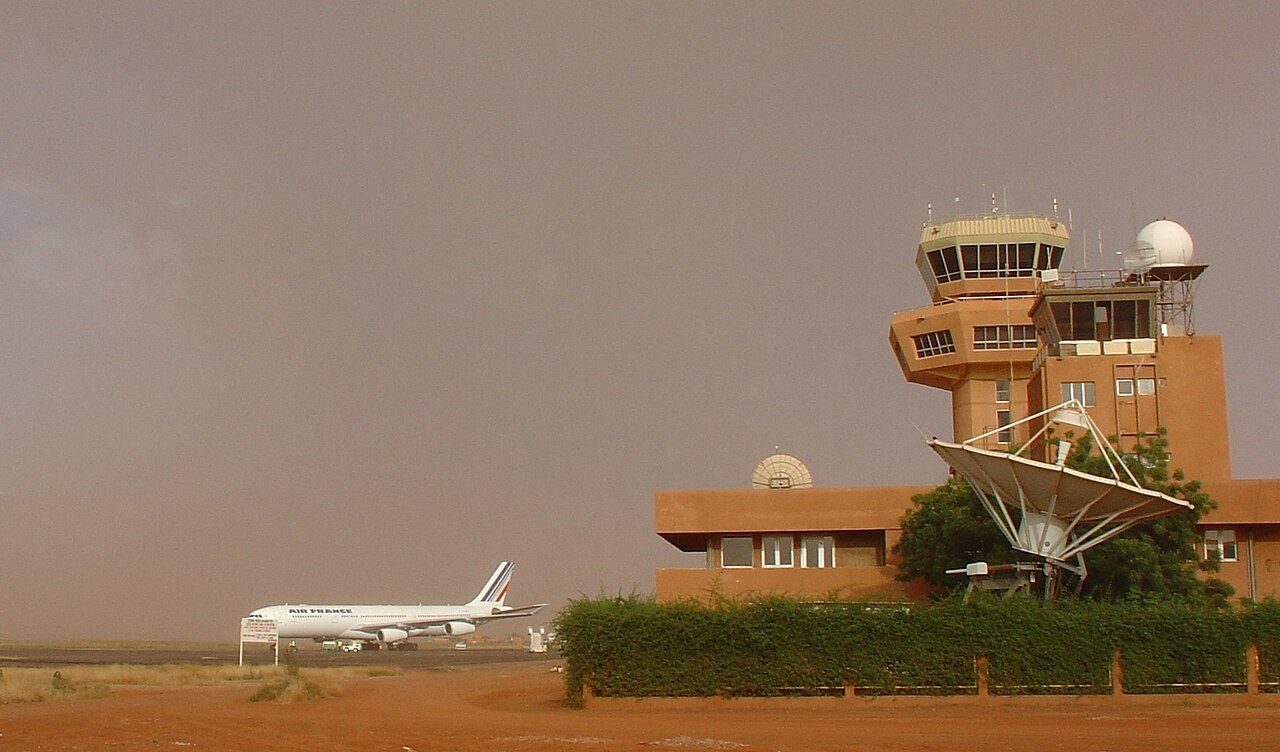
Diori Hamani International Airport (NIM) is Niger’s largest and most important airport.
It serves Niamey, the country’s capital, and acts as the main international gateway for commercial aviation. The airport’s ICAO code is DRRN.
The facility is also linked to military operations. The airport complex includes a Nigerien air force base and other strategic security assets.
That dual-use role is central to understanding the attack.
A purely civilian airport is already a sensitive target. A civilian airport that also supports military activity becomes even more important. It can hold aircraft, command assets, surveillance equipment, fuel, maintenance areas and logistics infrastructure.
That makes Diori Hamani International Airport (NIM) critical to both Niger’s air transport system and its security posture.
The Airport’s Military Role Increases Its Risk
The airport is not just an aviation gateway. It is also part of Niger’s broader security system.
The AP reported that the site hosts a Nigerien air force base and the headquarters of the joint military force involving Niger, Burkina Faso and Mali. Those three countries are part of the Alliance of Sahel States, a junta-led bloc formed as the region shifted away from some earlier Western security partnerships.
That makes the airport symbolically and operationally important.
From a militant group’s perspective, an airport like NIM offers several possible targets in one location. It includes civilian aviation, military infrastructure, government visibility and regional security cooperation.
That does not mean the attackers were focused on airline operations. However, any attack on the airport complex creates risk for civil aviation.
A Second Major Attack In Five Months
The June 18 attack follows another major assault on the same airport complex in January 2026.
That earlier attack was claimed by the Islamic State group. Reuters reported at the time that militants moved around parts of the airport area and damaged aircraft and military assets.
During the January incident, parked aircraft were reportedly hit, including aircraft operated by ASKY Airlines and Air Côte d’Ivoire. Reuters reported that no passengers or crew were injured because the attack happened outside normal operating hours.
The January attack was already a serious warning. The June attack now shows that the threat has not gone away.
Instead, the airport remains a target.
For airport security planners, two attacks in one year suggest a persistent vulnerability. They also suggest that militants continue to view the airport as a valuable target despite added security measures.
Security Measures Had Already Been Increased
Nigerien authorities had already taken steps to improve security around the airport after the January attack.
According to Al Jazeera, authorities expanded the airport perimeter fence and installed more than 350 security cameras inside and outside the perimeter.
Officials also cleared nearby informal neighborhoods. They said the move was designed to reduce the risk of armed groups using nearby areas to approach or monitor the airport.
Those measures show the government understood the threat. However, the June 18 attack shows how difficult airport security can be in a conflict environment.
Perimeter cameras, fencing and patrols can reduce risk. They cannot eliminate it when armed groups are active nearby and willing to attack fortified sites.
Commercial Aviation Depends On Confidence
For airlines, the immediate question is always operational safety.
Diori Hamani International Airport (NIM) remained open after security forces regained control, according to Niger’s civil aviation authority. However, that does not automatically remove airline concerns.
Carriers must assess crew safety, aircraft exposure, insurance conditions, ground handling reliability and the possibility of further attacks.
That calculation can change quickly.
If an airport is attacked repeatedly, airlines may become more cautious. Some may adjust schedules. Others may review overnight parking, ground time or crew layover procedures.
This is especially relevant at airports where military and civilian infrastructure share the same site. A strike aimed at a military target can still affect passenger aircraft, airport workers and scheduled services.
The Sahel Security Crisis Reaches Aviation Infrastructure
Niger sits at the center of the wider Sahel security crisis.
The country has faced persistent attacks from groups linked to al-Qaeda and the Islamic State. Neighboring Mali and Burkina Faso face similar threats.
That violence has also shaped aviation.
Airports, airbases and drone facilities have become more important as governments try to monitor large areas with limited road access. At the same time, those same facilities become attractive targets.
The Sahel’s geography makes air transport especially important. Long distances, poor road infrastructure and insecurity outside major cities make airports crucial for aid, government activity, military logistics and regional travel.
That is why an attack on Niamey’s airport matters beyond Niger.
It highlights the vulnerability of critical transport infrastructure across a region where governments are struggling to contain armed groups.
Why Airlines Will Watch The Response Closely
Airlines serving or overflying the region will watch what happens next.
They will want to know whether the June attack was isolated or part of a wider campaign. They will also want clarity on airport access, security screening, airside controls and military activity near civilian aprons.
International carriers tend to be cautious in these situations.
Even when an airport remains technically open, airlines can change operations if crews, aircraft or passengers may be exposed. They can also face higher insurance costs or internal risk restrictions.
That is why the government response matters.
A strong investigation and visible security improvements can help restore confidence. A pattern of repeat attacks can do the opposite.
A Strategic Site With No Easy Security Answer
Diori Hamani International Airport (NIM) is difficult to secure because of what it represents.
It is a national gateway. It is a military site. It is connected to regional security forces. It also sits in a country facing pressure from multiple extremist groups.
That combination creates a difficult security problem.
The airport cannot simply close itself off from the outside world. It must continue handling passengers, cargo, workers, suppliers, aircraft and official movements.
At the same time, it must defend against armed threats that may target either the civilian or military side of the complex.
This is one of the hardest problems in aviation security: protecting a mixed-use airport in an active conflict environment.
Bottom Line
The June 18 attack on Diori Hamani International Airport (NIM) left 35 people dead, including 11 soldiers, two civilians and 22 attackers.
It was the second major assault on Niamey’s main airport complex in less than five months. It also came despite added security measures around one of Niger’s most strategically important aviation sites.
For Niger, the attack is another sign that militant groups remain capable of striking high-value infrastructure near the capital.
For the aviation sector, the lesson is clear. Airports that combine civil aviation, military activity and regional security operations face a different level of risk.
Diori Hamani International Airport (NIM) may have reopened quickly, but the broader security question remains unresolved. Niger’s main airport is not only a transport hub. It is now a repeated target in the Sahel’s wider conflict.
Keep reading FlyMag
Get the Daily Brief in the morning or the Route Watch weekly recap on Fridays. Or both.