European Cargo Enters Administration As A340-600 Freighter Operation Stops Flying
European Cargo has entered administration, bringing a sudden halt to one of the most distinctive widebody cargo operations in the UK.
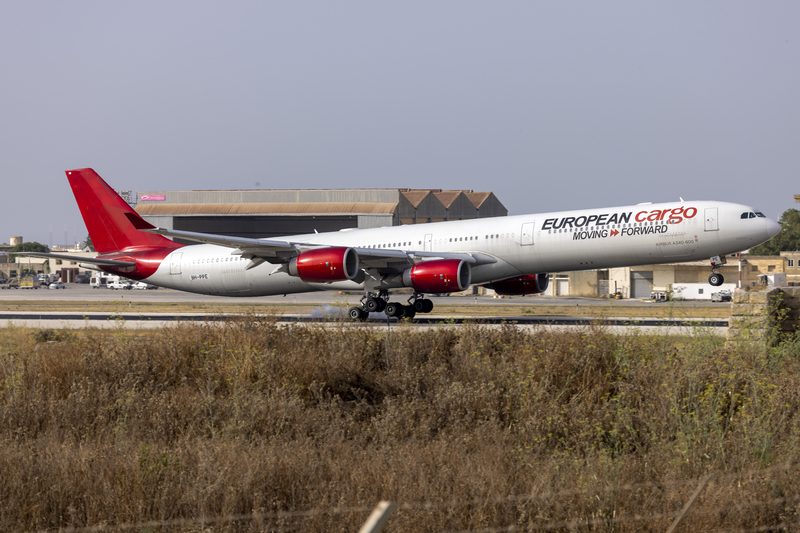
The Bournemouth-based carrier built its business around converted Airbus A340-600 freighters, using former passenger quadjets for long-haul cargo missions from regional UK airports. The airline had become especially associated with China-linked e-commerce and express freight flows, operating large-capacity A340-600 aircraft from Bournemouth Airport (BOH) and, more recently, Teesside International Airport (MME).
That operation is now suspended.
Read our stories in your inbox
Two aviation newsletters. Zero fluff.
Stuart Morris, Robert Fishman, and David Soden of Teneo Financial Advisory Limited were appointed Joint Administrators of European Cargo Limited on June 3, 2026. The company’s affairs, business, and property are now being managed by the administrators.
The administration filing follows an apparent operational shutdown in May, with flight-tracking and industry reporting showing no revenue flying after May 19.
Operations Stopped Before The Formal Filing
European Cargo’s formal administration date was June 3, but the airline had effectively stopped flying before then.
The final reported revenue flight was operated by Airbus A340-600 freighter G-ECLC on May 19, routing from Karaganda (KGF) in Kazakhstan to Maastricht (MST) in the Netherlands, followed by a ferry sector to Bournemouth (BOH). After that, the carrier’s A340 freighter operation appears to have gone quiet.
By the time the administration notice appeared, the fleet was already parked.
Current industry reporting says European Cargo had six active converted Airbus A340-600 freighters, all of which were parked in May. Five were at Bournemouth (BOH), the airline’s main base, while G-ECLN was at Teesside (MME). Additional A340-600 airframes have been associated with the European Cargo/European Aviation group over time, but the active converted freighter count reported at the time of administration was six.
That distinction matters because European Cargo’s own promotional material had previously referred to a larger A340-600 fleet plan. In practical operating terms, the aircraft that mattered in June were the A340 freighters already parked and no longer generating revenue.
A Rare A340-600 Freighter Model
European Cargo stood out because of the aircraft it operated.
The Airbus A340-600 is one of the longest passenger aircraft ever built. It was designed for ultra-long-haul passenger flying and became best known with airlines such as Virgin Atlantic, Lufthansa, Iberia, South African Airways, and Etihad. By the mid-2020s, however, the type had largely disappeared from front-line passenger service as airlines moved toward more efficient twin-engine widebodies such as the Boeing 787, Airbus A350, and Boeing 777-300ER.
European Cargo gave the A340-600 a second life.
The company adapted former passenger A340-600s for cargo missions, initially using them as temporary “preighters” during the pandemic cargo boom. Those flights carried personal protective equipment, test kits, and other urgent goods at a time when global belly cargo capacity had collapsed due to passenger-flight reductions.
European Cargo later moved toward a more permanent freighter configuration. Its own history says the first certified converted freighter was approved in December 2022, with scheduled operations beginning in April 2023 between Bournemouth (BOH) and Chengdu (CTU). Haikou (HAK) flights followed in 2024 as the operation expanded.
The model was unusual, but it had a clear logic: use large, available, long-range passenger aircraft to create dedicated cargo capacity from UK regional airports.
The A340-600 Offered Capacity, But At A Cost
On paper, the Airbus A340-600 gave European Cargo a powerful niche.
The aircraft offered up to 76 tonnes of gross payload and around 440 cubic meters of cargo capacity in the modified configuration marketed by the airline. Its 7,900-nautical-mile range gave the carrier flexibility on long-haul sectors, and its four-engine design meant it was not constrained by ETOPS routing considerations in the same way as twin-engine aircraft.
That helped make the A340-600 attractive for certain long-range freight missions, especially where volume and range mattered more than fuel efficiency.
But the same aircraft also carried obvious disadvantages.
The A340-600 is a four-engine widebody in a market increasingly dominated by efficient twin-engine freighters and belly cargo. It burns more fuel than newer twin-engine widebodies. It requires support for older Rolls-Royce Trent 500 engines. It has a smaller global operator base than mainstream freighter types. It also lacks the factory-freighter ecosystem of aircraft such as the Boeing 777F, 767F, 747-400F, or 747-8F.
That made European Cargo’s model highly specialized. When demand was strong and rates were high, the aircraft could be useful. When cargo yields softened, fuel costs rose, or competing capacity returned, the economics became much harder.
A Pandemic-Era Opportunity Became A Tougher Market
European Cargo’s rise was closely tied to the pandemic cargo environment.
During the early 2020s, air freight demand surged while passenger belly capacity collapsed. Airlines and specialist operators around the world rushed to convert passenger aircraft into temporary cargo carriers. Seats were removed, cabins were used for boxes, and older widebodies that might otherwise have been retired found new commercial life.
That environment did not last forever.
As passenger networks recovered, belly cargo capacity returned. Dedicated freighter operators faced more competition. E-commerce flows remained important, but rates normalized. Fuel prices and maintenance costs became more important again. The market became less forgiving for older, less efficient aircraft.
European Cargo was trying to turn a pandemic-era opportunity into a sustainable long-haul freighter business. Its A340-600 model gave it a distinctive product, but it also exposed the carrier to high operating costs in a market that no longer offered the same easy margins as the pandemic peak.
That is the larger industry context behind the administration.
Bournemouth Was The Core Base
Bournemouth Airport (BOH) was central to European Cargo’s identity.
The airline’s fleet was based at BOH, where the company developed its cargo operation around the airport’s available space, lower congestion, and long runway. Bournemouth offered European Cargo a regional UK platform outside the slot-constrained London system, giving the carrier room to park, maintain, and operate large widebody aircraft.
The airport also had a historical connection to the aircraft. European Cargo was linked with European Aviation, a Bournemouth-based group with long experience acquiring, storing, and repurposing widebody aircraft.
For Bournemouth, European Cargo represented a high-profile specialist operation: long-haul freighter flights, widebody movements, and a cargo identity that differentiated the airport from many other UK regional fields.
The administration leaves a visible gap at BOH. Parked A340-600s are large assets, and their future now depends on the administrators, aircraft owners, creditors, potential buyers, and whether any part of the operation can be sold or restarted.
Teesside Expansion Makes The Timing Sharper
The timing is especially striking because European Cargo had only recently expanded its UK footprint.
In March 2026, Teesside International Airport (MME) announced a major freight agreement with European Cargo. The plan called for five weekly long-haul cargo flights linked to China, providing up to 375 tonnes of weekly freight capacity and creating a new operational base at Teesside Airport Business Park.
Teesside promoted the deal as a major logistics win for the North of England, citing direct links to China, regional export opportunities, and the potential creation of 50 jobs. The service was expected to use European Cargo’s Airbus A340-600 freighters, each capable of transporting up to 76 tonnes of cargo.
Less than three months later, European Cargo was in administration and its A340 freighters were parked.
For Teesside, that is a significant setback. The airport had been positioning cargo as part of a broader strategy to diversify beyond passenger leisure flights and build a more financially sustainable business. A dedicated China-linked cargo program with European Cargo was meant to be a flagship development.
The collapse of the carrier leaves Teesside with a difficult question: whether another operator can replace that capacity, or whether the route was too dependent on European Cargo’s niche A340 model.
China-Linked E-Commerce Was The Main Prize
European Cargo’s business case was closely tied to China–UK freight flows.
The airline served or targeted routes linked to Chinese manufacturing, e-commerce, and express cargo. These flows have been a major part of the global air cargo market, driven by online retail platforms, fast-moving consumer goods, electronics, and direct-to-consumer shipments.
For UK regional airports, this traffic is attractive because it can bypass the congestion and cost of larger hubs. Airports such as Bournemouth (BOH) and Teesside (MME) can offer space, flexibility, and faster turnaround potential if the freight flows are consistent enough.
European Cargo’s A340-600s were well suited to high-volume cargo missions where main deck volume mattered. The aircraft’s size gave it a useful place in the e-commerce supply chain.
But e-commerce cargo can be volatile. Rates depend on consumer demand, platform strategies, customs flows, available capacity, fuel prices, and competition from both air and sea. A carrier relying on older four-engine aircraft has less room for error when yields soften.
Why Older Freighter Models Are Hard To Sustain
European Cargo’s collapse highlights a wider issue: older aircraft can fill gaps, but they are difficult to base an airline around unless the economics are exceptionally strong.
An older quadjet may be cheap to acquire compared with a new freighter, but acquisition cost is only part of the equation. Fuel burn, maintenance, spares, engine overhaul, reliability, insurance, crew training, and dispatch performance all matter.
The A340-600 is especially challenging because it is a large, four-engine aircraft with a shrinking global operator base. Operators must maintain expertise and parts access for a type that most passenger airlines have already retired. That can be done, but it requires scale, cash, and reliable revenue.
Newer freighters and passenger belly capacity also create pressure. A Boeing 777F, 747-8F, 767F, A330 converted freighter, or belly cargo on a passenger 787/A350 may offer better economics depending on the mission. Even if the A340-600 offers useful volume, customers ultimately care about price, reliability, schedule, and network.
That is why a specialist operator like European Cargo could be exciting and fragile at the same time.
Administration Does Not Always Mean Liquidation
European Cargo entering administration does not automatically mean the business will disappear forever.
Administration is a UK insolvency process designed to protect the company while administrators assess options. Those options can include restructuring, selling assets, selling parts of the business, seeking new investment, or winding down operations if no viable rescue is possible.
In aviation, the practical challenge is time.
Aircraft are expensive to keep parked. Crews, engineers, certificates, insurance, leases, airport fees, maintenance obligations, and customer relationships can all erode quickly if flights do not resume. Cargo customers also move fast. If a carrier stops flying, freight forwarders and shippers find other capacity.
That means any rescue would need to happen with urgency.
The parked A340-600s may have value as aircraft, parts sources, or cargo assets, but their future will depend on ownership structures, maintenance condition, creditor claims, and whether anyone believes the business can be restarted profitably.
What Happens To The Aircraft?
The parked A340-600 fleet is now the most visible question.
Five aircraft are reported parked at Bournemouth (BOH), with one at Teesside (MME). Aircraft connected to European Cargo include registrations such as G-ECLB, G-ECLC, G-ECLD, G-ECLE, G-ECLJ, G-ECLM, and G-ECLN, although not every associated airframe should be treated as an active converted freighter at the time of administration.
The aircraft could follow several paths. They could be sold or leased to another cargo operator. They could be returned to owners or lessors. They could be parted out. They could remain parked while administrators search for a buyer. A subset of the fleet could potentially be used if a restructured operation emerges.
The challenge is finding an operator willing to take on A340-600 freighters in 2026.
There are very few airlines globally with an obvious need for this exact aircraft type. The A340-600 offers range and volume, but it is not a mainstream freighter platform. Any buyer would need to believe that the aircraft’s low acquisition cost and capacity advantages outweigh fuel and maintenance disadvantages.
That is a narrow market.
A Blow To Regional UK Cargo Ambitions
European Cargo’s administration matters beyond the airline itself.
It is a setback for the idea that UK regional airports can quickly build long-haul cargo networks around specialist operators. Bournemouth and Teesside both offered clear advantages: space, lower congestion, regional market access, and political support. European Cargo provided the aircraft and the China-linked customer proposition.
The problem is that cargo route development depends on the operator’s financial strength.
An airport can attract a carrier, promote new freight capacity, and build local support, but if the airline’s aircraft economics do not work, the service will not last. That is especially true in long-haul freight, where fuel, maintenance, and aircraft availability can overwhelm regional-airport cost advantages.
For Teesside, the collapse is particularly painful because the base was announced only months earlier. For Bournemouth, it threatens the airport’s most distinctive cargo tenant.
The Wider Cargo Market Has Changed
The broader cargo market is no longer the boom environment that created opportunities for operators like European Cargo.
During the pandemic, the world needed urgent air freight capacity, and unusual aircraft solutions made sense. Passenger aircraft carried cargo in cabins. Older widebodies returned to service. Cargo rates rose sharply.
By 2026, the environment is different. Passenger belly capacity has largely recovered on many long-haul routes. E-commerce demand remains strong but more competitive. Fuel prices are volatile. Shippers have more options. Dedicated freighter operators face pressure to offer reliable schedules and competitive pricing.
In that market, a four-engine A340-600 freighter operator has a harder task.
European Cargo’s administration is therefore part of a broader post-pandemic correction. The cargo market still needs capacity, but it is less forgiving of expensive or highly specialized aircraft models.
Bottom Line
European Cargo has entered administration, with Teneo-appointed administrators taking control of the company on June 3, 2026.
The Bournemouth-based carrier had already stopped flying before the formal filing, with its last reported revenue flight operated by Airbus A340-600 freighter G-ECLC on May 19. Industry reporting says all six active converted A340 freighters were parked by May, with five aircraft at Bournemouth (BOH) and one at Teesside (MME).
The collapse brings an abrupt pause to one of the world’s most unusual cargo airline models. European Cargo built its business around former passenger Airbus A340-600s converted or adapted for freight, offering up to 76 tonnes of payload and 440 cubic meters of capacity on long-haul cargo missions.
The timing is especially sharp because European Cargo had only recently announced a Teesside base with five weekly China-linked flights and up to 375 tonnes of weekly freight capacity.
For Bournemouth and Teesside, the immediate issue is what happens to the parked aircraft and whether any part of the operation can be rescued. For the wider cargo market, the lesson is clear: the post-pandemic freighter boom has faded, and older four-engine aircraft face a much tougher economic environment.
European Cargo found a distinctive niche. The problem was making that niche survive once the cargo market returned to harsher commercial reality.
Keep reading FlyMag
Get the Daily Brief in the morning or the Route Watch weekly recap on Fridays. Or both.