United Airlines has resumed its seasonal nonstop service between Newark Liberty International Airport (EWR) and Nuuk International Airport (GOH), restoring the only direct air link between the United States and Greenland for a second consecutive summer.

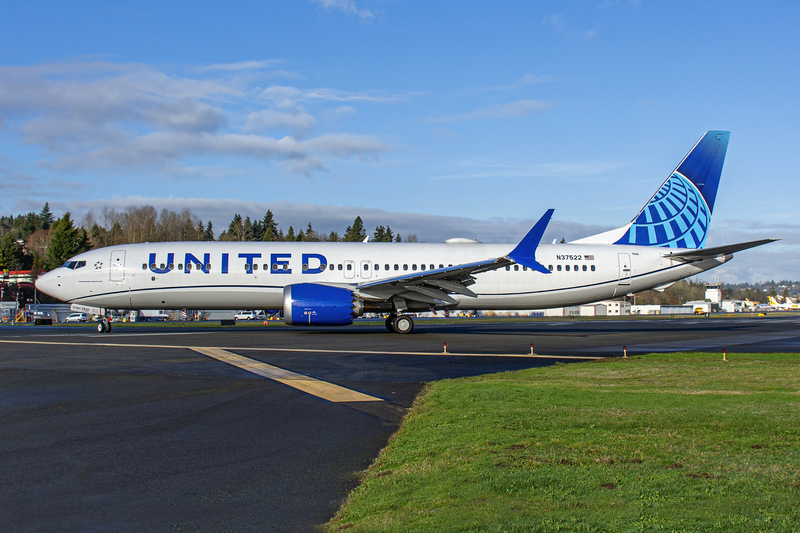
The route returns after its highly unusual 2025 debut, when United became the first U.S. airline to operate scheduled service to Greenland and the first carrier to link the United States directly with Nuuk (GOH). For 2026, the service is again being operated with the Boeing 737 MAX 8, giving United a right-sized aircraft for one of the most distinctive narrowbody routes in its transatlantic network.
The first 2026 season flight departed Newark (EWR) on June 6, with the Nuuk-originating schedule beginning the following day. United will operate the route twice weekly through September 23, with departures from Newark (EWR) on Tuesdays and Saturdays and return flights from Nuuk (GOH) on Wednesdays and Sundays.
Read our stories in your inbox
Two aviation newsletters. Zero fluff.
For Greenland, the route is more than a seasonal tourism link. It gives Nuuk (GOH) direct access to United’s Newark (EWR) hub, where passengers can connect to more than 80 destinations across North and South America. For United, it is another example of the airline’s willingness to build a summer network around destinations that most U.S. carriers would not attempt.
A Small Route With Outsized Strategic Value
On paper, Newark (EWR)–Nuuk (GOH) is a niche summer route. It operates only twice weekly, uses a single-aisle aircraft, and serves a destination that remains far outside the mainstream U.S. leisure map.
United Extends Palermo Into Winter, Showing Sicily May Be More Than Just A Summer Bet
In network terms, however, the route carries more significance than its frequency suggests.
Nuuk (GOH) is Greenland’s capital and largest city, but until recently it could not handle larger international jet aircraft in the way it can today. The opening of Nuuk’s expanded international airport in late 2024 changed that. The airport’s runway was extended from 950 meters to 2,200 meters, allowing aircraft such as the Boeing 737 MAX 8 and Air Greenland’s Airbus A330-800neo to operate directly into the capital.
That infrastructure shift is what made United’s route possible. Before the airport expansion, long-haul and larger jet access to Greenland was centered around Kangerlussuaq Airport (SFJ), which historically functioned as the island’s main international gateway. Moving more international traffic to Nuuk (GOH) brings Greenland’s air network closer to where many government, business, and tourism activities are actually based.
United’s EWR–GOH route is therefore not just a curiosity. It is part of a broader reorientation of Greenland’s aviation system around Nuuk.

The Boeing 737 MAX 8 Makes The Route Work
United is operating the route with the Boeing 737 MAX 8, configured for this service with 16 premium economy seats and 150 economy seats.
That aircraft choice is central to the route’s viability. Newark (EWR)–Nuuk (GOH) is not a market that needs a widebody, nor would a larger aircraft be easy to fill at a profitable fare level twice weekly. The 737 MAX 8 gives United enough range, a modern cabin, and a manageable seat count for a route that blends leisure, adventure travel, visiting-friends-and-relatives demand, and a small amount of business and government-related traffic.
The MAX 8 also fits United’s broader strategy of using narrowbody aircraft on longer, thinner transatlantic and near-transatlantic routes. The aircraft has allowed United to reach destinations where a Boeing 767, 787, or 777 would be too much airplane. In the case of Nuuk (GOH), the route is roughly four and a half hours from Newark (EWR), making it long for a North Atlantic narrowbody sector but well within the capability of the 737 MAX 8.
The onboard product is also worth noting. United is not selling a Polaris-style long-haul business cabin on this route. Instead, the forward cabin is marketed as premium economy, reflecting the recliner-style seating used on the MAX 8 rather than lie-flat seats. That is appropriate for the flight length and market profile, but it is an important expectation-setting detail for passengers accustomed to United’s widebody transatlantic product.
Newark Gives Greenland Access To The Americas
The strength of the route is not only the nonstop flight between New York/Newark and Nuuk. It is the connectivity behind it.
Newark Liberty International Airport (EWR) is one of United’s most important hubs, with extensive domestic, transborder, Latin American, Caribbean, and long-haul international service. Through EWR, Greenland-originating passengers can connect across the United States and into parts of Canada, Mexico, the Caribbean, Central America, and South America.
That matters because Greenland’s population base is small. The route cannot rely only on Nuuk-area demand to fill the aircraft. It needs connecting traffic in both directions.
For U.S. travelers, EWR makes Nuuk (GOH) reachable with a single connection from a large number of cities. A passenger from Chicago (ORD), Washington Dulles (IAD), Houston (IAH), Denver (DEN), Los Angeles (LAX), Boston (BOS), Cleveland (CLE), Raleigh-Durham (RDU), or many other United markets can connect over Newark (EWR) and reach Greenland without routing through Iceland, Denmark, or another European gateway.
For Greenland travelers, the same hub works in reverse. Instead of flying through Copenhagen (CPH), Keflavik (KEF), or other European points to reach North America, passengers can fly directly from Nuuk (GOH) to Newark (EWR) and connect onward across the Americas.
That is the core value proposition. The route is not designed to be high frequency. It is designed to make Greenland much easier to reach from North America during the peak summer travel period.
Demand Was Strong Enough To Bring The Route Back
United’s first season to Nuuk (GOH) was small but meaningful.
According to figures attributed to the airline, more than 6,200 passengers used the EWR–GOH service in its inaugural 2025 season, with more than 140 unique origin-and-destination itineraries flowing over the route. For a twice-weekly seasonal service to one of the world’s most remote capital cities, that is a useful signal.
The route was never going to be judged like Newark (EWR) to London Heathrow (LHR), Paris Charles de Gaulle (CDG), or Rome Fiumicino (FCO). The strategic value is different. Nuuk (GOH) helps United reinforce its reputation for creative, off-the-beaten-path international flying, while giving Greenland a direct U.S. link that no other carrier currently offers.
It also fits into United’s broader summer network approach. The airline has been increasingly willing to serve smaller, high-interest international destinations from Newark (EWR) and other hubs, using aircraft that match demand more precisely. Greenland sits firmly in that category. It is not a mass-market beach route; it is a high-visibility destination that appeals to travelers looking for nature, Arctic scenery, culture, and something genuinely different from the standard European summer circuit.
SAS Absence Makes United More Important In 2026
United’s return comes at a notable moment for Greenland’s international network.
SAS Scandinavian Airlines is not operating its planned Copenhagen (CPH)–Nuuk (GOH) service for the rest of 2026. The route had been scheduled as part of SAS’ return to Greenland, but Danish reporting says the carrier has dropped the service for the year, with fuel prices and demand cited as factors.
That does not leave Nuuk (GOH) without European access. Air Greenland continues to operate Copenhagen (CPH)–Nuuk (GOH), and Icelandair provides connectivity through Reykjavik-Keflavik (KEF). But SAS’ absence reduces carrier diversity in the market and makes United’s seasonal U.S. link more visible.
For Greenland Airports, that matters. The expanded Nuuk (GOH) airport was built to support a more internationally connected Greenland, and the success of that strategy depends on airlines returning, expanding, and proving that scheduled jet service can be sustained beyond an inaugural season.
United coming back for year two is therefore an important vote of confidence.
A Tourism Route, But Not Only A Tourism Route
Tourism is the most obvious driver of the Newark (EWR)–Nuuk (GOH) service.
Greenland has become increasingly visible to travelers interested in Arctic landscapes, fjords, icebergs, whale watching, hiking, Inuit culture, and remote adventure travel. Nuuk offers a rare combination: it is a capital city with museums, hotels, restaurants, government institutions, and cultural attractions, but it also sits close to dramatic natural scenery.
A nonstop from EWR changes the equation for U.S. travelers. Greenland was previously possible to visit, but the journey often required a more complex routing through Iceland or Denmark. United’s nonstop reduces friction, especially for shorter trips from the U.S. East Coast and connecting markets.
Still, the route should not be viewed only as a tourism flight. Greenland’s relationship with North America includes government, research, environmental, educational, and business dimensions. Climate science, Arctic policy, minerals, defense geography, fisheries, and infrastructure development all give Greenland broader relevance than its small population might suggest.
A direct U.S. air link supports that wider connection, even if the summer schedule is primarily designed around leisure demand.
Nuuk Airport Is Still Proving Itself As A New Gateway
The return of United also highlights the operational importance of Nuuk International Airport (GOH).
The airport’s expansion was transformative, but GOH is still a relatively new international jet gateway. Its 2,200-meter runway and new terminal have opened the door to direct service from aircraft that previously could not serve Nuuk efficiently. That includes Air Greenland’s Airbus A330-800neo on Copenhagen (CPH) service and United’s Boeing 737 MAX 8 from Newark (EWR).
But operating into Greenland is not the same as operating into a large European hub. Weather, runway conditions, ground handling, staffing, diversion planning, and passenger processing all matter. The route may be short by transatlantic standards, but it operates into an Arctic environment where operational resilience is essential.
That makes United’s second season important. Year one proved that the route could be launched. Year two begins to show whether it can become a reliable recurring part of Greenland’s summer air service pattern.
United’s Network Strategy Stands Out Again
Few U.S. airlines have been as aggressive as United in launching unusual international points.
Nuuk (GOH) fits the same strategy that has seen United pursue smaller or less conventional destinations across Europe, the Atlantic, and beyond. The airline has used Newark (EWR) especially well for this purpose. With a large local market, strong connecting feed, and a fleet that includes both long-haul widebodies and capable narrowbodies, EWR gives United a platform to test routes that would be difficult from smaller hubs.
The Boeing 737 MAX 8 is a key part of that playbook. It allows United to explore thinner international markets without committing widebody capacity. On routes such as Nuuk (GOH), that makes the difference between a realistic seasonal experiment and an aircraft that would be too large for the market.
The payoff is not only passengers. Routes like EWR–GOH generate brand attention, reinforce United’s global network image, and give MileagePlus members access to destinations that feel distinctive rather than routine.
That is valuable in a competitive market where airlines are not only selling seats, but also selling network identity.
Bottom Line
United Airlines’ Newark (EWR)–Nuuk (GOH) service has returned for a second summer, restoring the only nonstop link between the United States and Greenland.
The route is operated twice weekly with a Boeing 737 MAX 8, offering 16 premium economy seats and 150 economy seats, and runs through September 23. With departures from Newark (EWR) on Tuesdays and Saturdays and from Nuuk (GOH) on Wednesdays and Sundays, the service gives Greenland direct access to United’s large EWR hub and more than 80 onward destinations across the Americas.
For United, Nuuk (GOH) is a small but high-profile route that fits its strategy of using narrowbody aircraft to serve unique international destinations. For Greenland, the service is a key part of the country’s new aviation era, made possible by Nuuk’s expanded 2,200-meter runway and new international airport infrastructure.
The route will not be judged by the same standards as United’s largest transatlantic markets. Its value lies in connectivity, visibility, and the role it plays in opening Greenland more directly to North America. With SAS absent from the Copenhagen (CPH)–Nuuk (GOH) market in 2026, United’s return is even more meaningful for Greenland’s international air links.
Keep reading FlyMag
Get the Daily Brief in the morning or the Route Watch weekly recap on Fridays. Or both.