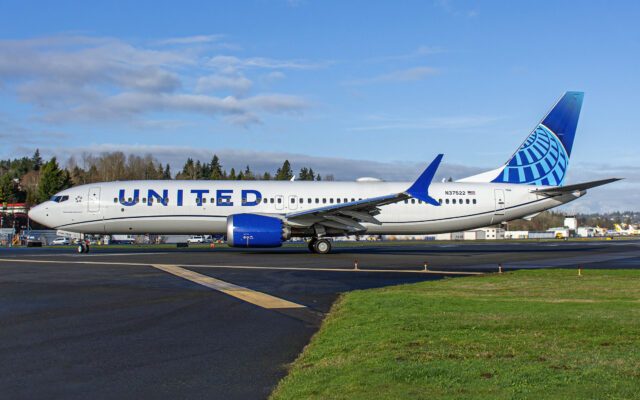
United Express is returning to Moab, restoring a key link between Denver International Airport (DEN) and Canyonlands Regional Airport (CNY) after a nearly two-year gap in branded United service to southeastern Utah.

The restored route is small by United’s network standards, but it is strategically important for Moab. Canyonlands Regional Airport (CNY) is the air gateway for one of the most tourism-dependent outdoor markets in the American West, serving travelers headed to Arches National Park, Canyonlands National Park, the Colorado River, Dead Horse Point, and the broader red-rock recreation economy around Moab.
The service will be operated by SkyWest Airlines under the United Express brand, reconnecting Moab (CNY) with United’s Denver (DEN) hub. More importantly, the flights are part of a broader SkyWest return to Canyonlands under a new four-year Essential Air Service contract that also brings Delta Connection service between Moab (CNY) and Salt Lake City International Airport (SLC).
Read our stories in your inbox
Two aviation newsletters. Zero fluff.
That makes this more than a simple route restoration. It is a reset of Moab’s commercial air service model.

SkyWest Replaces Contour With United and Delta Connectivity
The U.S. Department of Transportation selected SkyWest to provide Essential Air Service at Canyonlands Regional Airport (CNY) from October 1, 2026, through September 30, 2030. SkyWest will operate 12 weekly nonstop round trips using 50-seat regional jets, with Denver (DEN) flights branded as United Express and Salt Lake City (SLC) flights branded as Delta Connection.
That is a major change from the current Contour Airlines pattern. Contour had restored daily Denver service from Moab in April 2025 and also served Phoenix Sky Harbor International Airport (PHX). Under the new SkyWest contract, Moab shifts away from the Contour model and back toward fully integrated major-airline codeshare service.
For a small airport, that distinction is enormous. A Contour flight can still connect travelers through interline relationships, but a SkyWest-operated United Express or Delta Connection flight is sold directly through United or Delta channels. Travelers can book one itinerary, earn frequent-flyer miles, check bags through to a final destination, and receive major-carrier rebooking support when irregular operations occur.
That is exactly why Grand County emphasized codeshare connectivity during the carrier-selection process. For local residents, tourism operators, resort managers, and inbound visitors, the ability to book Moab (CNY) like any other United or Delta destination can be more valuable than the flight itself.
Denver Gives Moab a Powerful Connecting Hub
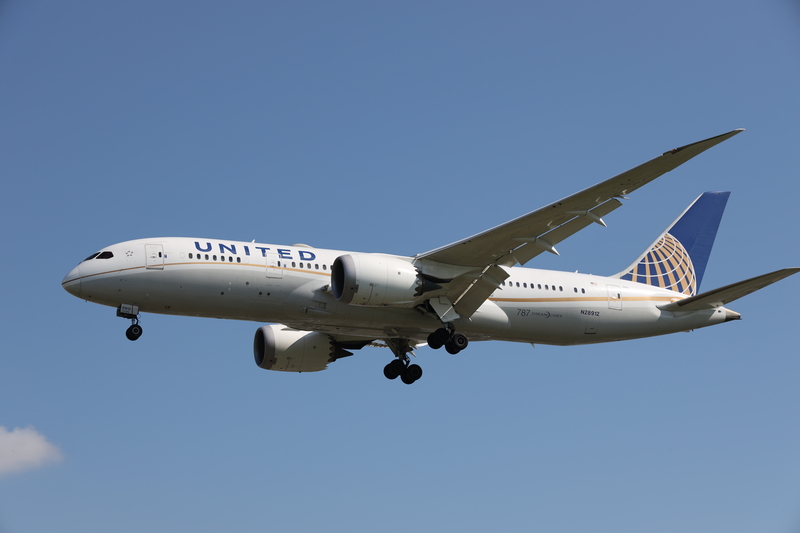
The restored Moab (CNY)-Denver (DEN) flight gives Canyonlands access to one of the most important connecting hubs in the Mountain West. Denver is United’s primary western interior hub and a natural gateway for small communities across Utah, Colorado, Wyoming, Montana, Nebraska, New Mexico, and the Dakotas.
The DEN-CNY route is only about 283 miles, or 246 nautical miles, but its network value is far larger than the stage length suggests. The local Moab-Denver market is modest. The real value comes from what sits beyond Denver: Chicago (ORD), Newark (EWR), Houston (IAH), San Francisco (SFO), Washington Dulles (IAD), Los Angeles (LAX), Boston (BOS), New York LaGuardia (LGA), and international connections across United’s network.
That is why routes like Denver-Moab exist. They are not designed primarily to move passengers between two local markets. They are designed to plug small communities into a national and global network.
Historical traffic patterns support that view. The original article cited U.S. Department of Transportation data showing that most passengers on United’s earlier Denver-Moab service connected beyond DEN rather than ending their trip in Denver. That is typical for Essential Air Service communities linked to a major hub: the first flight is only the beginning of the itinerary.
The Aircraft: 50-Seat CRJ Flying Into High-Desert Utah
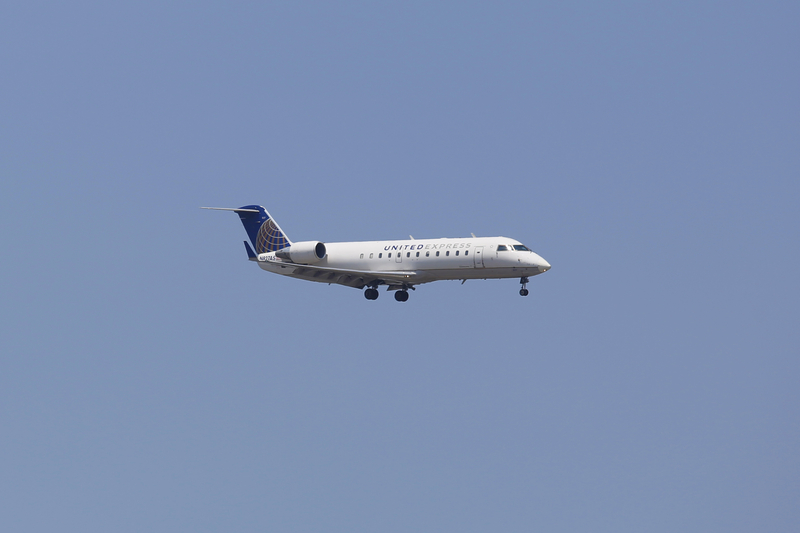
The flights are expected to use 50-seat Bombardier CRJ regional jets, either the CRJ200 or CRJ550 depending on final aircraft assignment. Local reporting on the SkyWest contract says the carrier will use 50-seat CRJ-200 or CRJ-550 regional jets, while schedule reporting for the Denver (DEN)-Moab (CNY) United Express service identifies the CRJ200.
The Bombardier CRJ200 is a familiar regional aircraft in U.S. Essential Air Service markets. It is not a premium aircraft by modern regional-jet standards, but it remains useful in small communities because of its 50-seat size, jet speed, and compatibility with the regional networks of carriers such as SkyWest.
For Moab, that seat count matters. A larger Embraer E175 or CRJ900 would bring more comfort and premium cabin potential, but it would also introduce more seats into a market that can be highly seasonal. A 50-seat aircraft gives SkyWest and United a better chance of matching capacity to real demand, especially outside the peak spring and fall outdoor travel periods.
Canyonlands Regional Airport (CNY) is equipped for this kind of operation. AirNav lists the airport’s main Runway 3/21 at 7,360 by 100 feet with an asphalt/grooved surface, medium-intensity runway edge lights, PAPI guidance, and published instrument procedures. The airport sits at 4,579 feet elevation, about 15 miles northwest of Moab.
That high-elevation, high-desert environment is part of the operational story. Hot summer temperatures, terrain, density altitude, and regional jet performance all matter at airports like CNY. The CRJ200 is not glamorous, but it is a known aircraft for SkyWest and has a long record of operating into smaller western communities.
Salt Lake City’s Return May Be Just as Important
The United Express return to Denver will attract most of the national attention, but the Salt Lake City (SLC) piece may be equally important locally.
SkyWest’s new contract restores Moab-Salt Lake City service, which the community lost when Contour took over the route. Salt Lake City is not just another hub. For Grand County residents, SLC is a major access point for medical care, state government, universities, business travel, and onward Delta connections.
That gives the new SkyWest structure a dual-hub advantage. Denver (DEN) connects Moab to United’s national network. Salt Lake City (SLC) connects Moab to Delta’s western hub and to Utah’s largest metropolitan area.
For local travelers, that is a major improvement over relying on a single hub. For inbound visitors, it also makes Moab easier to reach from more parts of the country. A traveler in Seattle (SEA), Minneapolis (MSP), Atlanta (ATL), Boston (BOS), or New York (JFK/LGA/EWR) may now see Moab (CNY) appear as a more practical one-stop option through either Delta or United.
That kind of visibility matters in a tourism market. If Moab is easy to book, more people consider flying directly into the region instead of driving several hours from Grand Junction (GJT), Salt Lake City (SLC), or Denver (DEN).
Why Moab Needs Commercial Air Service
Moab is a small community with an outsized travel economy. The city sits near two national parks, major public lands, world-famous mountain biking terrain, river-running routes, off-road trails, and year-round outdoor recreation assets.
The official airport page describes Canyonlands Regional Airport (CNY) as a gateway to Arches and Canyonlands national parks, the Colorado River, Moab Giants Dinosaur Museum, local hotels, shops, and restaurants. Discover Moab similarly markets CNY as the direct air gateway for the region’s red-rock landscape and tourism economy.
That is why air service has economic weight far beyond the number of daily departures. A reliable flight into CNY can affect hotel bookings, outfitter demand, guide services, restaurants, rental car activity, and conference or group travel. It also improves quality of life for residents who otherwise face long drives to larger airports.
The driving alternatives are not trivial. Grand Junction Regional Airport (GJT) is the closest larger airport option, but it still requires a significant drive. Salt Lake City (SLC) and Denver (DEN) offer more flights, but they are much farther away by road. For visitors arriving with limited vacation time, every hour spent driving from a distant airport is time not spent in Moab.
EAS Makes the Economics Work
The Essential Air Service component should not be treated as a footnote. It is the framework that makes this route structure viable.
Small communities like Moab often cannot support unsubsidized scheduled air service at the level needed for reliable year-round connectivity. The Essential Air Service program exists because airline deregulation made it possible for carriers to exit smaller markets that did not meet commercial profitability thresholds on their own.
Grand County’s own air-service review described EAS as the mechanism that ensures small communities maintain a basic level of commercial air service. The county also emphasized that the carrier choice affects more than schedules: it affects whether local families, businesses, healthcare travelers, and tourism operators can access the wider air transportation system efficiently.
The DOT’s selection of SkyWest creates a more stable four-year structure. That matters because Moab has seen multiple carrier changes over the years, and each change can disrupt booking patterns, airport marketing, and traveler confidence.
A Return With Some History Behind It
SkyWest is not new to Moab. The regional airline previously served Canyonlands before Contour took over, and Grand County’s air-service materials noted that the airport recorded 20,093 enplanements in 2021 under SkyWest codeshare service. After the transition to non-codeshare service, enplanements fell to 10,625 by 2024.
Those numbers do not prove that SkyWest alone caused the difference, because the period included pandemic recovery distortions and changing travel patterns. But they do show why local officials placed so much emphasis on major-airline integration.
The county also cited leakage from the Moab market, estimating that 21,000 to 44,000 passengers per year choose to drive to other airports rather than fly from Canyonlands. That is the opportunity SkyWest, United, and Delta are trying to recapture.
If the airport can bring back even a portion of that leakage, the new contract could do more than preserve air service. It could rebuild local confidence in CNY as a practical airport for residents and visitors.
What Travelers Should Expect
For travelers, the restored Denver (DEN)-Moab (CNY) service will be a short regional-jet flight with significant connection value. Schedule reporting shows United Express service returning in October with one or two daily flights early in the launch period before settling into a more regular daily pattern.
The key passenger benefit is not onboard luxury. A CRJ200 is a compact 50-seat jet with limited cabin space and no large-jet amenities. The value is convenience: flying directly into Moab (CNY), avoiding a long drive from another airport, and booking through United’s system for onward connections.
The Salt Lake City (SLC) flights under Delta Connection add another option, especially for Utah-focused travel and Delta loyalists. Together, the two hubs give CNY a stronger network proposition than a single point-to-point route could offer.
Travelers should still watch schedules closely, especially during the transition from Contour to SkyWest and the start of the new EAS contract. Small-airport schedules can shift as carriers finalize launch dates, aircraft assignments, and booking availability.
Bottom Line
United Express is returning to Moab through SkyWest’s new Essential Air Service contract at Canyonlands Regional Airport (CNY), restoring branded United connectivity between Denver (DEN) and one of Utah’s most important outdoor tourism gateways.
The broader story is even bigger than United. SkyWest will also operate Delta Connection service between Moab (CNY) and Salt Lake City (SLC), giving the community access to two major airline networks under one four-year federal contract.
For Moab, this is a meaningful air-service reset. The aircraft may be a 50-seat CRJ, and the route may be small on United’s map, but the impact is significant. Denver puts Moab back into United’s national network. Salt Lake City restores an important in-state link. And Canyonlands Regional Airport gains a stronger platform to capture visitors who might otherwise drive in from larger airports.
For a community built around access to some of the most iconic landscapes in the American West, easier access by air is not a luxury. It is infrastructure.
Keep reading FlyMag
Get the Daily Brief in the morning or the Route Watch weekly recap on Fridays. Or both.