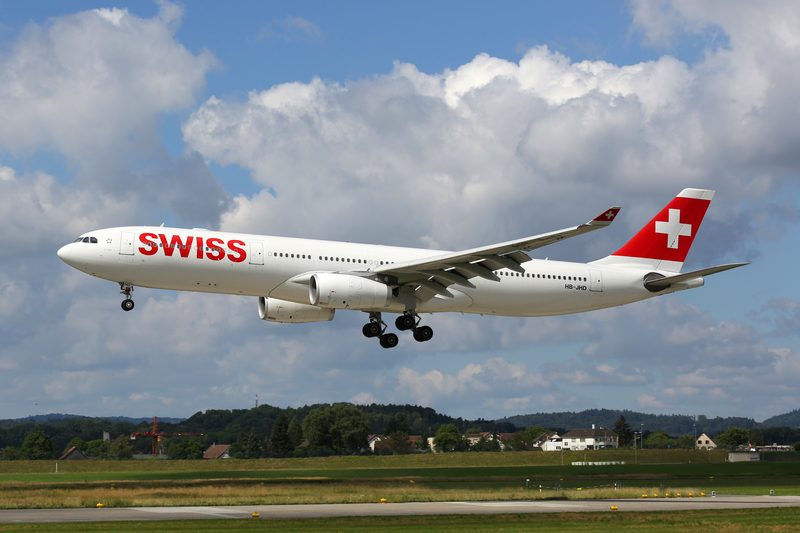
A SWISS long-haul departure from Indira Gandhi International Airport (DEL) was forced to abort takeoff in the early hours of April 26 after an engine fire during the takeoff roll, with the subsequent emergency evacuation leaving six passengers injured.

The aircraft involved was Airbus A330-343 HB-JHK, operating flight LX147 from Delhi Airport (DEL) to Zurich Airport (ZRH). According to multiple reports from India and international wire coverage, the crew rejected takeoff on runway 28 after an engine malfunction and fire, then ordered an evacuation on the runway.
For aviation professionals, the central issue is not only the engine event itself. It is that this became a high-speed rejected takeoff followed by a full slide evacuation on a widebody long-haul aircraft, exactly the kind of scenario where even a correct crew response can still produce injuries on the ground.
Read our stories in your inbox
Two aviation newsletters. Zero fluff.
The Incident Happened During The Most Critical Phase Before Liftoff
The aircraft was already accelerating for departure when the problem occurred.
That matters because a rejected takeoff at low speed and a rejected takeoff at higher speed are very different events in operational terms. By the time an A330-300 is deep into its takeoff roll, stopping the aircraft means dealing not only with the initiating malfunction, but also with brake energy, runway occupancy, passenger reaction, and the possibility of secondary hazards such as smoke, wheel heating, or fire spread.
In this case, early reports indicate the crew identified an engine problem, with visible flames also reported, and brought the aircraft to a halt on the runway. That is the correct first response, but once the aircraft stops, the next decision becomes just as important: whether to keep passengers seated or evacuate immediately.
The crew chose evacuation.
#BREAKING : Swiss International Air Lines flight LX147, operated by aircraft HB-JHK, suffered an engine No. 1 failure during the take-off roll while departing Delhi for Zurich.
Emergency slides were deployed and the aircraft was evacuated on the runway as a precaution.… pic.twitter.com/EwGFQjvLlZ
— upuknews (@upuknews1) April 26, 2026
This Was A Flight Crew Decision With No Margin For Hesitation
In a situation involving an apparent engine fire during the takeoff roll, there is very little room for indecision.
A long-haul Airbus A330-300 carrying a full passenger load to Zurich Airport (ZRH) is a heavy aircraft, and when an engine fire is suspected or confirmed, crews are trained to prioritize the immediate safety of the aircraft and those onboard. If the threat appears serious enough, evacuation follows even though evacuation itself carries real physical risk.
That is an important point for readers. Emergency evacuations are never benign events. They are controlled acts of risk transfer. The crew is deciding that the danger of remaining onboard is greater than the danger of getting hundreds of people off the aircraft quickly via slides.
That appears to be exactly the judgment made on LX147.
The A330-300 Is A Proven Aircraft, But Widebody Evacuations Are Inherently Physical
The Airbus A330-300 is a mature long-haul type with a strong operational record, and there is nothing in the early reporting to suggest a broader fleet issue tied to the aircraft model itself.
But evacuating any widebody is physically demanding. Slide descents can be chaotic even when cabin crew perform exactly as trained. Passengers may be barefoot, carrying stress injuries, colliding at the slide base, or disoriented by smoke, darkness, or shouting. On a fully loaded intercontinental flight, even a textbook evacuation can result in sprains, fractures, abrasions, and panic-related injuries.
That is why six injuries, while serious, should not automatically be interpreted as evidence that the evacuation was mishandled. In many cases, it means the evacuation happened quickly enough to prioritize survival over comfort.
The Cabin Crew Response Will Matter In Any Review
One of the more revealing details from the early aftermath is the circulating video showing cabin crew giving assertive commands during the evacuation.
That is not a side note. In real-world evacuations, the cabin crew are the operational difference between urgency and disorder. Their ability to project authority, block baggage retrieval, direct passengers to usable exits, and keep movement flowing often determines whether an evacuation remains controlled.
The reports of a flight attendant continuing to direct passengers while assisting an injured traveler are entirely consistent with the kind of high-intensity cabin work these events demand. As investigators and the airline review the incident, the cabin response will almost certainly be seen as a critical part of why the evacuation was completed without fatalities.
The Engine Fire Is The Headline, But The Rejected Takeoff Is The Core Event
Public attention naturally gravitates toward the engine fire, but from an operational perspective the rejected takeoff is just as important.
A rejected takeoff on a long-haul widebody is one of the most serious non-crash events in airline operations. The crew must diagnose the threat, commit to stopping, manage deceleration, communicate with ATC, run memory items and emergency procedures, and prepare for the possibility of evacuation in a matter of seconds.
If the aircraft is moving fast enough, the stop itself can create additional technical stress, especially on brakes and tires. That is why widebody rejected takeoffs often lead to prolonged runway closures, detailed engineering inspections, and close examination of whether the reject point and crew response aligned with procedure.
Delhi Will Now Be A Key Part Of The Technical Investigation
The investigation will focus first on what happened inside the affected engine system and how the fire developed during the takeoff roll.
But Delhi Airport (DEL) itself is also part of the operational story. Runway 28, the emergency response timing, the airport fire-service deployment, the condition of the runway after the stop, and the handling of passengers after evacuation will all form part of the broader picture.
That matters because runway incidents are never just about the aircraft. They are also about airport readiness. A quick and coordinated response from airport rescue and firefighting services is essential once an evacuation begins on an active runway.
A #SwissInternationalAirLines flight (SWR146) from Delhi to Zurich aborts take-off in the early hours after an engine failure, prompting a full emergency at the airport.
Smoke is seen from the left side of the aircraft, while a fire is reported near the right landing gear. All… pic.twitter.com/tYSpwyxQ0Y
— Gulistan News (@GulistanNewsTV) April 26, 2026
Zurich-Bound Long-Haul Flying Means Secondary Disruption Too
The operational consequences do not end with the rejected takeoff itself.
A cancelled long-haul departure from Delhi Airport (DEL) to Zurich Airport (ZRH) creates immediate downstream disruption: aircraft rotation problems, crew-duty complications, passenger reaccommodation, baggage handling issues, and possible knock-on effects to subsequent SWISS network planning. On a route like DEL-ZRH, many passengers are not ending their journey in Switzerland. They are connecting onward through Zurich, which means a single runway event in India can quickly spread through the wider network.
That is one reason airlines take these incidents so seriously even when everyone survives. The aircraft may stop safely, but the disruption footprint is much larger than the runway where it began.
The Six Injuries Do Not Diminish The Fact That The Safety System Worked
It is important to hold two truths at once.
Six passengers were injured, and that is serious. But the broader system still appears to have functioned as intended. The crew recognized a dangerous event, rejected the takeoff, evacuated the aircraft, and got everyone off. Airport responders then took over. That is exactly how the safety chain is meant to work in a severe engine-fire scenario on the ground.
In commercial aviation, the goal is not to make emergencies painless. It is to make them survivable.
Bottom Line
The SWISS incident involving Airbus A330-343 HB-JHK at Delhi Airport (DEL) was a serious rejected takeoff and runway evacuation, not just an engine malfunction with dramatic visuals. Flight LX147 to Zurich Airport (ZRH) stopped after an engine fire during the takeoff roll, and six passengers were injured during the subsequent emergency evacuation.
The investigation will determine the precise technical cause, but the larger takeaway is already clear. This was exactly the kind of high-pressure ground emergency where crew judgment, cabin authority, and rapid evacuation discipline matter most. The injuries are a reminder of how violent evacuations can be. The absence of anything worse is the clearest sign that the emergency response worked.
Keep reading FlyMag
Get the Daily Brief in the morning or the Route Watch weekly recap on Fridays. Or both.