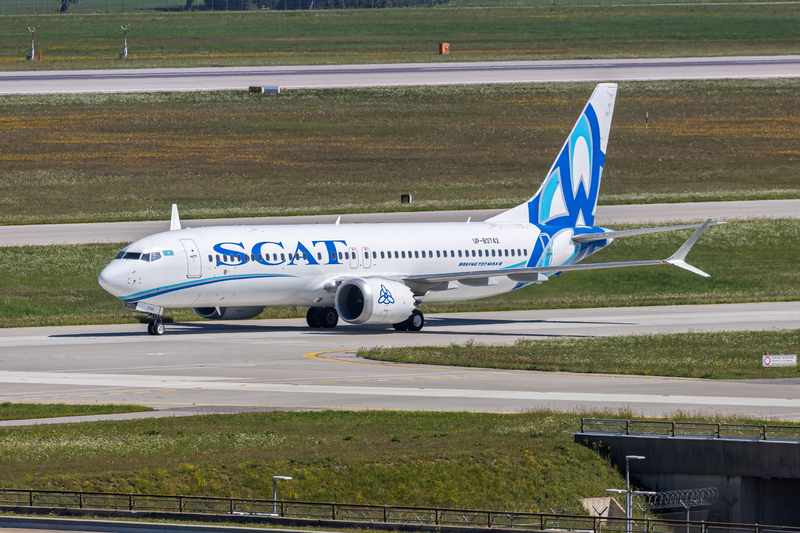
SCAT Airlines (DV) is evaluating a major step-up in in-house technical capability: a potential maintenance, repair and overhaul (MRO) center at Shymkent International Airport (CIT), developed in partnership with Boeing. The concept was discussed at the government level during a meeting in the United States between Kazakh President Kassym-Jomart Tokayev and Boeing leadership—an unusually high-profile setting for what is, at its core, an airline maintenance project.
Alongside the MRO discussions, SCAT is also considering additional Boeing aircraft orders, a logical extension for a carrier whose narrowbody backbone is already Boeing-heavy. For SCAT, tying fleet expansion to a stronger maintenance footprint at CIT would reduce out-of-country maintenance dependency and help stabilize dispatch reliability as the airline scales.
Why Shymkent (CIT) is the natural place to build SCAT’s maintenance muscle
CIT is more than just an address on the AOC. It is SCAT’s home base and operational center, with the runway and apron infrastructure to support routine 737-family flying and heavier movements. CIT’s primary runway is 3,300 meters, which is ample for high-weight departures and diversions—useful not only for operations, but also for test flights and post-maintenance functional checks once an MRO is in place.
Read our stories in your inbox
Two aviation newsletters. Zero fluff.
From a network and logistics perspective, anchoring a maintenance hub at CIT offers three practical advantages:
-
Reduced downtime: ferrying aircraft across borders for heavy checks is expensive in both direct costs and lost utilization. Local capability keeps assets closer to the schedule.
-
Better spares positioning: a base-maintenance footprint typically drives more disciplined inventory strategy—rotable pools, consumables, and tooling colocated where the fleet sleeps.
-
Regional third-party potential: Central Asia’s narrowbody fleets continue to grow, and an established hangar at CIT could evolve from “SCAT-only” work into contracted support for other operators—depending on approvals, capability, and capacity.
The fleet logic: why Boeing support matters for SCAT
SCAT’s fleet profile explains why Boeing is central to the discussion. The airline operates a mix that is predominantly Boeing on the jet side—most notably the 737NG and 737 MAX family, which share significant commonality in maintenance philosophy, tooling, and technician training pipelines. SCAT also has Boeing widebody and larger narrowbody experience within its broader group flying, which increases the value of standardized engineering support, manuals, and reliability programs.
From an MRO-planning standpoint, building capability around the 737 ecosystem typically follows a staged maturity path:
-
Line maintenance consolidation (night-stops, A-check packages, defect rectification consistency)
-
Base maintenance entry (structural inspections, heavier checks, cabin and systems work)
-
Component capability growth (wheels/brakes, avionics bench work, interiors, and selected accessory overhaul)
-
Engineering and reliability integration (data-driven defect trends, preventive maintenance optimization)
Boeing’s involvement—if it progresses beyond discussions—would be most meaningful in the “how” rather than the “what”: technician training frameworks, tooling baselines, maintenance documentation systems, and the digital backbone that increasingly defines modern maintenance performance.
What to watch next at CIT
Two indicators will tell the industry whether this becomes a real project or stays a strategic idea:
First: scope clarity. “MRO center” can mean anything from a reinforced line-maintenance operation to a full hangar capable of heavy structural checks. The difference is measured in hangar size, workforce depth, approvals, and capital investment.
Second: fleet commitment. If SCAT adds more Boeing aircraft—particularly within the 737 family—the economics for an expanded maintenance base at CIT become far easier to justify. A growing, standardized fleet improves utilization of maintenance infrastructure, tooling, and specialized labor, and it increases the value of keeping core work close to home.
Bottom Line
SCAT’s consideration of a Boeing-partnered MRO center at Shymkent (CIT) is a strategically coherent move for a carrier built around Boeing equipment and a hub airport designed to anchor growth. If the project advances, it would strengthen SCAT’s operational resilience, reduce maintenance-related schedule fragility, and potentially position CIT as a more meaningful technical node in Central Asia’s aviation ecosystem—especially if additional Boeing orders follow.
Keep reading FlyMag
Get the Daily Brief in the morning or the Route Watch weekly recap on Fridays. Or both.