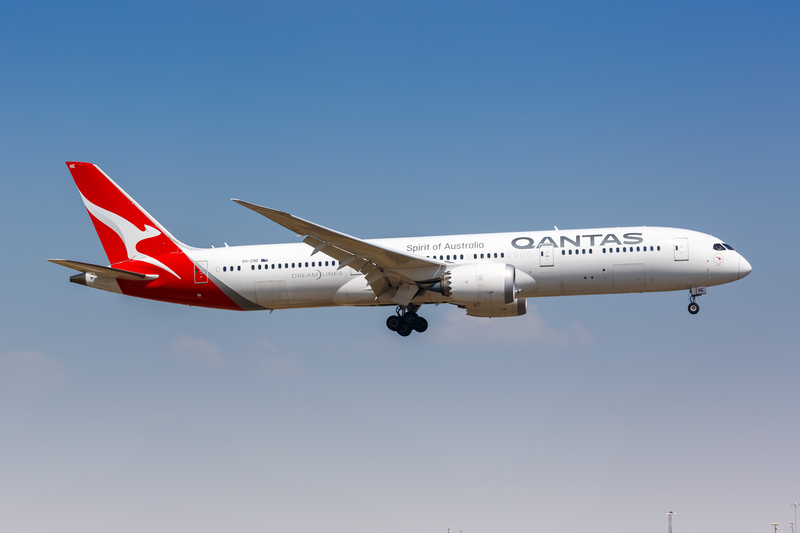
Qantas is temporarily removing its nonstop Perth Airport (PER) to Paris Charles de Gaulle Airport (CDG) service as part of a broader European network reshuffle, replacing the nonstop operation with a Sydney Kingsford Smith Airport (SYD) to CDG service via Singapore Changi Airport (SIN).

That distinction matters. This is not Paris disappearing from the Qantas map. It is Paris being moved onto a different operating pattern. Instead of the Boeing 787-9 Dreamliner running PER-CDG nonstop, Qantas will route the service through SIN and originate it in SYD for the affected period. The airline says the revised schedule will be phased in from mid-April and run through mid-July, which makes this a tactical network response rather than a formal long-term withdrawal.
For network planners, the reasoning is fairly easy to read. The 787-9 is a highly capable aircraft, but it is still subject to payload and range trade-offs on very long sectors when operating around airspace constraints and altered routings. By sending Paris via SIN instead of nonstop from PER, Qantas can carry more passengers and reduce some of the operational pressure that comes with ultra-long flying under current conditions.
Read our stories in your inbox
Two aviation newsletters. Zero fluff.
Why Singapore Has Become the Key Pivot Point
The route change is closely tied to the wider disruption affecting Europe-bound flying from Australia. Qantas has already been operating its Perth Airport (PER) to London Heathrow Airport (LHR) service westbound via SIN for a fuel stop because of flight path adjustments linked to the Middle East situation. Paris is now being pulled into that same broader strategy.
From a commercial standpoint, SIN is the logical pivot. It gives Qantas a stable intermediate point, adds flexibility, and allows the carrier to concentrate European traffic flows through one of the strongest hub airports in Asia. It also improves the economics of the Paris service. Reuters reported that operating via SIN allows Qantas to add more than 60 passengers per flight compared with the previous nonstop setup, which is a meaningful gain on a route of this length.

The aircraft itself is central to the story. Qantas’ Boeing 787-9 carries 236 passengers in its long-haul configuration, including 42 Business, 28 Premium Economy, and 166 Economy seats. It is the right aircraft for thin long-haul markets because it combines lower trip costs with genuine intercontinental range. But when route structure changes force operational compromises, even a well-matched aircraft can be more profitably redeployed on a different pattern. That is effectively what Qantas is doing here.
Paris Capacity Rises Even as the Nonstop Flight Pauses
There is an irony in the move: Qantas is dropping the nonstop PER-CDG leg, but it is actually increasing Paris frequency overall. The airline is raising Paris service from three weekly flights to five weekly on the new SYD-SIN-CDG routing.
That makes the change more nuanced than the headline suggests. The nonstop link between Australia and France is the casualty, but Paris itself is receiving more Qantas capacity. For the airline, that means retaining visibility in the French market while reshaping how it uses scarce long-haul aircraft time. For passengers in eastern Australia, it also shifts the center of gravity away from PER and back toward SYD, which is a more natural origin point for a larger share of the airline’s long-haul demand base.
Qantas originally launched nonstop PER-CDG in July 2024 with the 787-9, creating the first nonstop passenger service between Australia and France. It was a strategically important route and a strong branding play, particularly around the Paris Olympics period. But in the current environment, schedule resilience and payload efficiency appear to be taking precedence over the prestige of keeping the flight nonstop.
Rome Gains, Singapore Grows, and Widebodies Move Around the System
The Paris change is only one part of the reshuffle. Qantas is also strengthening its European operation through Rome Fiumicino Airport (FCO). Schedule filings show the Sydney-Perth-Rome operation ramping up sharply through the northern summer window, reaching daily frequency from late June through late July with the Boeing 787-9. That is a notable increase for a route that had previously been scheduled at lower seasonal frequency.
At the same time, PER-SIN rises from seven weekly flights to 10 weekly, reinforcing Singapore’s role as the airline’s key Europe bridgehead from Western Australia. In practical terms, that gives Qantas more room to funnel passengers from PER into the broader Singapore bank while preserving access to Europe without relying as heavily on nonstop ultra-long-haul flying.
These moves also ripple back into the domestic and transpacific network. Qantas is freeing up aircraft by reducing some Airbus A330 flying on transcontinental routes such as SYD-PER and Melbourne Airport (MEL)-PER, with smaller Boeing 737-800s covering more of that work. The released Airbus A330-200 capacity is then being used on Brisbane Airport (BNE) to Los Angeles International Airport (LAX), where the A330-200 replaces the 787-9 for part of the northern summer period.
That aircraft swap has a product consequence as well as an operational one. Qantas’ 787-9 offers Premium Economy, while the Airbus A330-200 does not in Qantas’ international layouts. So the BNE-LAX change is not just a fleet footnote. It alters the cabin mix on an important long-haul route while underlining how aggressively Qantas is reallocating widebody assets to support Europe.
This Is a Network Optimization Story, Not Just a Route Cut
The most important takeaway is that Qantas is not simply canceling a route because it underperformed. This is a network optimization move shaped by operational reality, fleet availability, and changing demand flows. Europe is currently attracting unusually strong demand as travelers look for alternatives to itineraries that would normally rely on major Gulf hubs. Qantas is trying to capture that demand with aircraft it already has, while minimizing the penalties attached to difficult long-haul operating conditions.
In that context, PER-CDG nonstop was always going to be vulnerable. It is a high-profile route, but it is also a demanding one. When the same Boeing 787-9 can be redeployed into routings that carry more passengers, connect more efficiently, or support multiple Europe markets through SIN and PER, the network math changes quickly.
That does not make the route unimportant. On the contrary, the suspension of nonstop France flying is significant because it shows how fragile even prestige long-haul links can become when operating conditions deteriorate. But it also shows Qantas acting with a fairly clear commercial logic: protect Europe volume, keep Paris in the network, strengthen Rome, deepen Singapore connectivity, and use the fleet where it earns the best return.
Bottom Line
Qantas is not walking away from Paris. It is stepping away, for now, from the nonstop Perth Airport (PER) to Paris Charles de Gaulle Airport (CDG) model and replacing it with a more flexible SYD-SIN-CDG operation built around the Boeing 787-9.
For airline professionals, that makes this less a story about retreat and more a story about network triage. PER loses a prestige nonstop route, but Paris gains frequency, SIN becomes even more central, Rome Fiumicino Airport (FCO) gets a meaningful boost, and aircraft are redistributed across the system to keep Europe capacity growing.
The bigger message is clear. In the current operating environment, Qantas is prioritizing network resilience and aircraft productivity over the symbolic value of maintaining every ultra-long-haul nonstop.
Keep reading FlyMag
Get the Daily Brief in the morning or the Route Watch weekly recap on Fridays. Or both.