Norfolk International Airport (ORF) has been talking about international growth for years. In early 2026, it finally started putting real infrastructure and real strategy behind that ambition—and the next logical step is Europe.
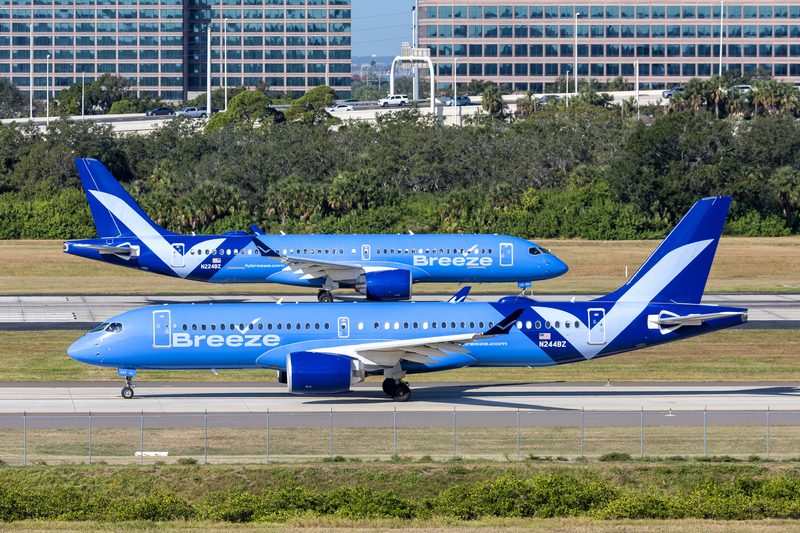
The airport’s first regularly scheduled international nonstop in nearly a quarter-century is already in the air: Breeze Airways’ seasonal Saturday service from Norfolk (ORF) to Cancún International Airport (CUN), launched January 10, 2026. And while Mexico is a solid proof-of-concept, it’s not the endgame. What ORF wants next is a transatlantic route that can convert the region’s steady “drive north and connect” traffic into local departures, ideally on right-sized aircraft that don’t require widebody volumes.
That’s why two countries keep coming up in the same breath—Iceland via Keflavík International Airport (KEF) and Ireland via Dublin Airport (DUB). Both offer proven connecting hubs, both have carriers accustomed to “long and thin” flying, and both can be served by the current generation of long-range narrowbodies that have rewritten the playbook for secondary transatlantic markets.
Read our stories in your inbox
Two aviation newsletters. Zero fluff.
The coalition behind the pitch: de-risking the first season
The biggest hurdle in launching a new long-haul route isn’t just demand—it’s risk concentration. A transatlantic station start means committing aircraft time, crews, maintenance planning, ground handling, catering, sales distribution, and regulatory work long before the first passenger boards. For a carrier, the first 12–24 months are often the danger zone: yields are still settling, load factors are ramping, and the route hasn’t yet made its way into corporate travel programs.
To address that, regional leaders have formed the Hampton Roads Transatlantic Air Service Coalition, a structure designed to look familiar to airline network planners: a community-backed financial backstop that can function as a minimum revenue guarantee-style “insurance policy” if performance falls short early on. The key point is that these funds aren’t a blank check—they’re typically tied to defined benchmarks and only come into play if the route underperforms.
It’s a well-worn strategy in the U.S. route-development world, and it’s especially relevant for a market like Hampton Roads, where demand exists but hasn’t historically been “captured” by ORF because Washington Dulles (IAD), Raleigh–Durham (RDU), and Charlotte Douglas (CLT) have offered abundant European nonstops for years.
ORF is finally building the operational pieces to support long-haul
A sales pitch only goes so far if the airport isn’t physically ready for the flight. ORF has made a point of removing that excuse.
The most important recent move is the airport’s new Federal Inspection Services (FIS) facility—effectively the backbone for handling arriving international passengers. The building is designed around efficient flow: primary inspection and baggage claim are positioned to keep walking distances short, and ORF has also added a Global Entry enrollment office with dedicated access so travelers can use it without entering the terminal complex.
This matters for more than just passenger experience. For airlines, a dependable FIS operation reduces irregular-ops headaches and limits the “unknowns” of turning an international flight at a smaller station.
From an airfield perspective, ORF’s primary runway length and low elevation also support the kind of equipment most likely to operate a first Europe route—namely, long-range narrowbodies that can make transatlantic economics work without requiring 250–300 seats per departure.
And ORF now has momentum to sell. The airport handled roughly 4.9 million total passengers in 2025—a fourth consecutive annual record—while the FAA’s commercial-service ranking places ORF in the mid-pack nationally by enplanements. That combination is attractive: a large enough base to matter, but still underpenetrated for true international flying.
Why the first Europe flight probably won’t be London
ORF’s Europe demand story almost always starts with one word: London. Heathrow (LHR) is a dominant corporate destination and a natural long-haul aspirational market. But “most popular” doesn’t automatically mean “most launchable.”
Slot-constrained airports like Heathrow (LHR) and even Gatwick (LGW) tend to reward scale. Airlines deploy capacity where they can maximize premium yields and connectivity, which usually favors larger metros and hub airports. For a first-time long-haul station like ORF, a London route can be a second step—after the market proves it can support consistent transatlantic lift.
That’s why the conversation has shifted toward hub-and-connect options first. If ORF can land a flight that reliably feeds multiple European endpoints through a single gateway, the route becomes less dependent on pure local point-to-point demand—and much easier to sustain through shoulder seasons.
Contender 1: Reykjavik (KEF) and the Icelandair-style connecting model
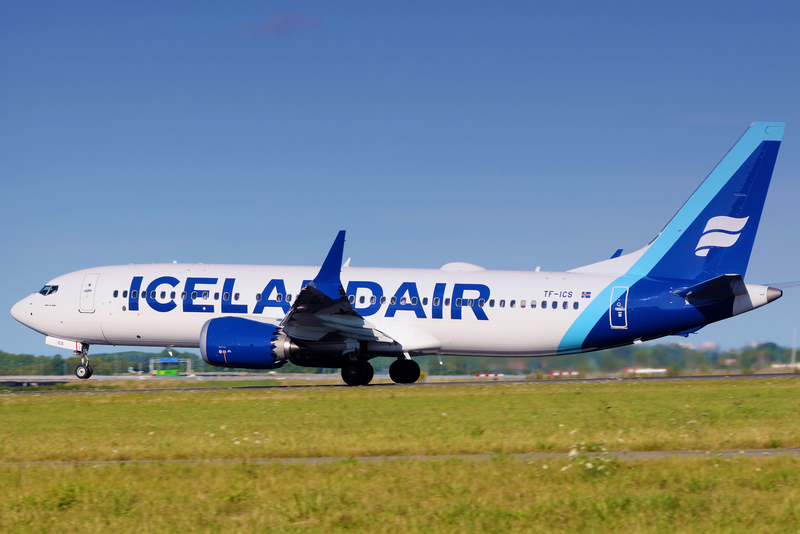
Keflavík (KEF) works because it’s engineered for connectivity. Icelandair’s operation is built around timed banks that make “small city to Europe” viable with a single transatlantic leg and a short onward hop. For a market like Norfolk (ORF), that’s a compelling value proposition: passengers don’t need a U.S. hub connection at all, and the airline can spread demand across multiple European cities instead of betting everything on one destination.
The aircraft angle is also favorable. Icelandair has been renewing and expanding its fleet with the Boeing 737 MAX family, and has been introducing Airbus A321LR aircraft as well. That matters because ORF’s most realistic transatlantic launch scenario is a narrowbody mission—something in the ~160–200 seat class that can be right-sized to the market.
On paper, ORF–KEF is well within the comfort zone of modern transatlantic narrowbodies. The great-circle distance is about 2,500 nautical miles, leaving operators margin for North Atlantic winds, alternates, and ETOPS planning. In practical terms, KEF is short enough to be forgiving operationally, while still delivering a robust European network through connections.
A KEF route would also let an airline sell more than just Europe. Iceland’s stopover appeal adds incremental demand that can help early route performance—useful in that critical first summer when a new transatlantic service is trying to establish itself.
Contender 2: Dublin (DUB), preclearance, and the Aer Lingus narrowbody play
Dublin (DUB) is a different kind of argument—one built around U.S. Customs and Border Protection preclearance and a proven North America strategy.
For passengers, preclearance changes the entire arrival experience. If travelers clear U.S. immigration and customs at Dublin (DUB), they arrive into Norfolk (ORF) as domestic passengers. That makes the flight feel operationally “simpler” on the U.S. end, improves connection prospects onto domestic flights, and reduces the unpleasant variability of arrival queues.
The equipment case is strong, too. Aer Lingus has leaned heavily into the Airbus A321neo LR, specifically built for long-haul narrowbody missions with a published capability of up to 4,000 nautical miles. The newer A321XLR pushes that long-range envelope even further to around 4,700 nautical miles—exactly the kind of aircraft that can make secondary U.S.–Europe routes pencil out without widebody risk.
ORF–DUB is approximately 3,000 nautical miles nonstop—well inside A321LR territory, and even more so for XLR-class aircraft. That’s the sweet spot where airlines can sell a “real” transatlantic product (premium cabin included) while keeping trip costs closer to a domestic narrowbody operation than a widebody one.
The main challenge for Dublin (DUB) is competitive gravity. Aer Lingus already has strong U.S. coverage, and Washington Dulles (IAD) is close enough to pull meaningful demand out of the same region. For ORF to win, the route would need to demonstrate clear advantages: convenience, time savings, and local capture that isn’t being realized today because passengers are driving to IAD (or connecting through Atlanta (ATL), Charlotte (CLT), or New York (JFK/EWR)).
What a “first season” ORF–Europe route could realistically look like
If ORF lands its first Europe flight, expect it to look like a classic “right-sized launch” rather than a daily, year-round swing for the fences.
A credible first pattern would be:
-
2–4x weekly, likely summer-season focused at the start
-
Narrowbody long-haul equipment (A321LR/A321XLR-class or 737 MAX-class)
-
Schedule timing built around morning European arrivals for onward connections and late afternoon/evening U.S. departures to maximize both business and leisure utility
For ORF, the airport’s new international-processing capability and its growing route-development posture are designed to support exactly that kind of ramp-up: prove performance, stabilize yields, then build frequency and season length.
Bottom Line
Norfolk International Airport (ORF) is no longer just “talking about Europe.” Between the launch of scheduled international service to Cancún (CUN), the opening of new international-arrivals infrastructure, and the formation of a dedicated transatlantic air service coalition, the region is putting tangible tools on the table to attract a carrier.
If ORF’s first Europe route happens, Reykjavik (KEF) and Dublin (DUB) stand out for the same reason: both are hubs that let airlines spread risk across multiple European endpoints, and both pair naturally with the long-range narrowbody aircraft that have made secondary transatlantic routes commercially realistic.
The most telling detail may be this: ORF is preparing for a transatlantic future that looks less like a widebody “statement route,” and more like a disciplined, frequency-built network play—exactly the kind of strategy that has quietly transformed U.S.–Europe flying over the past decade.