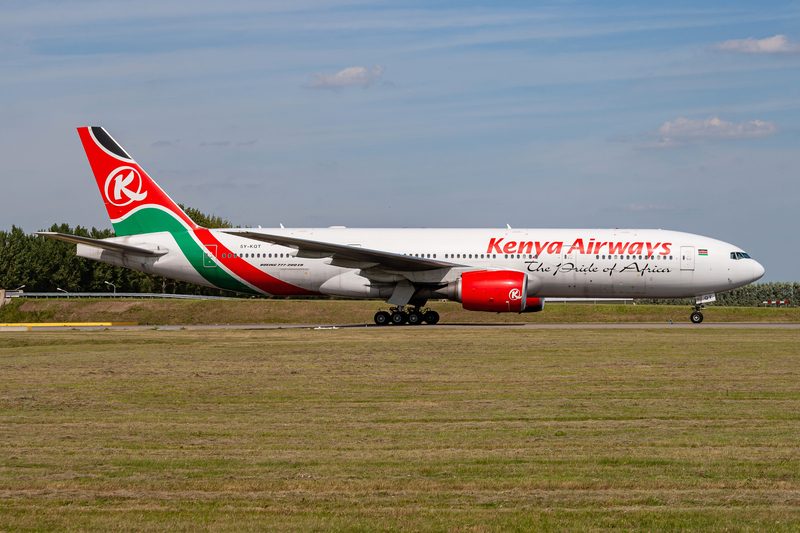
Kenya Airways is preparing to return one of its former Boeing 777-300ERs to scheduled passenger service, more than a decade after the aircraft left the Kenyan flag carrier’s fleet for a long-term lease with Turkish Airlines.

The 400-seat widebody, most recently registered as TC-LKC, arrived at Jomo Kenyatta International Airport (NBO) from Istanbul Airport (IST) on July 7, 2026. Kenya Airways plans to operate the aircraft on several domestic flights before introducing it on its flagship route between Nairobi (NBO) and London Heathrow Airport (LHR) beginning July 17.
The aircraft’s return gives Kenya Airways a substantial short-term capacity increase on one of its most important international routes. It also marks the reappearance of a type the airline removed from regular service in early 2016 after concluding that the Boeing 777-300ER was too large for its network at the time.
Read our stories in your inbox
Two aviation newsletters. Zero fluff.
A Familiar Boeing 777 Returns to Nairobi
The returning aircraft is Boeing 777-3U8ER manufacturer serial number 42097. The “U8” portion of the model designation is Boeing’s former customer code for Kenya Airways, reflecting that the aircraft was originally built specifically for the East African carrier.
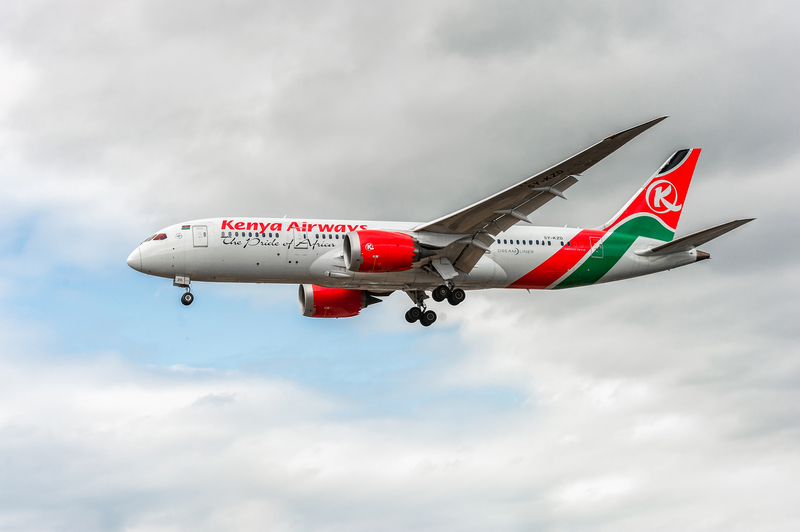
The airplane made its first flight in June 2014 and was delivered to Kenya Airways as 5Y-KZX on July 3, 2014. It joined Turkish Airlines as TC-LKC on March 7, 2016, beginning a lease that ultimately lasted more than 10 years.
Before returning to Kenya Airways, the 777 underwent pre-redelivery maintenance at Istanbul Atatürk Airport (ISL). The aircraft subsequently repositioned from Istanbul Airport (IST) to Nairobi (NBO), where the process of restoring its former Kenyan registration was underway.
The correct Turkish registration is TC-LKC, rather than “TK-LKC,” as it has occasionally been identified in reports.
Kenya Airways acting Group Managing Director and CEO George Kamal confirmed that the aircraft is expected to operate initial sectors from Nairobi (NBO) to Moi International Airport in Mombasa (MBA) between July 12 and July 16. It is then scheduled to enter long-haul service between Nairobi (NBO) and London Heathrow (LHR) on July 17.
Domestic Flights Will Provide an Operational Shakedown
Deploying the aircraft between Nairobi (NBO) and Mombasa (MBA) before sending it to London gives Kenya Airways an opportunity to conduct a controlled operational reintroduction.
The relatively short domestic sectors can help flight crews, cabin crews, maintenance personnel, dispatchers, and ground-handling teams become reacquainted with the 777 before it begins operating a significantly longer international mission. They also provide an opportunity to identify cabin, galley, inflight entertainment, servicing, or dispatch issues without exposing the airline to the disruption that would accompany a technical problem at London Heathrow (LHR).
Although Kenya Airways previously operated three Boeing 777-300ERs, the type has been absent from its active fleet for more than a decade. Reintroducing even a familiar aircraft therefore requires renewed operational procedures, qualified personnel, spare-parts support, and maintenance planning.
The 777 Will Transform Capacity on the Nairobi-London Route
Kenya Airways currently serves Nairobi (NBO) to London Heathrow (LHR) with the Boeing 787-8 Dreamliner. The airline’s standard 787-8 configuration accommodates 234 passengers, including 30 Premier World business-class seats and 204 economy-class seats.
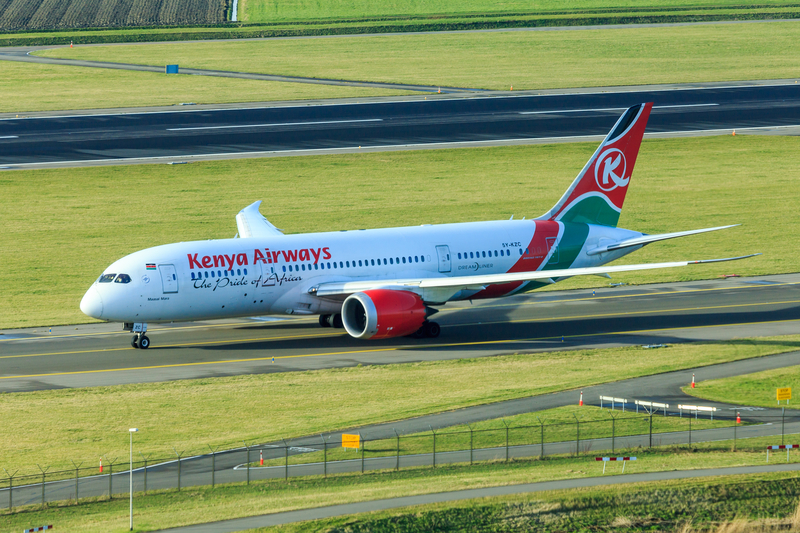
The returning 777-300ER is configured for 400 passengers, with 28 Premier World seats and 372 economy seats. Replacing a 234-seat Dreamliner with the 400-seat 777 adds 166 seats per departure, representing a capacity increase of approximately 71%.
Almost all of that additional capacity is in economy class. The 777 actually has two fewer business-class seats than the 787-8, but it carries 168 more economy passengers. That makes the deployment primarily a high-volume capacity decision rather than a major expansion of Kenya Airways’ premium cabin.
Kenya Airways’ March 2026 trade schedule assigned the 777-300ER to five of the seven weekly KQ100 and KQ101 rotations between July 17 and October 24. Under that plan, the Boeing 787-8 would continue operating the Tuesday and Thursday flights.
A more recent July report listed four weekly 777 services, however, indicating that the final operating pattern may have been adjusted as the aircraft completed maintenance and re-entry preparations. In either case, the 777 is expected to operate most weekly Nairobi-London frequencies. Travelers should continue checking the current KQ100 schedule, as aircraft assignments can change for operational reasons.
The published schedule has KQ100 leaving Nairobi (NBO) at 9:05 a.m. and arriving at London Heathrow (LHR) at 4:15 p.m. The return KQ101 departs Heathrow at 6:25 p.m. and reaches Nairobi at 5:00 a.m. the following morning.
The larger aircraft should also provide Kenya Airways with additional lower-deck cargo flexibility. London is an important passenger and freight market for the carrier, particularly for time-sensitive exports moving from East Africa to the United Kingdom and Europe.
At a slot-constrained airport such as Heathrow (LHR), adding capacity through a larger aircraft can be more practical than attempting to secure additional departure and arrival slots.
Inside Kenya Airways’ 400-Seat 777-300ER
The Boeing 777-300ER remains one of the largest and most capable twin-engine passenger aircraft in commercial service. The type measures approximately 242 feet long, has a wingspan of nearly 213 feet, and offers a published range of up to 7,500 nautical miles.
The returning Kenya Airways aircraft is powered by two General Electric GE90-115B engines. The GE90-115B was developed specifically for the 777-300ER and remains among the most powerful commercial aircraft engines ever placed into regular airline service.
Kenya Airways’ 777 cabin has 28 lie-flat Premier World seats arranged in a 2-3-2 configuration. Economy class contains 372 seats in a 3-3-3 layout.
The nine-abreast economy configuration is notable because many airlines later moved to denser 10-abreast, 3-4-3 layouts on the 777-300ER. Kenya Airways’ configuration provides fewer seats across each row and potentially more seat width than the high-density cabins now common on the type.
The aircraft does not provide the same newer-generation cabin environment as the airline’s Boeing 787-8 fleet, but it gives Kenya Airways something it urgently needs: considerably more passenger and cargo capacity from a single Heathrow slot pair.
A Single-Aircraft Subfleet Creates Operational Risk
Kamal has confirmed that Kenya Airways is working to secure a backup sister aircraft for the returning 777.
That could prove important. Operating a single aircraft of a particular type is rarely ideal for a network airline. If 5Y-KZX becomes unavailable because of an unscheduled maintenance issue, Kenya Airways cannot simply substitute another aircraft with identical capacity and operating characteristics.
A one-aircraft subfleet also creates costs involving pilot qualification, cabin crew training, spare parts, maintenance tooling, engineering support, and flight-planning procedures. Those expenses are easier to justify when spread across two or more aircraft.
A second 777-300ER would provide greater operational resilience and allow Kenya Airways to retain the type’s capacity benefits when one airplane is undergoing maintenance. It could also support seasonal demand, charter operations, pilgrimage flights, or other high-volume routes from Nairobi (NBO).
Kenya Airways originally introduced three 777-300ERs between 2013 and 2014. All three were removed from its operating fleet in January 2016 and subsequently transferred to Turkish Airlines as Kenya Airways reduced capacity and restructured its long-haul operation. The return of 5Y-KZX does not necessarily signal a broad reversal of that strategy, but it does show how dramatically the airline’s capacity requirements have changed.
Dreamliner Groundings Remain Central to the Fleet Strategy
The 777’s return is closely connected to availability problems within Kenya Airways’ Boeing 787-8 fleet.
Kenya Airways owns or operates nine 787-8s, but several have been unavailable because of engine maintenance requirements, spare-parts shortages, and scheduled heavy maintenance. Two Dreamliners have reportedly been grounded since late 2024 amid delays involving General Electric GEnx-1B engine maintenance and the wider aerospace supply chain.
Another 787-8 is undergoing its scheduled 12-year major maintenance inspection. Kenya Airways is performing that level of work internally for the first time, an important step in expanding the airline’s in-house technical capabilities.
Kamal expects all nine Dreamliners to be available by the end of 2027. Until then, the 777 gives Kenya Airways a way to restore capacity without waiting for every grounded 787 to return.
The fleet disruption has had measurable financial and operational consequences. Kenya Airways reported that available capacity declined by approximately 18% in 2025, while revenue fell by around 14%. The airline recorded a pretax loss of KES17.93 billion, equivalent to roughly $138 million at the time, after three Dreamliners were temporarily removed from service.
The 777-300ER therefore serves as more than a symbolic homecoming. It is a bridge aircraft intended to protect capacity, revenue, and schedule stability while the airline works through its Dreamliner maintenance backlog.
Bottom Line
The return of 5Y-KZX gives Kenya Airways a powerful capacity tool at a time when Boeing 787 availability continues to restrict its long-haul operation.
With 400 seats, the Boeing 777-300ER can carry approximately 71% more passengers than the airline’s 234-seat 787-8. That increase is particularly valuable on the Nairobi (NBO)-London Heathrow (LHR) route, where airport slots are limited and additional capacity cannot easily be added through more flights.
The aircraft’s success will depend on reliability, maintenance support, crew availability, and whether Kenya Airways can secure a second 777 as operational backup. A single-aircraft subfleet carries significant risk, especially when it is assigned to one of the airline’s most commercially important routes.
For now, the 777’s return is a pragmatic response to a capacity shortage rather than a nostalgic revival. It gives Kenya Airways additional seats, more cargo flexibility, and breathing room while the carrier restores its full Dreamliner fleet and rebuilds its long-haul operation.