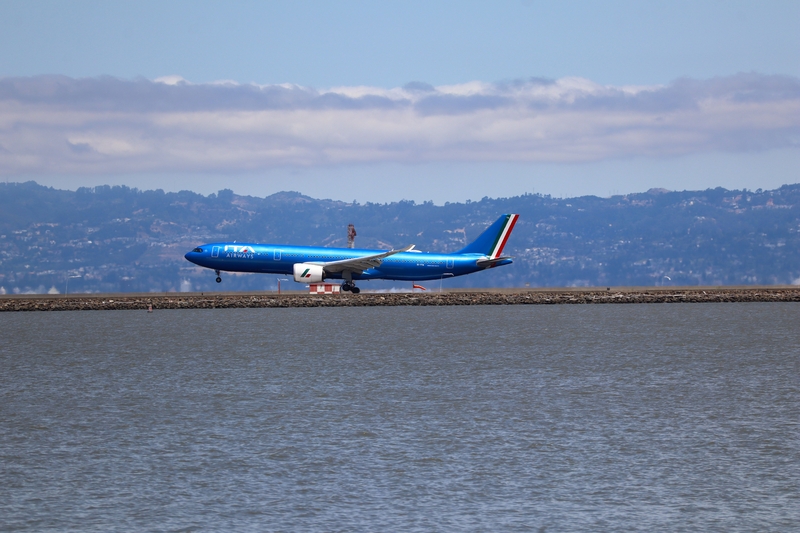
ITA Airways has launched its first nonstop service between Rome Fiumicino Airport (FCO) and George Bush Intercontinental Airport (IAH), giving Houston its first direct link to Rome and adding another important building block to the airline’s U.S. network.
The route began on May 1, 2026, initially operating three times weekly, with plans to increase to five weekly flights from June 1. It is being flown by the Airbus A330-900, one of the most important aircraft in ITA’s long-haul fleet.
This is not just another transatlantic route launch. For ITA Airways, Houston is a strategically serious addition, one that reflects the airline’s wider effort to deepen its long-haul network with markets that can support both premium business traffic and strong leisure demand.
Read our stories in your inbox
Two aviation newsletters. Zero fluff.
Houston Closes A Longstanding Gap In Italy–Texas Connectivity
The most obvious significance of the route is that it finally creates a direct Rome link for Houston.
That matters because Houston is not a niche secondary market. It is one of the United States’ largest international business centers, with major strength in energy, aerospace, engineering, medicine, and global trade. Until now, a city of that scale and profile still lacked nonstop service to Rome.
For ITA Airways, that gap represented an opportunity. A nonstop route between IAH and FCO gives the airline access to a substantial business market while also tapping strong tourism and visiting-friends-and-relatives traffic in both directions.
The Airbus A330-900 Is The Right Aircraft For The Job
The aircraft choice is important.
ITA is using the Airbus A330-900, which is particularly well suited to a route like Houston–Rome. It gives the airline the range and comfort expected on a transatlantic service, while also offering the efficiency advantages of a newer-generation widebody.
That matters because routes like this depend on more than local demand. They depend on economics. The A330neo allows ITA to open a market that is commercially promising without taking on the cost and seat risk of a much larger aircraft.
For an airline still building out its long-haul identity, that is exactly the kind of aircraft discipline you would want to see.
Rome’s Hub Role Makes The Route More Valuable Than It First Appears
The route is not just about Rome itself.
Rome Fiumicino Airport (FCO) remains the center of ITA Airways’ long-haul and intra-European strategy, which means Houston passengers gain not only access to the Italian capital, but also onward connectivity across Italy and Europe. That hub value is especially important for a carrier like ITA, which is still trying to strengthen the usefulness of its network beyond simple point-to-point flying.
This makes the IAH-FCO route more commercially flexible. It can support local business and leisure traffic while also feeding travelers deeper into the airline’s broader European and domestic Italian network.
Houston Is A Business Market, But Not Only A Business Market
One of the more interesting aspects of the route is that it is not purely corporate in character.
Yes, Houston is a major business city, and its links to Italy through energy and industrial sectors are clear. But the route also benefits from strong cultural, tourism, and community demand. Italy remains one of the strongest leisure markets in Europe for U.S. travelers, and nonstop access from a city the size of Houston can stimulate premium leisure traffic as much as business demand.
That matters because the healthiest long-haul routes are often the ones that do not depend on only one kind of traveler.
Five Weekly Flights By June Shows Confidence
The schedule ramp-up is telling.
Starting with three weekly flights and then increasing to five weekly from June 1 suggests ITA is approaching the market with confidence, but not recklessness. The airline is giving itself enough initial flexibility to bed in the route operationally while still scaling quickly into a more meaningful frequency once the summer travel season begins.
That is usually a very good sign in a new long-haul market. It shows the airline is not simply testing the route in a token way. It believes the market can support more than minimal presence relatively quickly.
The Route Also Strengthens ITA’s U.S. Positioning
The Houston addition pushes ITA’s North American footprint further beyond the classic legacy gateways.
That matters because the airline’s long-haul future depends on being more than just another Rome–New York operator. To grow meaningfully, ITA needs major U.S. cities that can support strong yields and offer distinctive demand profiles. Houston fits that requirement well.
For aviation readers, that is one of the clearest takeaways from the launch: ITA is trying to build a more credible North American map by adding strategically valuable cities, not just obvious volume markets.
This Is A Long-Haul Growth Move, Not A Prestige Move
It is tempting to look at a route like this and treat it as symbolic. It is more practical than that.
ITA has made it clear that long-haul expansion sits at the center of its development strategy, and Houston fits that narrative. The route gives the airline another substantial U.S. market, strengthens Rome’s relevance as a connecting hub, and aligns with the kind of widebody growth pattern a rebuilding network carrier needs.
This is not about bragging rights. It is about building a more serious transatlantic business.
Bottom Line
ITA Airways’ new nonstop service between Rome Fiumicino Airport (FCO) and Houston George Bush Intercontinental Airport (IAH) is a meaningful addition for both markets. It gives Houston its first direct Rome link, strengthens ITA’s U.S. network, and reinforces the airline’s strategy of building long-haul growth around Rome with efficient next-generation widebodies.
The use of the Airbus A330-900 and the move from three to five weekly flights in just a month suggest this is more than a tentative experiment. For ITA Airways, Houston looks like a route chosen not for visibility alone, but because it fits exactly the kind of transatlantic network the airline is trying to build.
Keep reading FlyMag
Get the Daily Brief in the morning or the Route Watch weekly recap on Fridays. Or both.