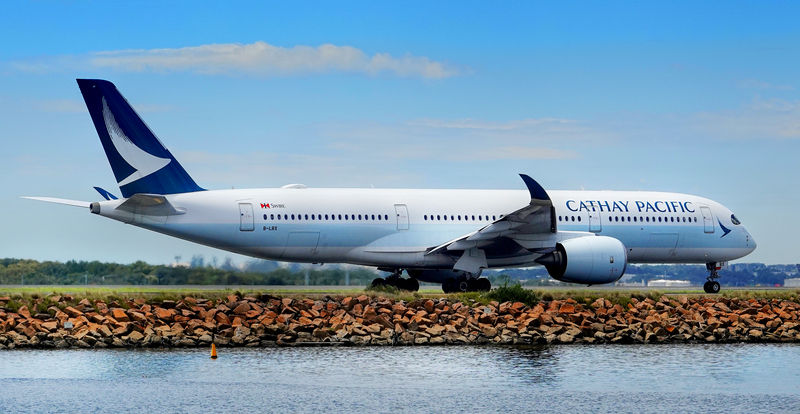
A Cathay Pacific Airbus A350-1000 operating from Hong Kong International Airport (HKG) to London Heathrow Airport (LHR) was intercepted by Hungarian fighter jets after temporarily losing contact with civilian air traffic control over Romania.

The July 4, 2026, incident involved Cathay Pacific flight CX257, operated by Hong Kong-registered Airbus A350-1000 B-LXA. The aircraft remained on its authorized route throughout the event and continued to London Heathrow (LHR) after communication was restored.
Hungarian authorities activated a NATO Quick Reaction Alert after the aircraft failed to establish contact with Romanian controllers. Two Hungarian Gripen fighters launched from Kecskemét Air Base, approached the Cathay Pacific jet near the Hungarian border and issued a visual signal. The A350 crew then re-established radio communication, allowing the fighters to end the intercept and return to base.
Read our stories in your inbox
Two aviation newsletters. Zero fluff.
Cathay Pacific described the event as a temporary loss of communication and said neither the aircraft nor anyone aboard was endangered. Hong Kong’s Civil Aviation Department has nevertheless expressed serious concern and ordered the airline to submit a detailed investigation report.
CX257 Was Flying From Hong Kong to London
Flight CX257 is one of Cathay Pacific’s principal long-haul services between Hong Kong International Airport (HKG) and London Heathrow Airport (LHR).
The nearly 6,000-mile route normally takes approximately 13 to 14 hours, depending on winds, airspace availability and the exact routing used across Asia and Europe.
On July 4, CX257 was operated by B-LXA, an Airbus A350-1041. Flight-tracking information places the aircraft at approximately 38,000 feet as it crossed Romanian airspace toward Hungary. The flight had already completed most of its journey and was following its planned route toward Western Europe.
The available timeline is:
| Event | Reported time |
|---|---|
| NATO Quick Reaction Alert ordered | 1:42 p.m. local time |
| Hungarian fighters departed Kecskemét | 1:51 p.m. |
| Fighters approached the A350 near Hungary | Shortly afterward |
| Visual signal issued to CX257 | During the intercept |
| Radio contact restored | Immediately following the visual signal |
| CX257 continued to London Heathrow (LHR) | Without further reported incident |
Hungarian Defense Minister Romulusz Ruszin-Szendi said the alert was initiated while the A350 was still inside Romanian airspace. The fighters took off nine minutes later from Kecskemét, approximately 53 miles southeast of Budapest.
Reports identify the responding aircraft as Hungarian Saab JAS 39 Gripens. Hungary has used the Gripen for its national and NATO Quick Reaction Alert responsibilities since 2010, with the aircraft stationed at Kecskemét.
The Communication Problem Began Over Romania, Not Hungary
Several early headlines described the aircraft as losing contact “over Hungary.” That is not the most precise account.
According to Hungarian and Hong Kong authorities, CX257 failed to establish communication with Romanian civilian air traffic control while it was still flying through Romanian airspace. The military interception occurred as the aircraft approached or entered Hungary.
That distinction helps explain why Hungarian fighters responded to a communication problem initially detected in another country.
Both Romania and Hungary are NATO members. Their civilian and military air traffic organizations cooperate through NATO’s integrated air and missile defense structure. If an unresponsive aircraft is traveling toward a neighboring country, the fighter aircraft best positioned to make the interception may launch before the airliner crosses the border.
Cathay Pacific emphasized that CX257 continued following its approved route. There has been no indication that the aircraft deviated toward restricted airspace, changed altitude without authorization or displayed any other abnormal flight behavior.
The trigger was the loss of communication—not an unauthorized route change.
Why NATO Fighters Were Dispatched
NATO maintains armed interceptor aircraft on continuous Quick Reaction Alert status to respond to unidentified, unresponsive, distressed or suspicious aircraft.
A commercial flight that stops answering air traffic control does not automatically become a security threat. However, controllers and military authorities cannot immediately determine whether the silence is caused by a radio problem, crew error, medical emergency, unlawful interference or another developing situation.
The purpose of the intercept is to identify the aircraft, observe its condition and establish some form of contact.
NATO explains that Quick Reaction Alert aircraft can approach an unresponsive airplane, visually inspect it and, when necessary, escort it to an airport or out of protected airspace. The interception can be ended once authorities establish that the aircraft is under control and no longer presents an unidentified situation. (NATO Air Policing)
In the case of CX257, the fighters did not force the A350 to divert or land in Hungary. They approached the aircraft, delivered a visual warning and ended the mission once radio communication resumed.
That is an important difference from an interception involving a suspected hijacking, deliberate airspace violation or aircraft following unauthorized instructions.
The Fighters Were Hungarian Saab JAS 39 Gripens
Hungary’s air-defense force operates the Saab JAS 39 Gripen, a single-engine multirole fighter developed in Sweden.
The compact supersonic aircraft is used for air policing, interception, reconnaissance and combat missions. It can be launched quickly, climb rapidly to airline cruising altitudes and operate effectively within the relatively confined airspace of Central Europe.
Hungary originally introduced 14 Gripens and recently expanded its force with additional aircraft. The fighters operate from Kecskemét Air Base and provide Hungary’s contribution to NATO’s standing air-policing system. (Hungarian Gripen operations)
During a civilian interception, the fighter pilots normally position themselves where the airline crew can see them. They can use internationally recognized visual signals, radio calls on emergency frequencies and aircraft movements to attract attention or issue instructions.
The Hungarian defense minister said the Gripen pilots issued a visual signal to CX257. Authorities have not disclosed the precise maneuver or signal used.
A Loss of Contact Does Not Necessarily Mean Every Radio Failed
Cathay Pacific’s description of a temporary loss of communication leaves several possible explanations.
Modern long-haul aircraft carry multiple communication systems, including more than one VHF radio, high-frequency equipment for long-range operations and digital datalink capability. The presence of redundant equipment makes a complete failure less likely, but it does not prevent an aircraft from becoming temporarily unreachable.
During an international flight, controllers repeatedly transfer the aircraft from one frequency and air traffic control sector to another. A controller may instruct the pilots to contact the next facility on a specific frequency as the airplane approaches a sector boundary.
Communication can be lost when:
- A frequency is entered incorrectly
- The correct frequency is entered into the standby window but not activated
- Radio volume is inadvertently reduced
- The wrong audio source or radio transmitter is selected
- The crew remains on the previous sector’s frequency
- A controller provides or reads back an incorrect frequency
- A radio transmission is blocked by another aircraft
- The aircraft moves beyond the range of the previous ground station
- One radio or audio-control component develops a fault
- A handoff is missed during a period of high crew or controller workload
EUROCONTROL safety studies have repeatedly found that incorrect frequency selection and incomplete sector handoffs are among the most frequent causes of prolonged air-ground communication losses. Equipment failures are possible, but they are only one part of a much wider group of potential causes. (EUROCONTROL communication-loss guidance)
Investigators must determine whether the Romanian controller transmitted a frequency change, whether the crew read it back correctly, which radios were selected and what attempts were made to reach the aircraft.
Why Did Contact Resume When the Fighters Arrived?
The timing does not prove that the aircraft’s communication equipment was functioning normally throughout the incident.
A visual intercept can cause the crew to recheck every radio, audio panel and selected frequency. The pilots may return to the previous frequency, call on the international emergency frequency, activate another radio or discover that one communication source had been incorrectly selected.
Controllers can also attempt to reach an aircraft through several alternative channels. These may include:
- The previous ATC sector
- The next ATC sector
- The emergency frequency of 121.5 MHz
- Calls relayed through nearby aircraft
- Airline dispatch or operations control
- Digital controller-pilot communications
The international emergency frequency, commonly called “guard,” gives civilian aircraft and air traffic services a common frequency on which to attempt contact. Guidance recommends monitoring 121.5 MHz when possible, particularly in airspace where interception may occur. (FAA guard-frequency guidance)
It is possible that the fighter pilots’ appearance alerted the crew to a frequency-selection or audio-panel problem that had not previously been noticed. It is also possible that communication resumed through an unrelated technical or procedural action at approximately the same time.
The final answer should come from radio recordings, flight-deck data, air traffic control logs and interviews with the pilots and controllers—not from the timing alone.
There Is No Evidence That Both Pilots Were Asleep
The claim that both pilots may have fallen asleep is unsupported by any information released by Cathay Pacific, Romanian authorities, Hungary, NATO or Hong Kong’s Civil Aviation Department.
It should not be presented as the most likely explanation.
A Hong Kong-London flight would normally carry an augmented flight crew, allowing pilots to take scheduled rest periods during the long cruise. The number of pilots aboard CX257 has not been publicly confirmed, nor has any information been released about which crew members were on the flight deck when communication was lost.
Dual-pilot sleep events have occurred in commercial aviation, but they are exceptionally rare. The existence of previous unrelated cases does not provide evidence that the same thing happened aboard CX257.
Temporary communication losses are far more commonly associated with frequency-selection errors, incomplete handoffs, receiver settings, blocked transmissions and radio problems. EUROCONTROL’s own occurrence analysis identifies those issues as recurring causes of radio silence during en route operations.
There is also no report that CX257 failed to make a required turn, missed a waypoint, changed altitude or continued beyond an intended descent point. The aircraft remained on its authorized route under autopilot and flight-management-system guidance.
That does not establish what the pilots were doing, but it gives no factual basis for asserting that the crew was asleep.
The Aircraft Was Airbus A350-1000 B-LXA
The aircraft involved, B-LXA, was Cathay Pacific’s first Airbus A350-1000 and entered the fleet in 2018.
Its complete model designation is Airbus A350-1041, and its manufacturer serial number is 118. The aircraft is powered by two Rolls-Royce Trent XWB-97 turbofan engines, the exclusive engine option for the A350-1000.
The A350-1000 is the longest passenger version of the A350 family. It measures approximately 242 feet from nose to tail and has a wingspan of about 212 feet. Airbus publishes a maximum range of approximately 9,000 nautical miles for the current model, giving it more than enough capability for the Hong Kong (HKG)-London Heathrow (LHR) route. (Airbus A350-1000 specifications)
Cathay Pacific configures its A350-1000s with 334 passenger seats:
| Cabin | Seats |
| Business Class | 46 |
| Premium Economy | 32 |
| Economy Class | 256 |
| Total | 334 |
The type does not have a First Class cabin in Cathay Pacific service. Its Business Class seats convert into fully flat beds, while Premium Economy and Economy occupy the remainder of the three-cabin layout. (Cathay Pacific A350-1000 seating plan)
The Trent XWB-97 produces as much as 97,000 pounds of takeoff thrust. It was specifically developed for the larger A350-1000 and incorporates a strengthened core and turbine system to support the aircraft’s greater weight and payload requirements. (Rolls-Royce Trent XWB)
No aircraft mechanical problem has been publicly identified in connection with the July 4 communication event.
The Flight Continued Normally After the Interception
Once contact was restored, CX257 was allowed to continue west toward London Heathrow Airport (LHR).
Cathay Pacific said the flight followed its authorized routing throughout the incident and reached its destination as planned. There was no reported emergency landing, passenger evacuation or aircraft damage.
The fighters returned to Kecskemét after authorities were satisfied that communication had resumed.
That outcome shows that the interception achieved its immediate purpose. The aircraft was identified, the crew became reachable and civilian controllers regained normal communication with the flight.
It does not mean the event was insignificant.
An airliner crossing international boundaries without responding to the responsible controller creates uncertainty for surrounding traffic and air-defense organizations. Controllers may be unable to issue revised clearances, weather deviations, traffic instructions or emergency information.
The event also required the launch of armed military aircraft and coordination between Romanian, Hungarian and NATO organizations.
Hong Kong’s Regulator Has Ordered a Report
Cathay Pacific reported the occurrence to Hong Kong’s Civil Aviation Department after the flight.
The department said it was seriously concerned and instructed the airline to conduct a detailed review and submit an investigation report within one week. The regulator is expected to examine the crew’s actions, the condition and settings of the aircraft’s communication systems, and the sequence of communications between CX257 and the air traffic control facilities involved.
Investigators will likely review:
- Cockpit voice recordings, if still available
- Quick-access and flight-data information
- Aircraft communication-system fault messages
- Selected and standby radio frequencies
- Audio-control-panel settings
- Controller recordings and radar data
- Romanian sector-handoff records
- Attempts made on the emergency frequency
- Messages sent through digital datalink
- Contacts between ATC and Cathay Pacific operations
- Statements from the operating pilots and controllers
Because the aircraft continued operating safely, the event may remain an airline and regulatory occurrence investigation rather than becoming a formal accident investigation.
As of July 13, no cause had been publicly identified.
A Previous Route Can Remain Safe During Radio Silence
A temporary communication loss does not mean that air traffic controllers completely lose awareness of an aircraft.
CX257’s transponder and ADS-B transmissions continued providing its identity, altitude, position and direction of travel. The aircraft also continued following the route programmed into its flight-management system.
Controllers could therefore see where the A350 was going even though they could not speak with its pilots.
That significantly reduces the immediate collision risk compared with an unidentified aircraft whose position or intentions are unknown. Controllers can protect surrounding traffic by keeping other aircraft away from the flight’s projected path.
However, surveillance is not a replacement for communication.
Controllers must be able to issue heading, altitude and speed changes as traffic conditions evolve. They may also need to direct an aircraft around severe weather, restricted airspace or a developing emergency.
The longer an aircraft remains silent while approaching national borders or sensitive airspace, the less willing authorities will be to assume that the problem is a harmless frequency error.
The Intercept Does Not Indicate Hostile Intent
The phrase “NATO alert” can sound more dramatic than the actual circumstances.
A Quick Reaction Alert is a readiness and response mechanism, not a declaration that an aircraft is hostile. NATO aircraft routinely intercept airplanes that have lost radio contact, entered airspace without proper identification or required assistance.
The fighters’ job is to establish what is happening before the situation becomes more serious.
CX257 remained on course, maintained its altitude profile and resumed communication following the visual signal. No authority has suggested that the crew deliberately ignored instructions or that the aircraft presented a security threat.
The location of the event may have contributed to the rapid response. The flight was crossing the eastern portion of NATO airspace, in a region where military and civilian air activity receives close scrutiny.
That operational environment can explain why authorities acted promptly without implying that CX257 was suspected of hostile intent.
Bottom Line
Cathay Pacific flight CX257 experienced a temporary loss of communication with Romanian civilian air traffic control on July 4 while operating from Hong Kong International Airport (HKG) to London Heathrow Airport (LHR).
The Airbus A350-1000, registered B-LXA, remained on its authorized route at approximately 38,000 feet. NATO initiated a Quick Reaction Alert at 1:42 p.m., and two Hungarian Gripen fighters departed Kecskemét Air Base nine minutes later.
The fighters approached the A350 near the Hungarian border and issued a visual signal. Communication was then restored, and CX257 continued safely to London Heathrow (LHR).
Cathay Pacific says the aircraft and its occupants were never endangered. Hong Kong’s Civil Aviation Department has nevertheless ordered a full report and described the incident as a matter of serious concern.
The available evidence does not show that the A350 suffered a complete communications-system failure. It also provides no support for speculation that both pilots were asleep.
A missed frequency transfer, incorrect radio selection, audio-panel setting, blocked transmission, ATC handoff problem or equipment fault could each produce a similar period of radio silence. Determining which of those factors was involved will require analysis of the cockpit systems, controller recordings and crew actions.
Until that investigation is complete, the most accurate description is straightforward: CX257 temporarily became unreachable over Romania, Hungarian fighters responded under established NATO procedures, and normal communication resumed without the aircraft deviating or diverting.