Ethiopian Airlines has added Lyon to its European network, but the most interesting part of the new route is not the long-haul flight from Africa. It is the short hop inside Europe.

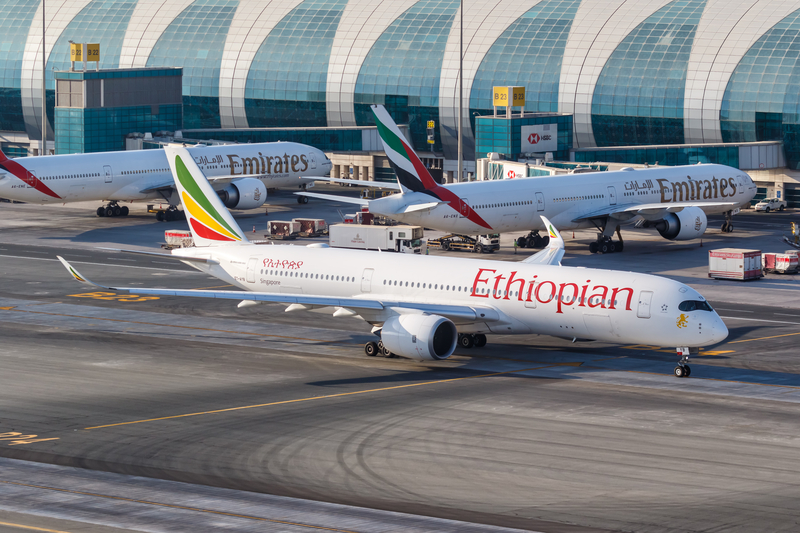
The carrier’s new Addis Ababa Bole International Airport (ADD)–Geneva Airport (GVA)–Lyon-Saint Exupéry Airport (LYS) service creates a scheduled Geneva-Lyon sector of only about 53 nautical miles. Ethiopian has filed the route with the Airbus A350-900, turning GVA-LYS into one of Europe’s most unusual widebody flights and, based on current published schedules, the continent’s shortest scheduled A350 sector.
The flight is blocked at 45 minutes. In pure airborne time, the aircraft may spend only a fraction of that crossing from Switzerland into eastern France. Yet the operation makes sense inside Ethiopian’s broader long-haul network, where one-stop routings and carefully placed European tags have long helped the airline add destinations without operating every city as a standalone nonstop from Addis Ababa (ADD).
Read our stories in your inbox
Two aviation newsletters. Zero fluff.
Lyon Becomes Ethiopian’s Third French Destination
The new Lyon service began on July 2, 2026, and operates three times weekly on Tuesdays, Thursdays, and Saturdays. It gives Ethiopian Airlines a third destination in France, joining Paris Charles de Gaulle Airport (CDG) and Marseille Provence Airport (MRS).

That matters because France has long been one of Ethiopian’s most important European markets. Paris (CDG) provides scale and premium demand, Marseille (MRS) offers access to southern France, and Lyon (LYS) adds the country’s second-largest urban economy into the carrier’s African, Middle Eastern, and Asian connecting network over Addis Ababa (ADD).
Lyon is also a commercially sensible addition. The city and surrounding Auvergne-Rhône-Alpes region have strong business, industrial, academic, pharmaceutical, and diaspora links. For Ethiopian, the route is not just about carrying Lyon-origin travelers to Ethiopia. It is about giving passengers across eastern France access to Ethiopian’s African network, including major cities that are not always easily reached from secondary European airports.
The Schedule Creates a Very Short Widebody Flight
Ethiopian’s published schedule is straightforward. Flight ET738 departs Addis Ababa (ADD) at 00:10 and arrives in Geneva (GVA) at 06:30. After a one-hour stop, the aircraft continues from Geneva (GVA) at 07:30 and arrives in Lyon (LYS) at 08:15.
The return flight, ET739, leaves Lyon (LYS) at 19:20 and lands in Geneva (GVA) at 20:05. It then departs Geneva (GVA) at 21:05 and arrives back in Addis Ababa (ADD) at 04:55 the following morning.

The Geneva-Lyon sector is the eye-catching part. The distance between Geneva Airport (GVA) and Lyon-Saint Exupéry Airport (LYS) is only about 52.5 nautical miles, or 97.3 km. That is shorter than many regional turboprop hops, and dramatically shorter than the type of mission usually associated with the A350-900.
From an aircraft-utilization perspective, it is clearly not an efficient A350 sector on its own. A widebody is not being deployed because Geneva-Lyon demand requires a long-haul aircraft. It is being deployed because the aircraft is already operating Addis Ababa-Geneva, and Lyon is being added as the tag city.
Why Ethiopian Cannot Sell Geneva-Lyon Like a Normal Route
A key detail is traffic rights. Ethiopian’s Geneva-Lyon sector is a tag flight, but it is not being marketed as a standard intra-European fifth-freedom route in the same way as some of the airline’s other European add-ons.
On the outbound journey, Ethiopian cannot simply sell seats from Geneva (GVA) to Lyon (LYS) as a local Switzerland-France trip. On the return, passengers boarding in Lyon (LYS) are not meant to disembark in Geneva (GVA) as if the flight were a standalone Lyon-Geneva service.
That makes the route different from Ethiopian’s Geneva-Manchester operation. Ethiopian has previously been granted fifth-freedom rights between Geneva (GVA) and Manchester (MAN), allowing the airline to sell tickets between Switzerland and the United Kingdom as part of its Addis Ababa-Geneva-Manchester routing.
The Lyon tag is more restrictive. Its main purpose is to extend the Addis Ababa service to a new French destination, not to compete in the local Geneva-Lyon market.
The A350-900 Is Vastly Overqualified for GVA-LYS
The Airbus A350-900 was designed for long-haul and ultra-long-haul flying, not sub-100-kilometer hops. Airbus lists the A350-900 with a range of up to 8,500 nautical miles and typical seating of roughly 332 to 352 passengers in a standard three-class layout.
Ethiopian’s A350-900 cabins vary by aircraft, but one of the airline’s published seat maps shows a 343-seat layout with 30 Cloud Nine Business Class seats and 313 Economy Class seats. That is a serious intercontinental platform: twin-aisle cabin, Rolls-Royce Trent XWB engines, long-haul crew rest capability, large cargo volume, and a passenger experience built for sectors measured in hours, not minutes.
On Geneva (GVA)-Lyon (LYS), the A350 is operating a mission it could complete many times over on a single tank of fuel. The aircraft’s long-range capability is irrelevant to the local sector. What matters is the through-routing from Addis Ababa (ADD), and the ability to carry passengers and cargo into Lyon without adding a separate aircraft type or building a dedicated Europe-based operation.
That is why the flight is so interesting. It is operationally odd in isolation, but logical inside Ethiopian’s network structure.
One-Stop Europe Is Part of Ethiopian’s Playbook
Ethiopian has become one of the world’s most aggressive users of one-stop and fifth-freedom-style routings. The airline’s home geography helps explain why.
Addis Ababa (ADD) sits in a powerful connecting position between Africa, Europe, the Middle East, and parts of Asia. Ethiopian can feed passengers from dozens of African cities into its hub, then distribute them to European destinations that may not justify daily nonstop service by themselves.
Adding a European tag allows the airline to serve more cities with fewer aircraft rotations. Instead of operating separate Addis Ababa-Geneva and Addis Ababa-Lyon flights, Ethiopian can combine the markets, build frequency, and extend its reach in Europe while keeping the widebody tied to a single rotation.
This strategy is not unique to Ethiopian, but the airline uses it unusually well. Its network has included tag sectors and fifth-freedom opportunities that give it broader visibility in Europe and elsewhere, while still anchoring the operation around Addis Ababa (ADD).
Geneva Remains a Flexible European Gateway
Geneva (GVA) has become a useful European stop for Ethiopian. The airline previously used Geneva as a continuation point to Brussels, and it continues to operate services linking Geneva with Manchester (MAN) on other days.
That flexibility is valuable. Geneva is a strong premium and diplomatic market, with international organizations, financial activity, multinational business demand, and high-yield local traffic. It can support Ethiopian’s long-haul presence while also acting as a platform for onward European tags.
Replacing the Geneva-Brussels continuation with Geneva-Lyon changes the emphasis. Brussels is already well served by major network carriers and has deep Africa links through other airlines. Lyon gives Ethiopian a more distinctive French addition and expands the carrier’s France footprint beyond Paris and Marseille.
For Geneva (GVA), the schedule also maintains Ethiopian’s presence and gives the airline a way to keep using the airport as a European distribution point.
What Lyon Gains From the Service
For Lyon (LYS), the new service is more meaningful than the short Geneva sector might suggest. The real value is the one-stop link to Addis Ababa (ADD) and the onward network beyond it.
Ethiopian’s Addis Ababa hub connects to more than 65 destinations across Africa, according to the airline. That gives Lyon passengers access to cities across East Africa, West Africa, Southern Africa, and the Indian Ocean region through a single African hub.
That matters for business travelers, diaspora traffic, NGOs, government travel, tourism, and cargo. Lyon’s industrial base and regional economy make it a stronger candidate for Africa connectivity than its long-haul profile might otherwise suggest. Direct access to Ethiopian’s network reduces reliance on backtracking through Paris (CDG), Frankfurt (FRA), Istanbul (IST), Doha (DOH), Dubai (DXB), or other major hubs.
The service also improves inbound access to Lyon. Travelers from Africa can now reach eastern France through Ethiopian’s network with a through flight number and a single airline itinerary, even though the aircraft stops in Geneva.
Cargo May Be Part of the Equation
Passenger demand is only part of the story. Ethiopian is also one of the world’s most important cargo operators, and widebody belly capacity can be useful on European tag routes.
An A350-900 operating into Lyon (LYS) can carry freight as well as passengers, and Lyon is a strong logistics, industrial, pharmaceutical, and technology region. While the short GVA-LYS sector itself is not cargo-critical, the overall Addis Ababa-Geneva-Lyon routing can support cargo flows between France, Switzerland, Africa, and beyond.
That is one reason widebody tag operations can make sense even when the passenger sector looks strange on a map. The aircraft is not simply moving people from Geneva to Lyon. It is carrying the commercial weight of a broader intercontinental rotation.
A Strange Flight, But Not a Gimmick
It would be easy to treat the 45-minute A350 hop as a curiosity. In some ways, it is. Widebodies on very short sectors always attract attention, especially when the aircraft type is normally associated with long-haul flying.
But Ethiopian’s Geneva-Lyon operation is not a stunt. It is a network-planning solution.
The route gives Ethiopian a third French destination, improves Lyon’s access to Africa, keeps Geneva in the carrier’s European pattern, and uses an aircraft already positioned on the Addis Ababa-Geneva leg. The 53-nautical-mile sector is unusual because of the aircraft, not because the airline lacks a reason to fly it.
That is what makes the service interesting for aviation professionals. It is a reminder that route maps are not always built around distance. They are built around rights, demand, aircraft availability, hub flows, bilateral agreements, cargo, crew patterns, and the economics of serving multiple markets with one rotation.
Bottom Line
Ethiopian Airlines’ new Addis Ababa (ADD)-Geneva (GVA)-Lyon (LYS) service gives the carrier a third destination in France and creates one of Europe’s most unusual scheduled widebody sectors. The Geneva-Lyon leg is only about 53 nautical miles and is blocked at 45 minutes, yet it is filed with the Airbus A350-900, an aircraft designed for intercontinental flying.
The route should not be viewed as a standalone Geneva-Lyon service. Ethiopian does not have local traffic rights on that sector in the same way it does on Geneva-Manchester. Instead, the Lyon tag is a strategic extension of the Addis Ababa-Geneva flight, giving the airline more reach in France while feeding passengers and cargo through its African hub.
For passengers, it is a rare chance to see a long-haul aircraft on an extremely short European sector. For Ethiopian, it is another example of how smart one-stop routing can turn a single widebody rotation into a wider network opportunity.