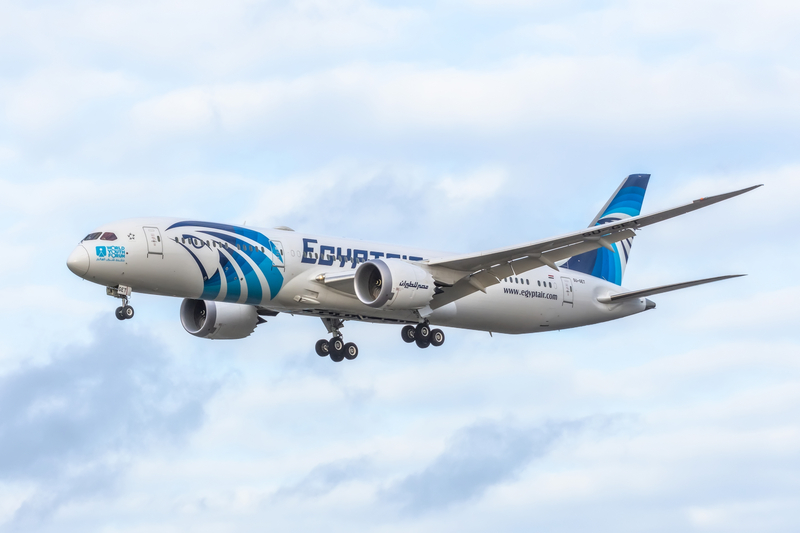
EgyptAir has returned to Los Angeles after a gap of more than two decades, restoring one of the most important long-haul links between Egypt and the western United States.

The Egyptian flag carrier launched nonstop service between Cairo International Airport (CAI) and Los Angeles International Airport (LAX) on May 23, 2026, using its new Airbus A350-900 aircraft. The route gives EgyptAir its first nonstop West Coast service in the United States and significantly expands the airline’s North American reach from its Cairo hub.
For Los Angeles (LAX), the new service adds another long-haul link to North Africa and the Middle East region. For EgyptAir, it is more than a new route. It is a statement about the airline’s long-haul ambitions, its fleet modernization program, and Cairo’s role as a connecting hub between Africa, the Middle East, Europe, and North America.
Read our stories in your inbox
Two aviation newsletters. Zero fluff.
EgyptAir Reopens A Long-Absent Los Angeles Route
EgyptAir previously served Los Angeles (LAX) more than 20 years ago, but not in the same form as today’s operation. The earlier service was routed via New York John F. Kennedy International Airport (JFK), using Boeing 767-300ER aircraft during the 1990s and into the early 2000s.
The new Cairo (CAI) to Los Angeles (LAX) flight is different. It is nonstop, operated by EgyptAir’s newest long-haul aircraft, and designed to connect Southern California directly with Egypt for the first time in scheduled nonstop form.
That distinction matters. Los Angeles (LAX) has long been one of the most significant unserved Egypt-U.S. markets, with demand driven by tourism, business travel, education, film and entertainment links, religious and cultural travel, and the large Egyptian, Arab, and broader MENA communities across Southern California.
From Cairo (CAI), passengers also gain onward access across EgyptAir’s domestic and regional network. That includes connections within Egypt as well as points across Africa, the Middle East, and parts of Europe. The route therefore serves both local Cairo–Los Angeles demand and connecting traffic beyond Cairo.
Three Weekly Airbus A350 Flights To LAX
EgyptAir is operating the Cairo (CAI) to Los Angeles (LAX) route three times weekly, with flights on Monday, Thursday, and Saturday.
The outbound flight, MS983, departs Cairo International Airport (CAI) at 8:30 a.m. and arrives at Los Angeles International Airport (LAX) at 1:20 p.m. local time. The scheduled block time is approximately 14 hours and 50 minutes.
The return flight, MS984, departs Los Angeles (LAX) at 5:25 p.m. and arrives back in Cairo (CAI) at 5:10 p.m. the following day. The eastbound sector is scheduled at around 13 hours and 45 minutes.
The schedule is commercially sensible. The morning departure from Cairo (CAI) allows passengers to arrive in Los Angeles (LAX) in the early afternoon, preserving same-day onward connections and ground transportation options across Southern California. The evening departure from Los Angeles (LAX) gives travelers a full day on the West Coast before an overnight flight to Egypt.
At roughly 7,600 miles, Cairo (CAI) to Los Angeles (LAX) becomes one of EgyptAir’s longest scheduled routes. It is also exactly the type of mission for which the Airbus A350-900 was designed: high-capacity, long-range flying with lower fuel burn than previous-generation widebodies.
Why The Airbus A350-900 Matters
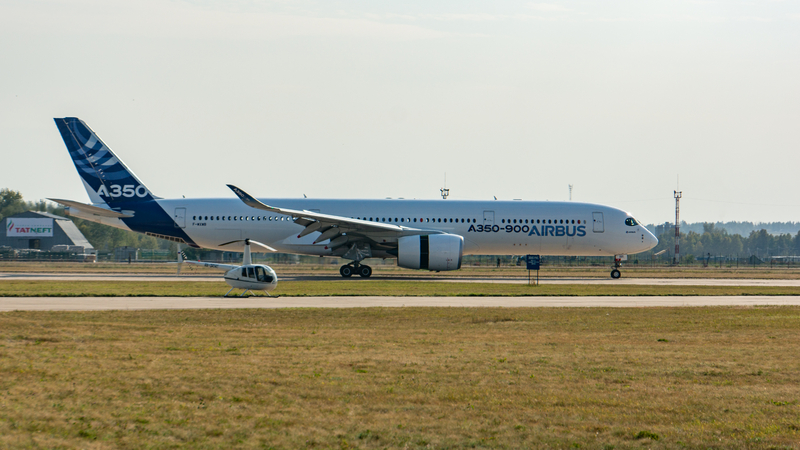
EgyptAir’s decision to deploy the Airbus A350-900 on Los Angeles (LAX) is central to the route’s viability.
The A350-900 gives the airline the range, payload capability, cabin comfort, and operating efficiency needed for a nonstop Cairo (CAI) to Los Angeles (LAX) sector. EgyptAir’s aircraft are configured with 340 seats: 30 Business Class suites and 310 Economy Class seats.
The Business Class cabin features direct aisle access, a significant improvement for EgyptAir’s premium long-haul product. That matters on a flight approaching 15 hours westbound, where cabin comfort, privacy, sleep quality, and service consistency are major factors for premium passengers.
For Economy Class travelers, the A350 also brings the benefits of a modern widebody platform: a quieter cabin, improved cabin pressure, better humidity levels, larger windows, and more efficient air systems compared with older-generation aircraft. Those features are not just marketing points on ultra-long-haul flying. They directly influence passenger fatigue on sectors of this length.
The aircraft also supports EgyptAir’s broader fleet renewal strategy. The carrier has 16 Airbus A350-900s on order, and the type is expected to become a major pillar of its long-haul network. Alongside the Boeing 787-9 Dreamliner and Boeing 777-300ER, the A350 gives EgyptAir a more modern widebody mix for future intercontinental expansion.
Cairo’s Hub Role Becomes More Important
The Los Angeles (LAX) route strengthens Cairo International Airport (CAI) as a connecting hub between North America and the wider region.
Cairo (CAI) is already well positioned geographically for traffic between North America and destinations in Egypt, the eastern Mediterranean, the Gulf, East Africa, North Africa, and parts of South Asia. The challenge for EgyptAir has historically been less about geography and more about product consistency, schedule depth, and long-haul aircraft capability.
The A350 helps address that. A more modern long-haul product makes EgyptAir more competitive for passengers who might otherwise connect over Istanbul (IST), Doha (DOH), Dubai (DXB), Abu Dhabi (AUH), London Heathrow (LHR), Frankfurt (FRA), or Paris Charles de Gaulle (CDG).
Los Angeles (LAX) is especially important because Southern California has enormous international demand but limited nonstop service to Africa. EgyptAir’s new route gives passengers a nonstop option to Cairo (CAI), while also opening one-stop connections beyond Egypt.
For tourism, the route is also valuable in both directions. Egypt receives a meaningful number of U.S. visitors drawn by Cairo, Luxor, Aswan, the Red Sea resorts, Nile cruises, and cultural tourism. A nonstop flight from Los Angeles (LAX) removes a connection from the itinerary and makes Egypt easier to sell to West Coast travelers.
LAX Continues To Build Its Long-Haul Network
Los Angeles International Airport (LAX) is already one of the world’s most important long-haul gateways, but the addition of EgyptAir adds a distinct network benefit.
The airport has extensive nonstop service to Europe, Asia, Oceania, Latin America, and the Middle East. In the broader Middle East, North Africa, and western Asia region, passengers from Los Angeles (LAX) already have options such as Emirates to Dubai (DXB), Qatar Airways to Doha (DOH), Turkish Airlines to Istanbul (IST), EL AL to Tel Aviv (TLV), and Saudia to Jeddah (JED).
EgyptAir adds Cairo (CAI) to that mix, while Royal Air Maroc is also preparing to launch Casablanca (CMN) service from Los Angeles (LAX). Together, those routes make LAX more relevant for nonstop links to North Africa, a region that has historically had limited direct connectivity from the U.S. West Coast.
For EgyptAir, Los Angeles (LAX) is not just a prestige destination. It is a market with a large catchment area, significant long-haul demand, and strong connecting potential. The challenge will be sustaining yields and load factors across a very long sector with only three weekly frequencies.
That frequency level is a cautious but reasonable starting point. Three weekly flights allow EgyptAir to test the market without the aircraft and crew commitment required for daily service. If the route performs well, Los Angeles (LAX) could eventually support more frequency, particularly during peak leisure and summer travel periods.
Chicago Is Next In EgyptAir’s U.S. Expansion
EgyptAir’s U.S. growth does not stop with Los Angeles (LAX). The airline is also preparing to launch nonstop flights between Cairo (CAI) and Chicago O’Hare International Airport (ORD) on June 21, 2026.
The Chicago (ORD) route will also operate three times weekly with Airbus A350-900 aircraft. Flights from Cairo (CAI) will operate as MS947 on Wednesday, Friday, and Sunday, departing at 12:50 a.m. and arriving in Chicago (ORD) at 5:15 a.m. local time.
The return flight, MS948, will depart Chicago O’Hare (ORD) at 10:30 a.m. and arrive in Cairo (CAI) at 5:40 a.m. the following day.
Chicago (ORD) is a logical addition for EgyptAir. It is one of the largest hub airports in the United States, with extensive domestic feed and a large metropolitan population. It also has strong business, academic, medical, and visiting-friends-and-relatives demand, all of which can support a long-haul route to Cairo (CAI).
With Los Angeles (LAX) and Chicago (ORD), EgyptAir’s U.S. network expands to five destinations: New York John F. Kennedy (JFK), Newark Liberty (EWR), Washington Dulles (IAD), Los Angeles (LAX), and Chicago O’Hare (ORD).
A Strategic Moment For EgyptAir
EgyptAir’s return to Los Angeles (LAX) arrives at an important time for the airline.
The carrier is modernizing its long-haul fleet, expanding its U.S. footprint, and attempting to position Cairo (CAI) as a stronger global connecting point. The Airbus A350-900 gives EgyptAir a more competitive platform, particularly on routes where aircraft efficiency and passenger comfort are both essential.
The Los Angeles (LAX) route will still need time to prove itself. Ultra-long-haul flights are expensive to operate, and three weekly service can be challenging for business travelers who value daily frequency. EgyptAir will need to rely on a blend of point-to-point demand, diaspora traffic, tourism, Star Alliance connectivity, and Cairo hub connections to build sustainable performance.
Still, the fundamentals are better than they were two decades ago. The aircraft is more efficient, the product is more competitive, Cairo’s connecting role is stronger, and Southern California has continued to grow as a global long-haul market.
For aviation professionals, the most interesting question is whether EgyptAir views Los Angeles (LAX) as a standalone strategic route or as the beginning of a broader long-haul push using the A350. Given the airline’s orderbook and stated ambitions, the latter seems increasingly likely.
Bottom Line
EgyptAir’s return to Los Angeles (LAX) is a major step in the airline’s U.S. expansion and long-haul modernization strategy.
The new nonstop Cairo (CAI) to Los Angeles (LAX) service restores a market that had been absent from EgyptAir’s network for more than two decades, this time with a modern Airbus A350-900 instead of a one-stop Boeing 767-era routing via New York (JFK).
With three weekly flights, a 340-seat A350 configuration, and a schedule designed for both local and connecting traffic, EgyptAir is making a measured but meaningful move into the U.S. West Coast. The upcoming Chicago O’Hare (ORD) launch will further expand the carrier’s North American presence.
For passengers, the route removes a major connection between Southern California and Egypt. For EgyptAir, it gives the airline a high-profile test of its new long-haul strategy — and a chance to turn Cairo (CAI) into a more relevant gateway between the United States, Africa, and the Middle East.