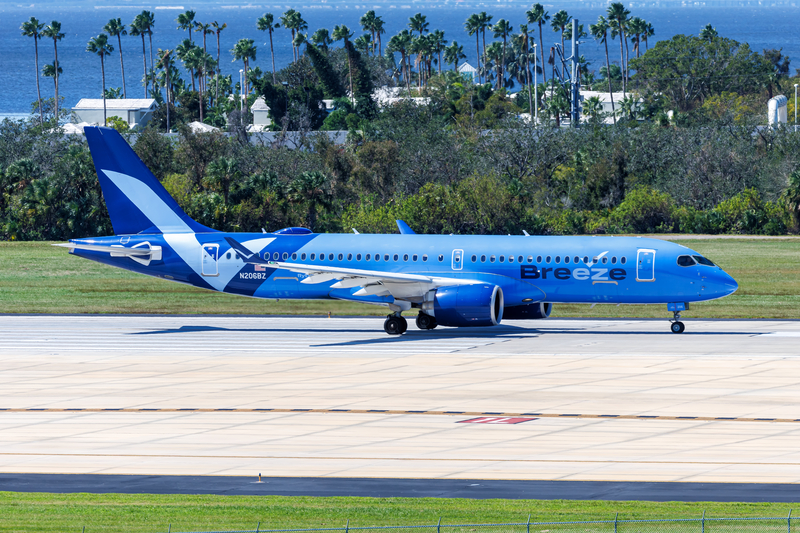
Breeze Airways (MX) is continuing its rapid network build with six new routes launching between March 6 and March 13, including two new cities and a mix of intra-Florida flying and West Coast growth anchored by the airline’s signature Airbus A220-300.

The strategy is classic Breeze: connect smaller or underserved markets with nonstop lift, keep frequency modest where demand is unproven, and use the A220’s economics—good range, low trip cost for its size, and a premium-leaning cabin—to make routes work that wouldn’t support larger narrowbodies.
The carrier is marketing introductory fares “from $39 one-way” on select services.
Read our stories in your inbox
Two aviation newsletters. Zero fluff.
The two new cities: Twin Falls (TWF) and Arcata/Eureka (ACV)
Magic Valley finally gets a second carrier: Las Vegas (LAS)–Twin Falls (TWF)
Breeze launched service to Magic Valley Regional Airport (TWF) in Twin Falls, Idaho on March 6, becoming only the second airline at the airport. That’s a meaningful step for a community that typically relies on a single hub link for most air travel.
The route is operated with the Airbus A220-300 and runs twice weekly (Mondays and Fridays). Operationally, it’s built as a continuation of Breeze’s Santa Ana (SNA)–Las Vegas (LAS) flying, which helps utilization: the aircraft stays productive instead of sitting on the ground between peaks.

Published schedule:
-
MX680: LAS 09:25 → TWF 12:00 (Mon/Fri)
-
MX681: TWF 13:40 → LAS 14:15 (Mon/Fri)
For airline planners, the play is obvious: TWF gets a new leisure-oriented connection to a major destination airport, while Breeze uses LAS as the launch pad to build a “small-city spoke” that can be fed by its growing Las Vegas portfolio.
Humboldt County joins the map: Las Vegas (LAS)–Arcata/Eureka (ACV) and Burbank (BUR)–ACV
Breeze is also entering California Redwood Coast–Humboldt County Airport (ACV), serving Arcata and Eureka for the first time. This is a quintessential Breeze market—scenic tourism demand, limited incumbent capacity, and a strong need for nonstop connectivity that doesn’t require backtracking via a major hub.
Two routes are launching:
-
ACV–Las Vegas (LAS) starts March 11
-
ACV–Burbank (BUR) starts March 12
Both are filed three times weekly.
ACV will become a rare example of a smaller California airport attracting multiple new entrants in a short time window, as other carriers are also eyeing the market. For Breeze, the competitive advantage is getting in early and offering a nonstop product that minimizes friction for leisure travelers.
The intra-Florida add: Orlando (MCO)–Pensacola (PNS) becomes Breeze’s newest “in-state connector”
Breeze is also adding a new Florida link: Orlando (MCO)–Pensacola (PNS) launches March 12 with twice-weekly service.
This is an interesting route choice because the local market is real—but not enormous—meaning the route’s success depends on matching capacity and frequency to demand without trying to force daily flying too early.
The sector is roughly 380 miles and blocks around 1:30–1:35 each way, and Breeze is using its A220-300. The airline’s differentiator here is product positioning: Breeze sells itself as a “premium low-cost” option with no change or cancellation fees and a cabin experience that feels more comfortable than the typical ULCC proposition.
Published schedule:
-
MX854: MCO 08:20 → PNS 08:55 (Thu/Sun)
-
MX853: PNS 09:40 → MCO 12:10 (Thu/Sun)
For Pensacola (PNS), this also adds another spoke into a major Florida demand center, complementing Breeze’s growing set of PNS routes that already span both leisure and business-friendly markets.
The West Coast frequency builder: Las Vegas (LAS)–Santa Ana (SNA) goes daily
Breeze also launched Las Vegas (LAS)–Santa Ana/John Wayne (SNA) on March 6, and it’s the highest-frequency add in the set: daily service.
This isn’t a quiet route. SNA–LAS is contested by multiple carriers, and capacity is plentiful. Breeze’s bet is that it can win on schedule, price discipline, and a product that sits between ULCC and full-service—while using the A220 to keep costs reasonable.
The Utah reload: Provo (PVU)–Las Vegas (LAS) returns March 13
Finally, Breeze is bringing back Provo (PVU)–Las Vegas (LAS) on March 13, operating twice weekly.
PVU has become one of Breeze’s signature growth points in Utah—an alternate to Salt Lake City (SLC) with lower costs and a strong catchment area. Adding PVU–LAS complements Breeze’s broader PVU network, which already includes routes to markets like Burbank (BUR), Orlando (MCO), and Washington Dulles (IAD).
The aircraft that makes this possible: Airbus A220-300 as Breeze’s route-opener
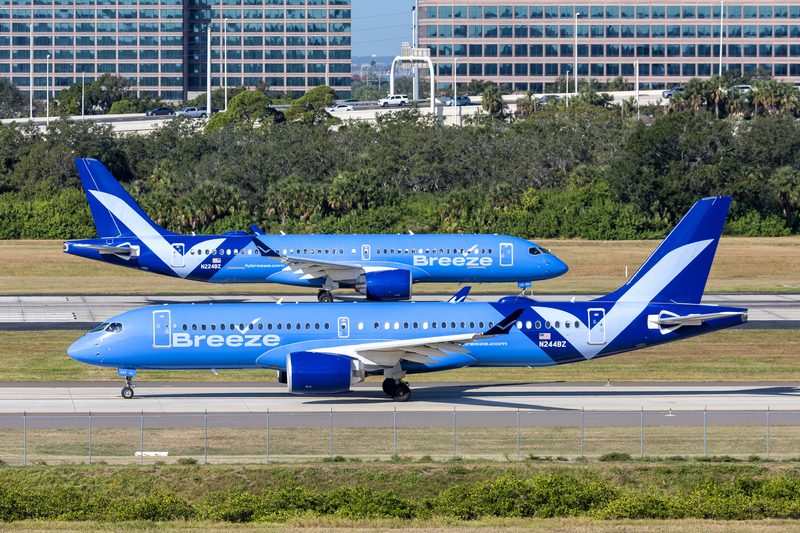
Across this launch wave, the Airbus A220-300 is doing the heavy lifting. It’s the right tool for Breeze’s network thesis:
-
a comfortable 2–3 cabin with strong passenger appeal,
-
efficient economics for medium-length routes,
-
and the ability to right-size markets that can’t support a larger mainline narrowbody profitably.
Breeze also operates the Embraer 190, but the routes in this batch are firmly A220 territory—especially the West Coast sectors and the longer stage lengths into Idaho and northern California.
Bottom Line
Breeze’s latest route wave—six new services launching March 6–13—adds two new cities to the network (Twin Falls (TWF) and Arcata/Eureka (ACV)), expands West Coast flying from Las Vegas (LAS), and introduces a new intra-Florida link between Orlando (MCO) and Pensacola (PNS).
This is exactly how Breeze has grown since 2021: modest-frequency nonstops that open up underserved markets, anchored by the Airbus A220-300’s economics and a product positioned above the typical ultra-low-cost experience.