Etihad Airways has unveiled 11 new long-haul routes in just five days, a burst of network expansion that goes well beyond normal seasonal fine-tuning and points to a carrier moving with unusual intent.

The Abu Dhabi-based airline announced five new mainland China routes, followed days later by six additions in Africa. Taken together, the move suggests Etihad is no longer simply rebuilding its network after years of retrenchment. It is now using its improved financial footing and growing Boeing 787-9 fleet to strengthen Abu Dhabi Zayed International Airport (AUH) as a bridge between Asia, Africa, and the wider world.
For aviation readers, the most important point is that these are not random additions. The China and Africa moves complement each other, and the airline has been unusually direct about the cargo, trade, and connectivity rationale behind them.
Read our stories in your inbox
Two aviation newsletters. Zero fluff.
The China Push Is A Serious Scale-Up, Even From A Small Base
Before this latest announcement, Etihad’s mainland China passenger network was far smaller than many would expect from a Gulf network carrier. The airline’s only mainland China passenger service was its daily Abu Dhabi (AUH) to Beijing Daxing Airport (PKX) operation.
That is what makes the latest expansion so notable.
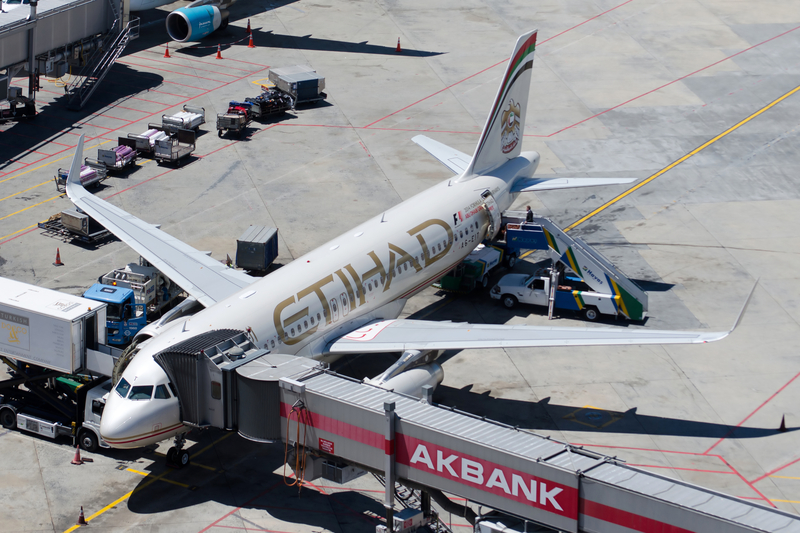
With the addition of Shanghai Pudong Airport (PVG), Guangzhou Baiyun Airport (CAN), Hangzhou Xiaoshan Airport (HGH), Chengdu Tianfu Airport (TFU), and Shenzhen Bao’an Airport (SZX), Etihad will move from one mainland China destination to six. The increase in weekly frequencies is just as telling. The airline says it is adding 28 weekly flights on top of the existing seven, taking its mainland China operation to 35 weekly services.
That is a 400% increase in China flying, even if the starting point was relatively modest.
These Are Not Just Obvious Flagship Cities
One of the more interesting aspects of the China expansion is the city mix.
Shanghai Pudong Airport (PVG) and Guangzhou Baiyun Airport (CAN) are obvious choices. Both are major international gateways with deep commercial relevance, strong cargo demand, and wide business appeal. But Hangzhou Xiaoshan Airport (HGH), Chengdu Tianfu Airport (TFU), and Shenzhen Bao’an Airport (SZX) show a more targeted kind of thinking.
These are not vanity destinations. They are high-value economic markets.
Hangzhou is one of China’s most important digital-economy centers. Shenzhen is one of the world’s leading technology and export cities. Chengdu is a major commercial and industrial center in western China. That tells you Etihad is not just chasing big-city prestige. It is going after business flows, manufacturing demand, cargo relevance, and city pairs that fit a trade-and-transit model.
The China Expansion Is Deeply Tied To The China Eastern Joint Venture
The five new China routes do not sit in isolation. They are part of a broader strategic framework already built around Etihad’s joint venture with China Eastern Airlines.
That matters because the scale of the new route bank makes much more sense when viewed through a partnership lens. Joint ventures are designed to do more than codeshare. They allow airlines to coordinate schedules, build connecting relevance, and create stronger combined networks than either carrier could build alone.
Etihad’s latest China push looks like the clearest sign yet that the China Eastern relationship is moving into a more ambitious phase. The airline is not merely maintaining a presence in China. It is building toward something closer to a real network position.
The Cargo Story Matters Just As Much As The Passenger Story
Etihad has been particularly explicit that the China expansion is not only about travelers.
The airline has said the new routes will strengthen the movement of both passengers and goods between the UAE and China, and that is a crucial point. Abu Dhabi (AUH) is being developed not just as a passenger hub, but also as a freight bridge connecting China to the Middle East, Africa, Europe, and beyond.
That is why the Boeing 787-9 assignment is so important.
A 787-9 is not just a passenger aircraft with range. It is also a platform with meaningful belly cargo capability. On routes to major export and manufacturing centers such as Shenzhen (SZX), Guangzhou (CAN), and Shanghai (PVG), that matters a great deal. These are markets where cargo is part of the route case, not a secondary benefit.
The Africa Expansion Is Equally Ambitious
The second half of the 11-route burst may be even more revealing.
Etihad has announced six new African destinations: Asmara International Airport (ASM), Kotoka International Airport (ACC) in Accra, N’djili Airport (FIH) in Kinshasa, Murtala Muhammed International Airport (LOS) in Lagos, Robert Gabriel Mugabe International Airport (HRE) in Harare, and Lubumbashi International Airport (FBM).
That is a substantial increase for a network that already includes points such as Johannesburg O.R. Tambo Airport (JNB), Nairobi Jomo Kenyatta Airport (NBO), Addis Ababa Bole Airport (ADD), Casablanca Mohammed V Airport (CMN), and others. Adding six cities in one push is not a marginal adjustment. It is a clear statement that Africa has become a core growth theater for the airline.
These Are Large, Strategic Markets, Not Experimental Niches
The African choices are also revealing.
Lagos is one of the continent’s biggest commercial markets and one of the most strategically important cities in West Africa. Accra is a fast-growing capital with rising commercial relevance and strong regional demand. Kinshasa and Lubumbashi give Etihad access to the Democratic Republic of the Congo, one of Africa’s most underconnected but economically consequential markets in aviation terms. Harare adds another Southern African spoke, while Asmara gives Etihad a route with both regional and diaspora significance.
This is not an airline fishing around the edges of Africa. It is adding major urban and commercial centers where Gulf connectivity, cargo demand, and long-haul transfer traffic can all matter.
The China And Africa Moves Depend On Each Other
The most interesting strategic angle is that the two announcements are not separate stories.
Etihad is clearly trying to build Abu Dhabi (AUH) into a stronger bridge between Africa and Asia, and especially between Africa and China. That is where the route logic becomes more powerful.
Many of the new African destinations have limited direct connectivity to China and limited eastbound long-haul options beyond a handful of Gulf and international carriers. By simultaneously building out China and Africa, Etihad is increasing the usefulness of both networks. A passenger from Lagos (LOS), Accra (ACC), Kinshasa (FIH), or Harare (HRE) gains more one-stop access to China through Abu Dhabi. A shipper in China gains more one-stop access to African markets through the same hub.
That is why this 11-route blitz matters more than its headline count suggests. It is not just growth. It is network architecture.
The 787-9 Assignment Shows Real Commitment
Etihad could have been more cautious.
Some of the new African routes, in particular, might have looked like natural candidates for the Airbus A321LR, which the airline is also bringing into its wider strategy. On paper, a smaller narrowbody could have reduced risk on thinner long-haul sectors.
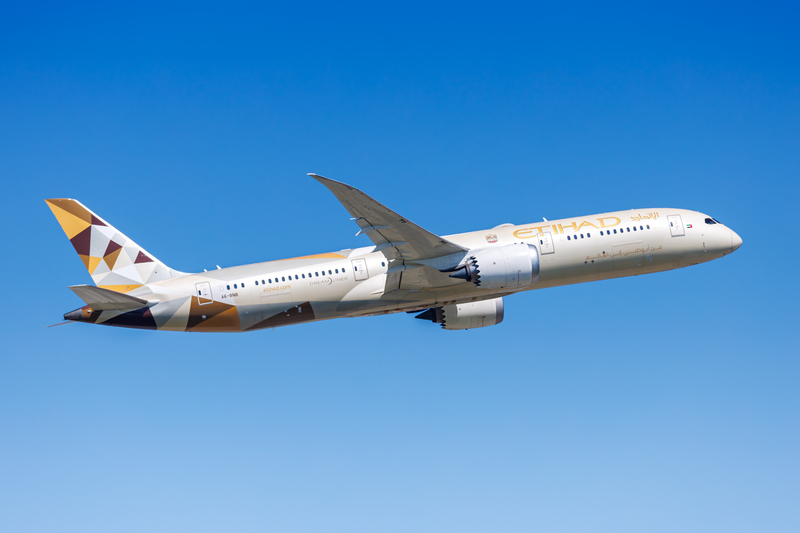
Instead, Etihad has assigned the Boeing 787-9 across all of the new China and Africa routes.
That tells you how the airline views these markets. It sees them as routes that need real premium capacity, real cargo capability, and proper integration into long-haul connection banks at Abu Dhabi (AUH). These are not being treated as lightly tested seasonal experiments. They are being plugged into the main network using a true widebody product.
That is a strong vote of confidence.
Abu Dhabi Is Being Rebuilt As A Bigger Connector Hub
The larger message behind all this is about Abu Dhabi itself.
Etihad wants AUH to be more than a home base. It wants it to be a more important transfer platform between regions that are growing quickly but are still not always well linked to one another. China, Southeast Asia, the Gulf, Africa, and selected parts of Europe can all fit inside that strategy.
This is also where Etihad’s recent financial improvement becomes relevant. The airline has more room now to take network bets that would have looked difficult a few years ago. With a larger fleet, better results, and a clearer strategic direction, it is in a stronger position to pursue bridge traffic rather than merely defend core routes.
Bottom Line
Etihad’s 11 new long-haul routes in five days are not just an aggressive burst of announcements. They are a coordinated statement about where the airline thinks future value lies.
The five new China routes strengthen Etihad’s position in trade-heavy and technology-driven markets while deepening its China Eastern partnership. The six new African routes add large, commercially relevant cities with strong potential for both passenger and cargo traffic. The common thread is Abu Dhabi (AUH), which Etihad is increasingly shaping as a bridge between Africa and Asia rather than simply a Gulf endpoint.
The use of the Boeing 787-9 across all 11 routes makes the strategy even clearer. Etihad is not tiptoeing into these markets. It is going in with a proper widebody commitment and a network plan built around scale, cargo, and long-haul connectivity.
Keep reading FlyMag
Get the Daily Brief in the morning or the Route Watch weekly recap on Fridays. Or both.