American Airlines is preparing to restore nonstop service between Miami International Airport (MIA) and Simón Bolívar International Airport (CCS), with flights expected to resume as soon as April 30.

That date still comes with an important qualifier. The airline has made clear that the restart remains subject to final government approvals and ongoing security preparations. So while the route is now much closer to reality than it was earlier this year, it should still be viewed as a planned relaunch rather than a fully locked-in resumption.
Even so, the significance is obvious. If the service starts on schedule, it will mark the return of a U.S. airline to Venezuela for the first time in more than six years.
Read our stories in your inbox
Two aviation newsletters. Zero fluff.
Miami Is the Logical Gateway
The choice of MIA is no surprise.
Before the 2019 suspension, American Airlines was the dominant U.S. carrier in the Venezuela market, and Miami was the natural anchor for that network. The South Florida gateway remains the strongest U.S. point for Venezuela traffic, given its large diaspora base, deep Latin America connectivity, and longstanding business and family links with Caracas.
That makes MIA–CCS much more than a symbolic restart. It is the one route that can most credibly test whether the market is ready for a broader rebuilding of U.S.–Venezuela air service.
Envoy’s Embraer 175 Keeps the Relaunch Measured
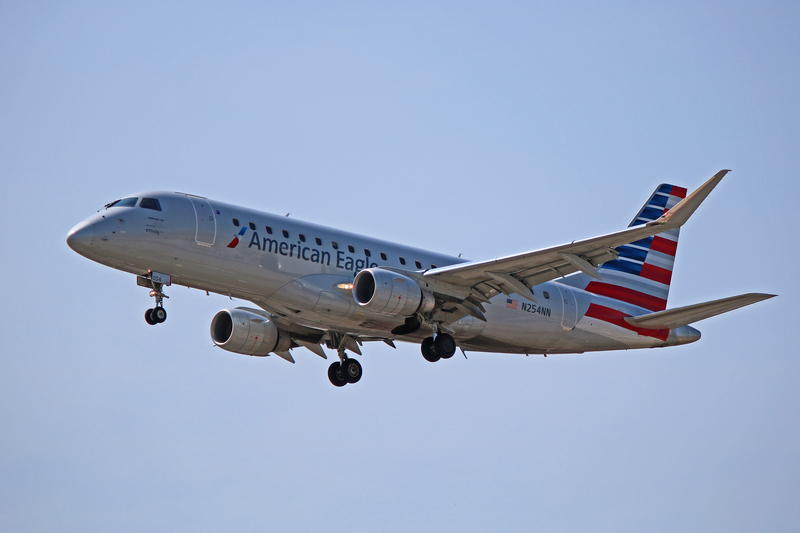
American is planning to operate the route with Envoy Air, its wholly owned regional subsidiary, using the Embraer 175.
That aircraft choice matters. The E175 is a much more cautious tool than a mainline Boeing 737 or Airbus A320-family jet. It allows American to return with a smaller-capacity, two-class product while still offering a business cabin and a more familiar network-carrier experience.
In strategic terms, that suggests discipline rather than exuberance. American clearly sees enough demand to return, but it is also acknowledging that this market needs to be rebuilt carefully. The E175 is the right aircraft for that kind of measured re-entry.
This Is a Regulatory Story as Much as a Route Story
The restart is only possible because the policy environment has shifted.
The U.S. Department of Transportation approved American’s request in March after the earlier 2019 restriction on U.S.–Venezuela flying was lifted. But regulatory permission alone was never going to be enough. Airport security checks have also been part of the process, and American has continued to emphasize that the final launch depends on both government clearance and operational readiness.
That is why the route should be read as a cautious reopening rather than a blanket normalization of the market. American is returning, but it is doing so under closer oversight than a standard international relaunch would require.
Why This Route Matters Beyond Point-to-Point Demand
The obvious demand base is family, personal, and humanitarian travel, and that alone is substantial.
But the route also has broader strategic value. American can use MIA not just as a local origin point, but as a gateway into its wider Latin America and domestic U.S. system. For travelers heading beyond South Florida, that adds real usefulness to the relaunch. For American, it creates a better traffic base than a purely local Miami–Caracas route would offer.
That is especially important in a market returning after a long suspension. Connectivity helps make the economics stronger and gives the airline more room to build the route gradually.
A Careful First Step, Not a Full Rebuild
It would be a mistake to read this as American suddenly restoring its historic Venezuela network.
The airline once had a much deeper presence in the country, but the current plan is far more limited and far more cautious. That is sensible. Conditions may be better than they were during the shutdown period, but they are not being treated as fully normalized.
This is a first step. If the route performs well and the operating environment remains stable, it could eventually support broader restoration. But for now, the focus is clearly on getting MIA–CCS back into the market safely and consistently.
Bottom Line
American Airlines’ planned restart of MIA–CCS is one of the more significant Latin America route developments of the year.
It restores a high-profile market after a six-year gap, puts a U.S. carrier back into Venezuela, and does so in a way that looks commercially disciplined. Using the Embraer 175 through Envoy keeps the relaunch measured, while Miami provides the strongest possible U.S. gateway for the return.
The key point is that this is not yet a fully completed restart. It is a near-term relaunch that still depends on final approvals. But if it proceeds as expected, it will mark the first real step in rebuilding direct U.S.–Venezuela air connectivity.
Keep reading FlyMag
Get the Daily Brief in the morning or the Route Watch weekly recap on Fridays. Or both.