AirAsia AirAsia (AK) is reportedly closing in on a major Airbus A220 commitment—around 100 aircraft, with options for roughly 50 more—a move that would mark the group’s first step into smaller, purpose-built short/medium-haul narrowbodies outside its familiar A320-family playbook.
If this lands as described, it’s not just a “big order” headline. It’s a strategic signal that AirAsia is preparing to add a true lower-gauge aircraft that can defend frequency, open thinner city-pairs, and make better economic sense on routes where an A320neo is simply more airplane than the market wants—especially outside peak travel weeks.
The group’s core base at Kuala Lumpur International Airport (KUL) is the natural center of gravity for this story. KUL is where scale lives, where banks are built, and where a smaller narrowbody can create new “connectivity math” without forcing the airline to dilute yields by dumping A320 seats into marginal demand.
Read our stories in your inbox
Two aviation newsletters. Zero fluff.
Why the A220 fits the “regional” mission without being a regional jet
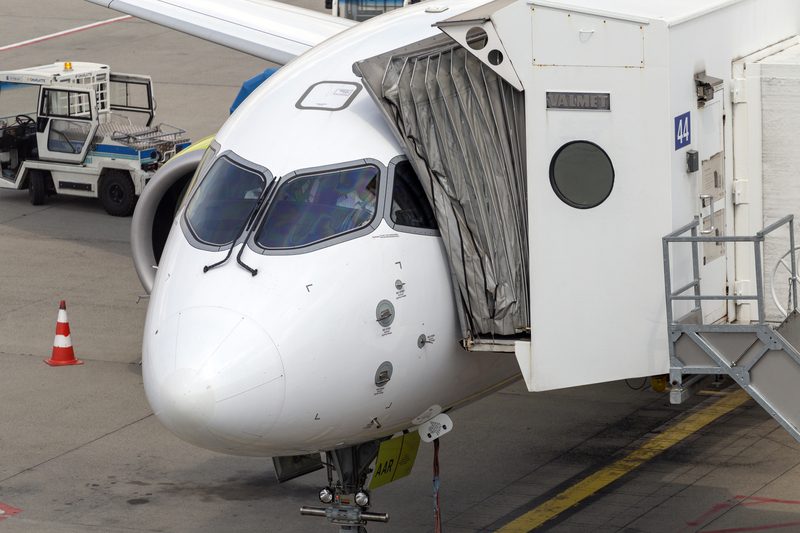
Despite how the industry casually labels it, the A220 isn’t a traditional “regional jet” in the CRJ/ERJ sense—it’s a clean-sheet single-aisle designed to be efficient in the 100–160-seat bracket. Airbus positions it as a complement to the A320 family, and the key performance numbers explain why:
-
A220-100: up to 135 seats, up to 3,600nm range
-
A220-300: up to 160 seats, up to 3,400nm range
For an LCC, those ranges are less about flying ultra-long missions every day and more about operational flexibility: alternates, weather deviations, seasonal payloads, and the ability to run longer stage lengths without forcing an upgauge to a larger aircraft.
Technically, the A220’s efficiency story is tightly tied to its Pratt & Whitney GTF powerplant family and a modern aerodynamic package built for lower trip costs in this segment. For AirAsia, the A220’s value proposition isn’t just fuel burn—it’s the total mission package: seat-mile cost in the right size, with strong “hot day” performance margins and an airframe designed to do a lot of cycles without living on the maintenance edge.
The network logic: frequency, right-sizing, and opening thinner lanes from KUL
AirAsia’s network model thrives on frequency where it matters and on filling aircraft through price stimulation where it can. The problem is that an A320-family fleet can leave a gap: markets that can support two daily flights of ~140–160 seats may not support two daily flights of ~180 seats, and running fewer frequencies can be commercially damaging in business-heavy or connection-sensitive markets.
That’s where an A220 can quietly become a network weapon:
-
Higher frequency with less seat-risk: more departure choices without flooding the market.
-
Better “shoulder season” economics: keeping routes alive when demand is soft but strategically important.
-
New route experiments with less downside: a cleaner way to test city-pairs that would be too risky on an A320.
From KUL, this could translate into more precise deployment across domestic Malaysia and short-haul international markets—without AirAsia needing to lean as hard on deep discounting to fill the last rows. And because KUL is a connection-heavy environment, right-sizing doesn’t just protect local point-to-point demand; it can strengthen connecting flows by making schedules more bankable.
The operational reality: adding a new type isn’t free
AirAsia has historically benefited from the simplicity of a largely Airbus narrowbody ecosystem. Introducing the A220 means real complexity: pilot type ratings, simulator capacity, spares provisioning, engineering training, and the slow ramp of dispatch reliability that comes with any new fleet type—even a mature one.
That said, the airline isn’t making this decision in a vacuum. AirAsia has been open since mid-2025 that it was evaluating aircraft in the A220/Embraer E2 size class—essentially acknowledging that its next phase of growth needs a lower-capacity tool. If you’re building a high-frequency network across markets with uneven demand curves, a two-size narrowbody strategy is often the difference between sustainable growth and “growth that only works in peak season.”
What to watch next if the deal is real
If you want to read this like an airline professional, the biggest tells won’t be the headline number—they’ll be the details AirAsia and Airbus Airbus choose to reveal (or avoid):
-
Variant mix: more -300s suggests a direct A320 complement; more -100s suggests deeper right-sizing and thinner market focus.
-
Cabin density and pitch strategy: a high-density layout changes the trip-cost curve and how aggressively AirAsia can price against competitors.
-
Delivery timeline: early slots would imply Airbus believes it can feed the supply chain reliably; later slots could indicate the order is more “strategic stake” than immediate capacity play.
-
Base plan beyond KUL: whether AirAsia concentrates the type at KUL or spreads it across key group stations will signal how it intends to manage complexity.
Bottom Line
A ~100-aircraft A220 deal—plus options—would be a defining fleet shift for AirAsia, giving it a true right-sizing lever below the A320 family. If the order is confirmed, expect the biggest impact to show up not in splashy new city announcements, but in the quiet mechanics of network design: more frequency where it matters, better economics in weaker seasons, and a lower-risk pathway to open thinner routes from hubs like KUL.