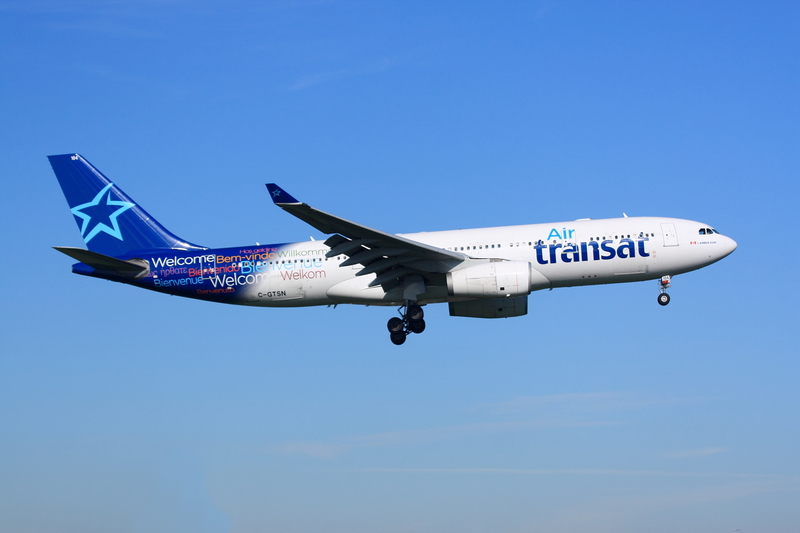
Air Transat is making one of its most ambitious transatlantic moves in years, adding seven new international routes for the 2026 summer season from Ottawa, Quebec City, Montréal, and Toronto.

The Canadian leisure carrier is expanding into the United Kingdom, France, Morocco, Senegal, Iceland, and Albania, using a mix of Airbus A321LR narrowbodies and Airbus A330 widebodies. The strategy is clear: Air Transat is targeting long, thin markets where nonstop demand exists, but where a traditional high-capacity widebody service may be too much aircraft.
Several of the routes are especially notable. Ottawa (YOW) has regained nonstop London Gatwick (LGW) service. Quebec City (YQB) is gaining direct access to Marseille (MRS) and Nantes (NTE), bypassing the usual Paris connection. Montréal (YUL) is adding new links to Agadir (AGA), Dakar (DSS), and Reykjavík/Keflavík (KEF). Toronto (YYZ) is getting a first-of-its-kind nonstop route to Tirana (TIA), giving Albania its only scheduled nonstop link to North America.
Read our stories in your inbox
Two aviation newsletters. Zero fluff.
For Air Transat, this is not simply a summer capacity increase. It is a focused network play built around underserved city pairs, diaspora demand, leisure traffic, and the economics of modern Airbus aircraft.
Seven New Long-Haul Routes Across Europe And Africa
Air Transat’s summer 2026 expansion covers a wide geographic spread, from Western Europe to North Africa, West Africa, the North Atlantic, and the Balkans.

The current route list includes:
| Route | Start Date | Frequency | Planned Aircraft | Strategic Note |
|---|---|---|---|---|
| Ottawa (YOW) – London Gatwick (LGW) | May 15, 2026 | 3 weekly | Airbus A321LR | Restores a nonstop transatlantic link from Canada’s capital region |
| Quebec City (YQB) – Marseille (MRS) | May 21, 2026 | 1 weekly | Airbus A321LR | Direct access from Quebec to southern France |
| Quebec City (YQB) – Nantes (NTE) | June 2, 2026 | 1 weekly | Airbus A321LR | New western France route from Quebec City |
| Montréal (YUL) – Agadir (AGA) | June 12, 2026 | 1 weekly | Airbus A321LR | First nonstop North America–Agadir link |
| Montréal (YUL) – Reykjavík/Keflavík (KEF) | June 16, 2026 | 2 weekly | Airbus A321-family aircraft | Air Transat’s first Iceland route |
| Montréal (YUL) – Dakar (DSS) | June 17, 2026 | 2 weekly | Airbus A321LR | Rare nonstop Canada–Sub-Saharan Africa link |
| Toronto (YYZ) – Tirana (TIA) | June 18, 2026 | 1 weekly | Airbus A330 | Only nonstop North America–Albania route |
That list also explains why the route count can look confusing. Air Transat’s broader summer program included additional new flying, including the Montréal (YUL)–Ottawa (YOW) domestic feeder route and a planned Toronto (YYZ)–Accra (ACC) service. The Ottawa–Montréal link is not transatlantic, while the Accra route was later postponed. The current long-haul expansion story is therefore best understood as seven new international/transatlantic routes that are active or scheduled for the 2026 summer program.
Ottawa Regains A London Link
The most symbolically important route may be Ottawa (YOW) to London Gatwick (LGW).
Air Transat launched the route on May 15, 2026, operating three times weekly with the Airbus A321LR. For the Ottawa–Gatineau region, this is a significant restoration of direct transatlantic access. Canada’s capital has often been underserved internationally compared with Toronto (YYZ) and Montréal (YUL), despite having a strong government, diplomatic, academic, technology, and visiting-friends-and-relatives travel base.
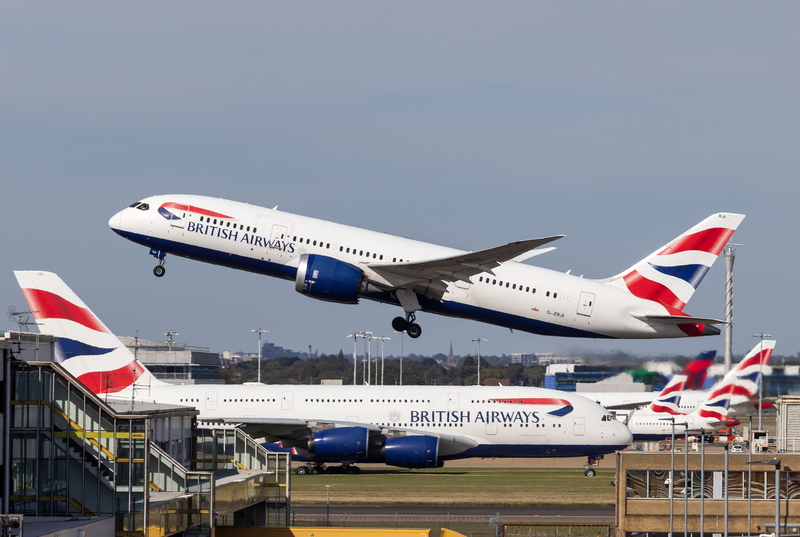
London Gatwick (LGW) is not Heathrow (LHR), but it is still one of the United Kingdom’s most important airports. It gives Ottawa (YOW) travelers direct access to London and southern England, while also offering onward connectivity through Gatwick’s extensive European and leisure network.
The aircraft choice is central to the economics. A three-weekly Ottawa (YOW)–London Gatwick (LGW) route is exactly the kind of market the Airbus A321LR was built to serve. The aircraft gives Air Transat long-haul range with fewer seats than an Airbus A330. That reduces risk while still offering a proper transatlantic product, including Club Class, Economy, inflight entertainment, and long-haul service standards.
The timing also fits Air Transat’s broader partnership strategy. With Porter Airlines building Ottawa (YOW) into a larger eastern Canadian focus city, Air Transat can draw feed from more Canadian and U.S. points than Ottawa alone might otherwise provide. That makes the route more than a local Ottawa–London service. It becomes part of a wider eastern Canada transatlantic flow.
Quebec City Gets Two New France Routes
Quebec City Jean Lesage International Airport (YQB) is one of the biggest beneficiaries of Air Transat’s 2026 program.
The airline is launching two new nonstop routes from Quebec City (YQB) to France: Marseille Provence Airport (MRS) and Nantes Atlantique Airport (NTE). Both are being flown with the Airbus A321LR, giving Air Transat a right-sized aircraft for seasonal regional France demand from Quebec.
The Quebec City (YQB)–Marseille (MRS) route began May 21, 2026, operating once weekly. Marseille (MRS) gives travelers direct access to Provence, the Côte d’Azur region, southern France, and Mediterranean cruise and leisure markets. For Quebec travelers, it removes the need to connect through Paris Charles de Gaulle (CDG), Montréal (YUL), or another European hub to reach southern France.
The Quebec City (YQB)–Nantes (NTE) route begins June 2, 2026, also operating once weekly with the A321LR. Nantes (NTE) serves western France, including the Loire region, Brittany access, the Atlantic coast, and a large catchment area that is often inconvenient to reach from Canada without a connection.
These routes show how Air Transat is using Quebec City (YQB) differently from a traditional network airline. Rather than funneling every passenger through Montréal (YUL), the carrier is taking advantage of Quebec City’s local demand, francophone travel ties, and seasonal leisure flows.
For passengers, the value is obvious: a nonstop flight from Quebec City (YQB) to regional France. For Air Transat, the advantage is equally clear: limited nonstop competition, a strong local cultural connection, and an aircraft with enough range but not excessive capacity.
Montréal Adds A New Morocco Gateway With Agadir
Montréal (YUL) to Agadir (AGA) is one of the more interesting additions in the program.
The route begins June 12, 2026, operating once weekly with the Airbus A321LR. It gives Air Transat a new point in Morocco beyond its existing focus on North African leisure and diaspora traffic.
Agadir (AGA) is not Casablanca (CMN) or Marrakech (RAK). It is a coastal leisure destination on Morocco’s Atlantic side, known for beaches, resorts, surf tourism, and access to the Souss-Massa region. That makes the route different from a conventional business gateway. It is heavily leisure-oriented, but it also benefits from strong Canada–Morocco ties, particularly in Quebec.
The route is commercially interesting because Agadir (AGA) has not historically had the same North American profile as Casablanca (CMN) or Marrakech (RAK). By launching Montréal (YUL)–Agadir (AGA), Air Transat is not simply following established long-haul demand. It is helping create a new nonstop market.
That is where the A321LR matters again. A weekly service on a 199-seat narrowbody is a much more controlled way to test Agadir than a widebody launch would be. The route can serve outbound Canadian leisure demand, Moroccan diaspora traffic, and inbound tourism without requiring large daily volumes.
It also strengthens Air Transat’s North Africa positioning. The airline already has experience in Morocco and can use that brand familiarity to introduce a more specialized coastal destination.
Dakar Gives Air Transat A Rare Canada–West Africa Link
Montréal (YUL) to Dakar Blaise Diagne International Airport (DSS) may be the most strategically distinctive route in the group.
Air Transat is scheduled to launch the route on June 17, 2026, operating twice weekly through October with the Airbus A321LR. The route gives Canada a rare nonstop link to Sub-Saharan Africa and directly connects Quebec with Senegal.
This is not a typical beach-leisure route. It is a diaspora, cultural, business, education, government, and tourism route. Quebec has meaningful ties with Senegal through the francophone world, immigration, education, development, family travel, and cultural exchange. For many passengers, the alternative has been a long one-stop itinerary through Paris (CDG), Brussels (BRU), Casablanca (CMN), Istanbul (IST), or another European or North African hub.
A nonstop Montréal (YUL)–Dakar (DSS) flight changes that journey.
The route also shows how Air Transat is willing to move beyond traditional European leisure markets. Dakar (DSS) is not an obvious mass-market leisure route from Canada. But it has enough underlying traffic and community relevance to justify a twice-weekly seasonal operation if the aircraft economics work.
The use of the A321LR is especially important here. Montréal (YUL) to Dakar (DSS) is a long sector for a narrowbody, but it falls within the aircraft’s intended long-range mission profile. The route would have been much harder to justify with a larger widebody unless demand was already proven at scale.
Iceland Joins The Network Through Keflavík
Air Transat’s Montréal (YUL) to Reykjavík/Keflavík (KEF) service is another notable network addition.
The route begins June 16, 2026, operating up to twice weekly through late September. Keflavík (KEF) is Iceland’s primary international airport and one of the most recognizable North Atlantic gateways, sitting between North America and Europe.
For Air Transat, Reykjavík/Keflavík (KEF) is different from its other new routes. It is shorter, more North Atlantic-focused, and less dependent on long-range capability than Dakar (DSS), Agadir (AGA), or Tirana (TIA). It is also entering a market where Icelandair has long built a business around one-stop North America–Europe connectivity.
Air Transat’s approach is not the same. The airline is not trying to replicate Icelandair’s full connecting model. Instead, it is adding Iceland as a destination from Montréal (YUL), tapping into strong tourism demand for Reykjavík, the Blue Lagoon, South Coast itineraries, volcano tourism, hiking, stopover-style trips, and outdoor travel.
The route also diversifies Air Transat’s European summer offering. Iceland has become one of the most popular cold-climate leisure destinations for North American travelers, and a nonstop Montréal (YUL)–Keflavík (KEF) flight gives Quebec travelers another direct option.
From an aircraft perspective, the sector is well within A321-family range. That gives Air Transat flexibility in assigning equipment while preserving the lower trip costs of a single-aisle aircraft.
Toronto–Tirana Opens A New North America–Albania Link
The Toronto (YYZ) to Tirana (TIA) route is arguably the most headline-grabbing addition.
Beginning June 18, 2026, Air Transat is scheduled to operate one weekly nonstop flight between Toronto Pearson International Airport (YYZ) and Tirana International Airport (TIA) using Airbus A330 equipment. Schedule filings indicate the Airbus A330-200, one of Air Transat’s long-haul widebody aircraft, is planned for the route.
This is a different kind of market from Ottawa–London or Quebec City–France. Toronto (YYZ) to Tirana (TIA) is a long, specialized diaspora and leisure route. It gives Albania its first scheduled nonstop link to North America and provides a direct service for the large Albanian community in Ontario and nearby regions.
The A330 makes sense here. Toronto (YYZ) to Tirana (TIA) is longer and more capacity-intensive than many of Air Transat’s A321LR missions. The widebody gives the airline more seats and more belly capacity, which can be useful on a market with heavy peak-season family travel, baggage demand, and summer leisure flows.
Air Transat’s A330-200 fleet is configured in multiple layouts, generally offering between 330 and 345 seats, including 12 Club Class seats. That is a much larger capacity commitment than the A321LR, but the route’s diaspora profile may support it during the summer season.
Tirana (TIA) has grown rapidly in recent years as Albania has become one of Europe’s rising tourism markets. The country’s Adriatic and Ionian coastlines, lower price point, diaspora travel, and improving tourism infrastructure have all contributed to demand. For travelers who previously connected through Istanbul (IST), Vienna (VIE), Frankfurt (FRA), Rome (FCO), London (LHR), or other European hubs, the nonstop Toronto flight is a major convenience improvement.
The A321LR Is Doing The Heavy Lifting
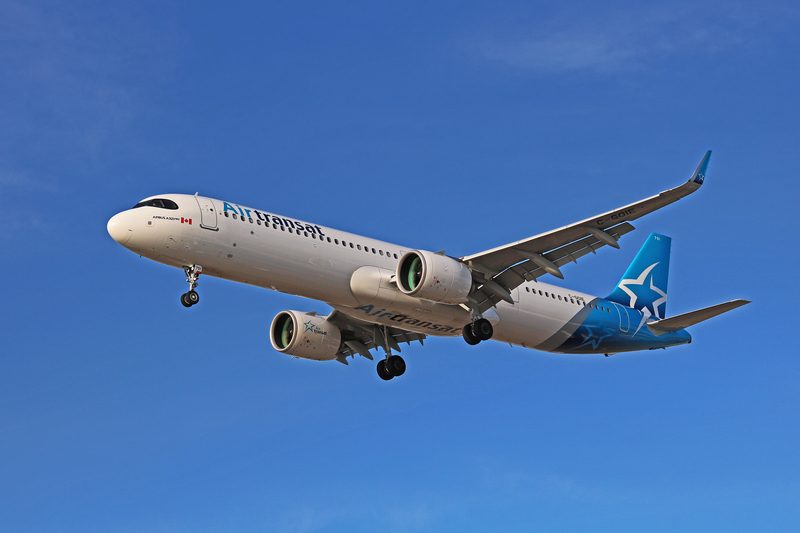
The most important aircraft in this expansion is the Airbus A321LR.
Air Transat’s A321LR is configured with 199 seats: 12 in Club Class and 187 in Economy Class. It has individual entertainment screens, USB charging, Pratt & Whitney geared turbofan engines, and a published maximum range of 7,400 kilometers, or 3,996 nautical miles.
That range is what makes the network possible.
A decade ago, several of these routes would have been difficult to justify. Airlines could use widebodies such as the Airbus A330 or Boeing 767, but those aircraft came with higher trip costs and more seats to fill. For markets such as Quebec City (YQB)–Nantes (NTE), Quebec City (YQB)–Marseille (MRS), Ottawa (YOW)–London Gatwick (LGW), or Montréal (YUL)–Agadir (AGA), the widebody economics were not always attractive.
The A321LR changes that. It allows Air Transat to fly long-haul routes with narrowbody trip costs, while still offering a long-haul cabin product. It does not provide the twin-aisle comfort of an A330, but it gives the airline the ability to open routes that might otherwise not exist.
This is one of the most important trends in modern transatlantic aviation. Long-range narrowbodies have made secondary city pairs more realistic. Instead of concentrating every passenger through Toronto (YYZ), Montréal (YUL), Paris (CDG), London Heathrow (LHR), or Frankfurt (FRA), airlines can connect smaller markets directly with appropriately sized aircraft.
Air Transat is one of the clearest examples of that strategy in Canada.
Why These Markets Make Sense
The seven-route package looks diverse, but the logic is consistent.
Ottawa (YOW) to London Gatwick (LGW) restores transatlantic access for a capital-region market with government, technology, diplomatic, education, and leisure demand.
Quebec City (YQB) to Marseille (MRS) and Nantes (NTE) builds on deep cultural and linguistic ties between Quebec and France while bypassing the traditional Paris funnel.
Montréal (YUL) to Agadir (AGA) and Dakar (DSS) uses Quebec’s North African and West African links to support routes that blend leisure, diaspora, and cultural traffic.
Montréal (YUL) to Reykjavík/Keflavík (KEF) gives Air Transat a high-profile North Atlantic leisure destination that fits summer travel patterns.
Toronto (YYZ) to Tirana (TIA) taps into strong Albanian diaspora demand and the rising popularity of Albania as a European vacation destination.
None of these routes needs to be daily to make sense. That is the point. Air Transat can operate once, twice, or three times weekly, align capacity with peak summer demand, and use aircraft that fit the market.
This is not a network-carrier hub-and-spoke strategy in the traditional sense. It is a leisure-focused, demand-specific, aircraft-enabled strategy.
Regional Canada Is A Major Part Of The Story
Another important part of this expansion is that Air Transat is not only growing from Toronto (YYZ) and Montréal (YUL).
Ottawa (YOW) and Quebec City (YQB) play major roles. That is significant because Canadian long-haul flying has historically been heavily concentrated at Toronto Pearson (YYZ), Montréal–Trudeau (YUL), Vancouver (YVR), and Calgary (YYC). Secondary markets often depend on connections, even when local demand exists.
Air Transat is taking a different approach. By launching long-haul routes from Ottawa (YOW) and Quebec City (YQB), it is giving passengers in those regions direct access to Europe without requiring a backtrack through Toronto or Montréal.
The carrier’s partnership with Porter Airlines also supports this strategy. Porter’s growing network can help feed Air Transat flights from Ottawa (YOW), Montréal (YUL), and Toronto (YYZ), giving the airline access to passengers beyond the local market.
That matters because long-haul routes from secondary cities need more than local passengers. They need connecting support, tour operator traffic, diaspora demand, cruise demand, and seasonal leisure flows. The more feed Air Transat can build, the more durable these routes become.
Accra Shows The Risk In Long-Thin Flying
One important footnote is Toronto (YYZ)–Accra (ACC).
Air Transat originally announced a planned nonstop route between Toronto (YYZ) and Accra (ACC) for summer 2026, which would have been the first nonstop link between Canada and Ghana. The route was later postponed before launch.
That decision is a useful reminder that long-thin route planning remains risky, even with the right aircraft. A route can have strong community interest, a compelling story, and limited nonstop competition, but still face challenges around aircraft availability, fuel prices, yields, seasonality, operational reliability, or booking strength.
The postponed Accra (ACC) launch does not weaken the broader Air Transat strategy. If anything, it shows the airline is willing to adjust before putting capacity into a market that may not yet be ready. That kind of discipline matters in long-haul leisure flying, where a poorly timed launch can consume aircraft time and commercial resources quickly.
The seven routes still moving forward are better understood as the current executable program: a mix of Europe, North Africa, West Africa, Iceland, and the Balkans, largely built around the A321LR.
A330s Still Have A Role
While the A321LR is the star of the expansion, the Airbus A330 remains important.
The Toronto (YYZ)–Tirana (TIA) route is scheduled with Airbus A330 equipment, giving Air Transat more capacity than the A321LR. That makes sense for a long-haul route with expected peak summer demand, diaspora traffic, and likely high baggage loads.
Air Transat’s A330-200 aircraft have multiple cabin layouts, ranging from 330 to 345 seats, with 12 Club Class seats and the remainder in Economy. The type offers greater range and capacity than the A321LR, along with the passenger advantages of a twin-aisle aircraft on longer sectors.
The A330 is also a reminder that fleet flexibility is part of Air Transat’s advantage. The carrier can use A321LRs for smaller, thinner long-haul routes and A330s where demand or distance requires more capacity.
That balance is especially important for a leisure airline. Demand can vary sharply by season, origin, destination, school holidays, diaspora travel patterns, and package-tour demand. A mixed Airbus fleet lets Air Transat match aircraft to market more precisely.
Air Transat Is Carving Out A Distinct Niche
Air Transat is not trying to be Air Canada.
It does not have the same hub depth, alliance structure, domestic network, or premium corporate base. Instead, it is building a different kind of long-haul network: leisure-oriented, regionally focused, and highly selective.
That gives the airline room to serve markets that larger network carriers may ignore. Routes such as Quebec City (YQB)–Nantes (NTE), Montréal (YUL)–Agadir (AGA), and Toronto (YYZ)–Tirana (TIA) are not obvious targets for a conventional daily hub strategy. But they can make sense for a carrier that understands seasonal demand, tour operator dynamics, and community travel.
The challenge will be consistency. Low-frequency long-haul routes need strong execution. A missed connection, aircraft swap, delay, or cancellation can be more disruptive when the flight operates once weekly. Air Transat must also maintain awareness in markets where nonstop service is new and travelers may still default to established connecting options.
But the opportunity is meaningful. If these routes perform, Air Transat can strengthen its reputation as Canada’s most creative transatlantic leisure carrier, especially from Quebec and eastern Canada.
Bottom Line
Air Transat’s summer 2026 expansion is a targeted long-haul push built around seven new transatlantic and international routes.
The carrier is adding Ottawa (YOW)–London Gatwick (LGW), Quebec City (YQB)–Marseille (MRS), Quebec City (YQB)–Nantes (NTE), Montréal (YUL)–Agadir (AGA), Montréal (YUL)–Dakar (DSS), Montréal (YUL)–Reykjavík/Keflavík (KEF), and Toronto (YYZ)–Tirana (TIA). Together, the routes expand Air Transat’s reach across the United Kingdom, France, Morocco, Senegal, Iceland, and Albania.
The Airbus A321LR is the key enabler. With 199 seats, long-haul range, and lower trip costs than a widebody, it allows Air Transat to serve markets that may not support larger aircraft. The Airbus A330 still has an important role where more capacity is needed, particularly on Toronto (YYZ)–Tirana (TIA).
This is a smart, disciplined expansion. Air Transat is not simply adding capacity to the busiest transatlantic trunk routes. It is connecting underserved Canadian cities with underserved overseas markets, using aircraft that match the demand profile.
For passengers, the result is more nonstop choice. For Air Transat, it is a chance to deepen its niche as Canada’s long-haul leisure specialist while proving that the next wave of transatlantic growth will not belong only to the biggest hubs.