Air Rarotonga is adding another Saab 340B to its fleet, a small but strategically important acquisition for the Cook Islands’ domestic air network.
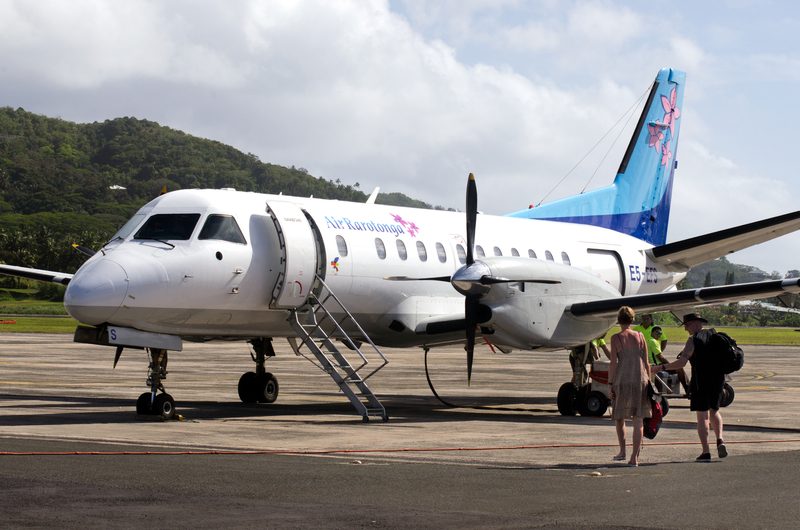
The Rarotonga-based carrier has purchased Saab 340B N703RS, manufacturer serial number 340-252, from U.S.-based C&L Aerospace. The aircraft is currently undergoing a major overhaul and modification program at C&L’s maintenance facility at Bangor International Airport (BGR) in Maine, with delivery to the Cook Islands expected in October 2026.
Once in service, the aircraft will increase Air Rarotonga’s Saab fleet to three aircraft. That matters in a market where one additional 34-seat turboprop can materially change schedule resilience, charter capacity, and the ability to serve remote island communities.
Read our stories in your inbox
Two aviation newsletters. Zero fluff.
For Air Rarotonga, this is not simply a fleet replacement. It is a capacity and reliability move that supports the airline’s core Rarotonga (RAR)–Aitutaki (AIT) operation while also preparing for future Saab 340 service to Manihiki Island (MHX) in the Northern Cook Islands once runway upgrades are complete.
A Third Saab For A Small-Island Network
Air Rarotonga is the Cook Islands’ primary domestic airline, based at Rarotonga International Airport (RAR/NCRG). Its network links Rarotonga (RAR) with outer-island airports including Aitutaki (AIT), Atiu (AIU), Mangaia (MGS), Mauke (MUK), Mitiaro (MOI), Manihiki (MHX), Penrhyn/Tongareva (PYE), and Pukapuka (PZK), along with regional flying to Papeete (PPT) in French Polynesia.
In that kind of network, fleet depth is critical. The Cook Islands are spread across a large area of the South Pacific, and many routes are thin, remote, weather-sensitive, and operationally specialized. A single aircraft going out of service can have an outsized effect on schedules, freight, medical travel, tourism itineraries, and local mobility.
Adding a third Saab 340B gives Air Rarotonga more flexibility. It can better protect its core schedule, support seasonal peaks, and provide additional charter capacity. That is especially important on the Rarotonga (RAR)–Aitutaki (AIT) route, which is the airline’s main tourism trunk route and one of the most important domestic air links in the Cook Islands.
Aitutaki (AIT) is a major visitor destination, famous for its lagoon and high-value tourism market. Reliable air access from Rarotonga (RAR) is essential because many international visitors arrive in the Cook Islands through RAR and then connect onward to AIT.
The Aircraft: Saab 340B N703RS
The incoming aircraft is a Saab 340B, registration N703RS, manufacturer serial number 340-252.
Built in 1991, the aircraft is 35 years old, but that is not unusual for the Saab 340 fleet globally. The type has remained popular in specialist regional operations because it is rugged, economical, and well suited to short sectors where 30 to 36 seats are enough capacity.
C&L’s aircraft listing identifies N703RS as a 34-seat Saab 340B with Collins avionics. The aircraft had accumulated approximately 34,700 flight hours and just over 37,100 cycles when marketed. It previously flew in the United States and was later stored at Bangor (BGR), where C&L has a strong Saab 340 maintenance and support presence.
Before delivery, the aircraft is being overhauled and modified. The work includes repainting the aircraft in Air Rarotonga’s livery and installing Acro passenger seats. That cabin update is important because Air Rarotonga is not buying the aircraft simply to add metal. It is preparing the aircraft for a specific operating environment where passenger comfort, dispatch reliability, and maintainability all matter.
Why The Saab 340 Still Fits The Cook Islands
The Saab 340 is an older design, but it remains a highly useful aircraft for island operations.
The 340B is a twin-engine turboprop regional airliner powered by General Electric CT7-9B engines. It typically carries 34 passengers and is optimized for short- to medium-haul regional flying. Saab lists the 340B/Bplus family with a maximum cruise speed of around 283 knots and a maximum operating altitude of 25,000 feet.
For Air Rarotonga, the type offers several advantages.
It is large enough to move meaningful passenger volumes on Rarotonga (RAR)–Aitutaki (AIT), but not so large that it overwhelms smaller markets. It has twin-engine reliability for overwater island flying. It can operate into regional airports where runway length, pavement condition, and support infrastructure may be more limited than at large international gateways. It is also a known aircraft type for Air Rarotonga, which reduces training and maintenance complexity compared with adding a completely new fleet type.
That commonality is important. A small airline operating in a remote island environment benefits from keeping fleet complexity under control. Pilots, engineers, spares, procedures, and operational planning all become easier when the airline builds around aircraft it already knows.
The Saab 340 may no longer be in production, but for the Cook Islands’ domestic network, it remains the right size.
Bangor Overhaul Before Pacific Delivery
The overhaul work at Bangor International Airport (BGR) is an important part of the acquisition.
C&L Aerospace is based in Bangor, Maine, and has long experience with Saab 340 support, aircraft sales, component supply, and maintenance. Preparing the aircraft at BGR before delivery allows Air Rarotonga to receive the aircraft in a configuration suited to its operation rather than taking on a stored aircraft and doing the work after arrival in the South Pacific.
That matters because maintenance logistics become more complex once the aircraft is in the Cook Islands. Rarotonga (RAR) can support Air Rarotonga’s day-to-day operation, but deep refurbishment, major modification work, and certain component support are easier to complete at a specialized facility before the aircraft is ferried across the Pacific.
The delivery itself will also require careful planning. Moving a Saab 340B from the United States to the Cook Islands is not a simple ferry flight. The aircraft will need a multi-sector routing, fuel planning, crew positioning, permits, maintenance support, and possibly temporary equipment or configuration considerations depending on the ferry profile.
For airline professionals, this is one of the more interesting parts of the story. Buying the aircraft is only the first step. Preparing it, modifying it, and moving it halfway across the world are part of the real operational challenge.
Manihiki Is The Long-Term Prize
The most strategic part of the acquisition may be what comes next: planned Saab 340 operations to Manihiki Island (MHX/NCMH) in 2027.
Manihiki is in the Northern Cook Islands, far from the main tourism flows of Rarotonga (RAR) and Aitutaki (AIT). Air service to the Northern Group is inherently difficult because demand is thin, distances are long, alternates are limited, and airport infrastructure is constrained.
Infrastructure Cook Islands has identified the Manihiki Airport upgrade as a long-term priority. The project is intended to rehabilitate and construct runway infrastructure, improve safety and resilience, and support larger aircraft operations. Government planning documents have specifically discussed Saab 340 operations into an upgraded Manihiki airstrip, with Penrhyn/Tongareva (PYE/NCPY) serving as an alternate.
That is a major point. For larger turboprop operations into remote atolls, alternate-airport planning is not just a regulatory detail. It is central to safe and reliable operations. Weather, runway condition, fuel planning, aircraft performance, and emergency options all matter more when the airport is remote and surrounded by ocean.
If Saab 340 service to Manihiki (MHX) becomes practical after the runway upgrade, it could materially improve access to the Northern Group.
Why Manihiki Service Would Matter
A Saab operation to Manihiki (MHX) would be a major improvement for community connectivity and visitor access.
Manihiki is a remote atoll, and air service is not just about tourism. It supports residents, medical movement, education, government services, freight, family travel, and emergency response. Better aircraft capability can reduce travel friction, improve reliability, and make it easier to support local economic activity.
Tourism is also part of the story, though it needs to be understood carefully. Manihiki will not become another Aitutaki overnight. The Northern Group has limited infrastructure, fragile environments, and small communities. Any visitor growth needs to be sustainable and appropriate to local capacity.
Still, improved air access can help develop carefully managed tourism, especially for travelers interested in remote atolls, culture, pearl farming, fishing, diving, and high-end expedition-style travel. The Saab 340’s size makes sense for that kind of growth. It is large enough to be more efficient than a small commuter aircraft but still small enough to avoid overbuilding demand.
In that sense, the aircraft acquisition and the runway project are connected. The aircraft provides the capacity; the runway upgrade provides the access.
Protecting The Aitutaki Schedule
Before Manihiki (MHX), the third Saab will first strengthen Air Rarotonga’s existing schedule.
The Rarotonga (RAR)–Aitutaki (AIT) route is the airline’s most important domestic market. It carries residents, tourists, day-trip passengers, package travelers, and freight. Because Aitutaki is one of the Cook Islands’ signature destinations, reliability on the route has a direct impact on the country’s tourism product.
A third Saab 340B helps protect that operation. It can provide spare coverage, reduce schedule vulnerability during maintenance events, and allow the airline to handle seasonal charter demand without stripping capacity from scheduled services.
For small carriers, the difference between two and three aircraft of a core type can be substantial. With two aircraft, maintenance or technical issues can quickly force schedule changes. With three, the airline gains more operational breathing room.
That is likely one of the main reasons Air Rarotonga is making this investment.
A Small Fleet Move With National Importance
In a large airline market, a single 34-seat turboprop acquisition might barely register. In the Cook Islands, it matters.
Air Rarotonga’s network is part of the country’s basic transport infrastructure. The airline connects islands that are separated by hundreds of miles of ocean. It supports tourism, healthcare access, local communities, government movement, freight, and inter-island commerce.
The addition of another Saab 340B therefore has significance beyond the airline’s balance sheet. It affects how reliably people and goods can move across the country. It also supports the Cook Islands’ broader effort to improve outer-island connectivity and develop the Northern Group in a measured way.
That is why the Manihiki (MHX) plan is so important. If the airport upgrade is completed and Saab operations begin in 2027, the third Saab will help unlock a route that has been discussed for years.
The Challenge: Keeping Older Turboprops Supported
The main risk is supportability.
The Saab 340 is no longer produced, and operators must rely on used aircraft, parts inventories, specialist maintenance providers, and careful fleet planning. C&L’s role is important because it has experience supporting the type and can prepare the aircraft before delivery.
For Air Rarotonga, operating older regional aircraft in a remote island environment requires strong maintenance discipline. Corrosion control, parts availability, engine support, avionics upkeep, and propeller maintenance all require planning. The South Pacific environment can be demanding, with salt air, humidity, remote stations, and limited local infrastructure.
That said, this is also why the Saab 340 remains attractive. It is a known quantity. It has proven itself in regional operations around the world. Air Rarotonga already understands the type. The airline is not taking on a new aircraft family with unfamiliar training and maintenance requirements.
A third aircraft strengthens the fleet while preserving commonality.
Bottom Line
Air Rarotonga’s purchase of a third Saab 340B is a strategically important fleet move for the Cook Islands.
The aircraft, N703RS, MSN 340-252, is undergoing overhaul and modification at C&L Aerospace’s facility at Bangor (BGR) before delivery to Rarotonga (RAR), expected in October 2026. Once in service, it will increase Air Rarotonga’s Saab fleet to three aircraft and add capacity, reliability, and charter flexibility to the airline’s domestic operation.
The immediate benefit is stronger schedule integrity, especially on the core Rarotonga (RAR)–Aitutaki (AIT) route. The longer-term opportunity is more significant: planned Saab 340 service to Manihiki (MHX) in 2027 once runway upgrades are complete.
For a small island nation, this is more than an aircraft purchase. It is an investment in connectivity. One additional 34-seat turboprop can improve tourism access, strengthen community links, support remote atolls, and give Air Rarotonga the fleet depth it needs to operate more reliably across one of the most challenging regional air networks in the Pacific.