
African Safari Airways was never a large airline in the traditional sense.
It did not build a hub-and-spoke network. It did not chase global alliance traffic. It did not try to become Kenya’s flag carrier.
Instead, African Safari Airways did something more unusual. It served as the flying arm of a vertically integrated holiday business that brought European tourists directly to Kenya’s coast.
Read our stories in your inbox
Two aviation newsletters. Zero fluff.
From its base at Moi International Airport (MBA) in Mombasa, the carrier linked Europe with East African safari lodges, beach hotels and package holidays. Its business model was simple but powerful: sell the full trip, then fly the customer there on your own aircraft.
That made African Safari Airways one of the more distinctive charter airlines of its era.
A Safari Airline Built Around The Package Holiday
African Safari Airways was formed in 1967 as part of the African Safari Club group.
The group was associated with Swiss entrepreneur Karl Jakob Rüdin, who built a tourism business around Kenya’s beach and safari market. The idea was not just to sell a flight. It was to control the holiday from Europe to East Africa.
That included flights, hotels, safari lodges, ground transport and, later, cruise products. In modern airline terms, it was a vertically integrated leisure operation.
The aircraft were not the whole business. They were the bridge between the customers and the properties.
That is what made African Safari Airways different. It was an airline, but it also worked like a logistics tool for a holiday empire.
Mombasa Was The Center Of The Network
The airline’s main base was Mombasa’s Moi International Airport (MBA).
That location was central to the strategy. Mombasa is Kenya’s main coastal gateway and the natural airport for beach resorts north and south of the city. It also gives travelers access to safari circuits across Kenya.
For European package tourists, flying directly to Mombasa (MBA) was far easier than routing through Nairobi’s Jomo Kenyatta International Airport (NBO). It put passengers closer to the coast and reduced the need for domestic transfers.
African Safari Airways built its route network around that advantage.
Historical records show charter flights linking Mombasa (MBA) with European markets such as Switzerland, Germany, France and the United Kingdom. Other accounts list London, Frankfurt, Munich, Basel, Milan, Rome, Madrid, Vienna and Paris among the airline’s important source markets.
In later years, aircraft carrying the African Safari Airways colors were photographed at airports including Frankfurt Airport (FRA), Vienna Airport (VIE), Zurich Airport (ZRH), EuroAirport Basel Mulhouse Freiburg (BSL/MLH/EAP), Düsseldorf (DUS) and Berlin Schönefeld (SXF).
This was not a conventional scheduled network. It was a seasonal leisure pipeline from Europe to the Kenyan coast.
The Early Fleet: Bristol Britannia Turboprops
African Safari Airways’ early long-haul identity was tied to the Bristol Britannia.
The Britannia was a four-engine turboprop airliner built by the Bristol Aeroplane Company. It became known as the “Whispering Giant” because of its relatively quiet exterior noise and smooth performance for the era.
By the late 1960s, however, the Britannia was already being overtaken by pure jet aircraft. Boeing 707s and Douglas DC-8s were reshaping long-haul travel.
Even so, the Britannia made sense for a young charter carrier. It offered long-range capability at a time when African Safari Airways needed to move holidaymakers from Europe to East Africa without building a large fleet.
Aircraft such as 5Y-ALT and 5Y-AYR became part of the airline’s early story. The type gave African Safari Airways a practical way to start long-distance charter flying before the carrier moved fully into the jet age.
The DC-8 Years Gave The Airline Its Jet-Age Character
The next major step was the Douglas DC-8.
The DC-8 was one of the aircraft that defined the first generation of long-haul jet travel. It gave airlines more speed, more range and more passenger appeal than older piston and turboprop types.
For African Safari Airways, the DC-8 was a natural upgrade.
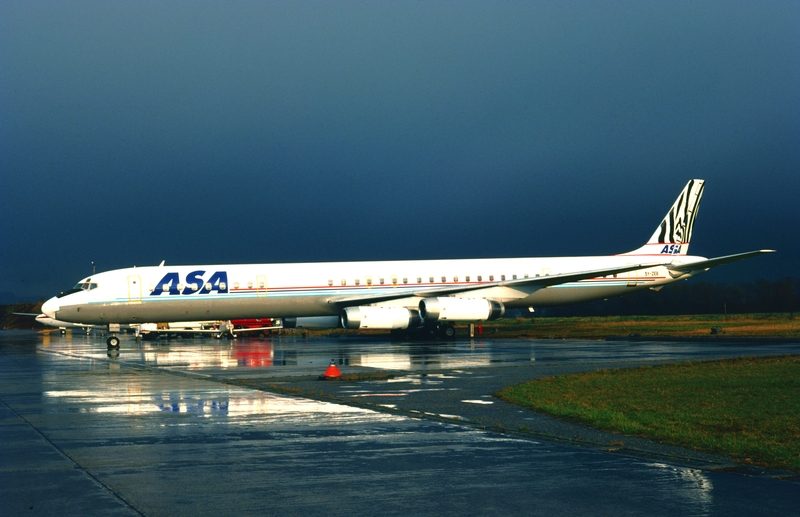
The airline used several DC-8 variants over the years. That included smaller early models and larger, stretched aircraft such as the DC-8-63. Aircraft in African Safari Airways colors were seen at major European airports including Frankfurt (FRA), Zurich (ZRH) and Basel/Mulhouse (BSL/MLH/EAP).
One of the most recognizable aircraft was 5Y-ZEB, a DC-8-63 that carried the airline’s distinctive zebra-themed identity. The ZEBRA callsign matched the branding perfectly.
That was part of the airline’s charm. African Safari Airways did not have a bland charter identity. Its aircraft looked connected to the destination they served.
A Small Fleet With A Very Specific Job
African Safari Airways was never about fleet size.
The airline often operated with only a small number of long-haul aircraft. That was enough because the mission was narrow and focused.
The aircraft had one main job: move blocks of leisure travelers from Europe to Kenya and back.
That made the airline very different from a scheduled carrier. A flag carrier needs daily frequencies, network coverage and interline feed. African Safari Airways needed reliable long-haul lift for a tour operator.
Because of that, aircraft utilization followed the rhythm of leisure demand. Peaks mattered. Source markets mattered. Hotel occupancy mattered.
If the aircraft filled with package holiday passengers, the model worked. If demand weakened, the risk moved quickly through the whole group.
The DC-10 Brought Widebody Capacity
In the 1990s, African Safari Airways moved into the widebody era with the McDonnell Douglas DC-10-30.
The DC-10-30 was a long-range trijet built for intercontinental flying. It offered more capacity than the DC-8 and gave the airline a wider cabin, greater cargo volume and better economics for dense leisure routes when demand was strong.
African Safari Airways operated DC-10-30 aircraft associated with the registration 5Y-MBA. The aircraft became one of the most visible symbols of the airline during the 1990s.
For a charter airline, the DC-10 was both useful and risky.
It could carry a large number of passengers to Mombasa (MBA) in one movement. That worked well when hotels were full and European demand was strong.
However, a widebody also needs volume. If bookings fall, the aircraft becomes hard to fill and expensive to operate.
That challenge would become more important later.
The Airbus A310 Was The Final Flagship
By the early 2000s, African Safari Airways moved away from the DC-10 and into the Airbus A310.
The A310 was a shorter-fuselage, longer-range development of the Airbus A300. It offered widebody comfort in a smaller twin-engine package. It also used the Airbus commonality concept that later became central to the manufacturer’s product strategy.
For African Safari Airways, the A310 was a sensible late-era aircraft.
It was smaller than the DC-10. It burned less fuel. It required two engines instead of three. It also gave the airline enough range for Europe–Mombasa flying without the capacity burden of a larger widebody.
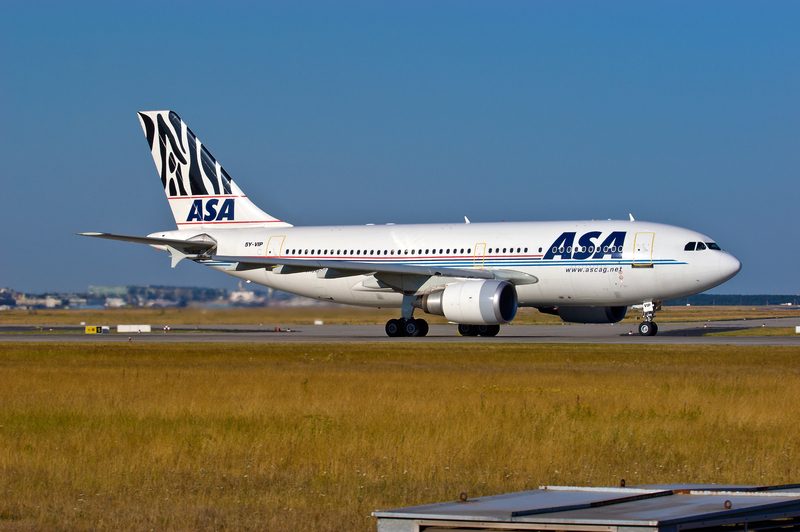
The best-known aircraft was 5Y-VIP, an Airbus A310-308 that had previously flown for Hapag-Lloyd. It became the airline’s final long-haul workhorse.
In 2007 and 2008, 5Y-VIP was still being photographed across Europe, including Frankfurt (FRA), Vienna (VIE), Zurich (ZRH), Düsseldorf (DUS), Berlin Schönefeld (SXF) and Basel/Mulhouse (BSL/MLH/EAP).
By then, African Safari Airways had become almost a one-aircraft airline. That made it fascinating, but also vulnerable.
The Zebra Identity Made The Airline Memorable
African Safari Airways had one of the most distinctive brand identities in African charter aviation.
The ZEBRA callsign was memorable. So was the aircraft livery. The airline’s later aircraft carried large ASA titles and a zebra-style tail design that made them stand out on European ramps.
This mattered.
For package holiday passengers, the aircraft was part of the vacation experience. It was not just transport. It was the start of the safari trip.
For aviation enthusiasts, the airline also became a cult favorite. A Kenyan-registered Airbus A310 or DC-8 in safari-themed colors at Frankfurt (FRA), Zurich (ZRH) or Vienna (VIE) was not something seen every day.
That visual identity helped African Safari Airways remain remembered long after it stopped flying.
SkyTrails Added A Domestic Safari Layer
African Safari Airways was also connected to a smaller Kenyan domestic operation called SkyTrails.
SkyTrails reportedly operated from 1998 to 2005 and used small aircraft such as the de Havilland Canada DHC-6 Twin Otter and Cessna 206. These aircraft were well suited to short safari sectors and rougher airstrips.
That made sense within the African Safari Club model.
The widebody aircraft brought European tourists into Mombasa (MBA). Smaller aircraft could then support movement within Kenya, including safari destinations that were not practical for larger aircraft.
The DHC-6 Twin Otter was especially well suited to that job. It is known for short takeoff and landing performance, simple operation and the ability to serve remote airstrips.
This gave the group a more complete aviation chain. Long-haul charters handled Europe. Light aircraft handled the safari market.
Why The Business Model Worked
African Safari Airways worked because it solved a specific problem.
European customers wanted simple access to Kenya’s coast and safari destinations. African Safari Club wanted to fill its hotels and lodges. The airline connected both sides of the equation.
That gave the group control over capacity, pricing and the customer journey.
When demand was healthy, the model had real advantages. The company could package the flight, hotel, safari and ground arrangements together. It could also direct passengers to its own properties.
That reduced dependence on scheduled airlines. It also allowed African Safari Club to shape its own holiday product.
In other words, African Safari Airways was not just carrying passengers. It was feeding a controlled tourism ecosystem.
Why The Model Became Fragile
The same structure also created risk.
Because the airline depended heavily on leisure travel, it was exposed to external shocks. Fuel prices, political instability, currency movements and negative travel sentiment all mattered.
The group also carried the weight of hotels, lodges, cruise ships, aircraft and travel offices. That gave it reach, but it also created large fixed costs.
By the late 1990s and early 2000s, the African Safari Club group was under financial pressure. Reports describe a restructuring effort around 1999, followed by a return to profitability in the early 2000s.
However, the recovery did not last.
Kenya’s post-election violence after the disputed December 2007 election hit the country’s tourism sector hard. Even areas away from the worst violence suffered as international travelers and tour operators lost confidence.
That was a violence suffered as international travelers and tour serious problem for a company built around European holiday traffic to Kenya.
The End Of African Safari Airways
Historical airline databases generally place African Safari Airways’ operating life from 1967 to 2008. Some later travel references continued to discuss the wider African Safari Club business into 2009 and 2011.
The difference matters.
The airline itself appears to have stopped flying before the final collapse of the wider tour group. The African Safari Club business continued struggling afterward and eventually ceased trading in 2011.
By the end, African Safari Airways had moved from a small but distinctive long-haul charter airline to a costly asset the parent company could no longer justify.
The A310 was returned. The group moved toward using third-party lift. Then the wider business faded.
It was a quiet end for an airline with a very colorful identity.
Why African Safari Airways Still Matters
African Safari Airways matters because it represents a different era of leisure aviation.
Today, many long-haul leisure routes are served by large network airlines, low-cost long-haul operators, or major holiday carriers. African Safari Airways came from a more specialized world.
It was a tour operator’s airline. Its purpose was narrow, but its execution was memorable.
It connected Basel (BSL/MLH), Zurich (ZRH), Frankfurt (FRA), Vienna (VIE), London (LGW), and other European markets with Mombasa (MBA). It used aircraft as varied as the Bristol Britannia, Douglas DC-8, McDonnell Douglas DC-10 and Airbus A310.
It also showed how important aviation was to Kenya’s coastal tourism economy. Without direct charter flights, filling remote beach hotels and safari programs from Europe was much harder.
African Safari Airways helped make that model work for decades.
Bottom Line
African Safari Airways was one of Africa’s most unusual charter airlines.
It was small, specialized and deeply tied to a Swiss-Kenyan tourism group. Yet it operated serious long-haul aircraft, including the Bristol Britannia, Douglas DC-8, McDonnell Douglas DC-10-30 and Airbus A310-308.
Its main mission was clear: bring European package tourists directly to Mombasa (MBA) and into the African Safari Club holiday system.
That made it more than an airline. It was the aviation backbone of an all-inclusive safari and beach business.
The company’s decline showed the weakness of that model. When tourism demand fell, the aircraft became too expensive to sustain.
Still, African Safari Airways remains memorable. Its zebra branding, ZEBRA callsign, Kenyan registrations and classic widebody aircraft gave it a character few charter airlines could match.
.jpg)