My Freighter Turns Liège Into a Daily Cargo Gateway for Central Asia
Uzbekistan-based My Freighter is significantly increasing its European capacity, moving to daily cargo operations from Liège Airport (LGG) beginning in August 2026.
The expanded schedule will strengthen freight links between Europe and Uzbekistan, Kazakhstan, Kyrgyzstan, Tajikistan and Turkmenistan. It also gives freight forwarders more frequent access to My Freighter’s growing network through Islam Karimov Tashkent International Airport (TAS).
However, the announcement does not mean My Freighter will operate a separate daily nonstop flight from Liège Airport (LGG) to every country listed. The airline has confirmed a daily schedule from LGG, but it has not published the complete routing pattern, flight numbers or aircraft rotation for each day.
Read our stories in your inbox
Two aviation newsletters. Zero fluff.
The more important development is that Liège Airport (LGG) is becoming a daily European gateway into My Freighter’s Central Asian distribution system.
This Is a Frequency Expansion, Not a New Liège Route
My Freighter is not new to Liège Airport (LGG).
The airline began operating a scheduled cargo route between Zhengzhou Xinzheng International Airport (CGO) in China and Liège Airport (LGG) in October 2024. That service launched with four weekly Boeing 767-300 freighter flights, connecting China and Europe through the carrier’s Central Asian network.
The new August schedule therefore represents a substantial frequency increase rather than My Freighter’s first arrival in Belgium.
According to My Freighter’s announcement through Neutral Air Partner, the daily operation is intended to provide shorter waiting times, more consistent capacity and greater flexibility for freight forwarders moving cargo between Europe and Central Asia.
Daily service can be particularly valuable in air cargo because shipments do not have to wait several days for the next scheduled departure. That matters for perishables, urgent automotive components, e-commerce packages and other time-sensitive goods.
It also allows freight forwarders to build more predictable schedules around collection, customs clearance, warehouse handling and final delivery.
Tashkent Will Remain the Center of the Network
My Freighter is based at Islam Karimov Tashkent International Airport (TAS), which the airline is developing as a transfer point between Europe, Central Asia and the wider Asian market.
The carrier has not confirmed that every daily Liège flight will operate nonstop between Liège Airport (LGG) and Tashkent Airport (TAS). However, the structure of My Freighter’s existing network suggests that TAS will remain central to the new schedule.

Cargo arriving from Belgium can be transferred in Tashkent for onward delivery by aircraft or road-feeder service to markets throughout Central Asia.
Potential connections include Almaty International Airport (ALA) and other destinations in Kazakhstan, Manas International Airport in Bishkek (FRU), Dushanbe International Airport (DYU) in Tajikistan and Türkmenabat International Airport (CRZ) in Turkmenistan.
The daily announcement should therefore be understood as improved access to those markets rather than a promise of daily nonstop flights between Liège Airport (LGG) and every listed airport.
This hub structure allows My Freighter to consolidate freight from several smaller markets onto a single Boeing 767 departure from Europe. It can then distribute the cargo across Central Asia according to demand.
Why Liège Works for My Freighter
Liège Airport (LGG) is one of Europe’s most important dedicated cargo airports.
Unlike major mixed-use hubs where freight operations compete with passenger airlines for runway slots and terminal space, LGG is primarily designed around cargo.
The airport operates without a nighttime curfew, allowing freighters to arrive and depart throughout the day and night. It also offers specialized facilities for e-commerce, express shipments, pharmaceuticals, perishables, oversized cargo and live animals.
Liège Airport handled approximately 1.325 million metric tons of cargo in 2025, making it the fifth-largest cargo airport in Europe. The airport also says more than 1.35 billion e-commerce parcels passed through its facilities during the year.
Its location is another major advantage.
Liège Airport (LGG) sits within trucking distance of major logistics and population centers in Belgium, the Netherlands, Germany, France and Luxembourg. Cargo arriving by road can be consolidated at LGG before being flown east, while imports can be distributed across Western Europe without requiring another flight.
For My Freighter, that creates access to a much larger market than Belgium alone.
The Boeing 767 Will Do Most of the Work
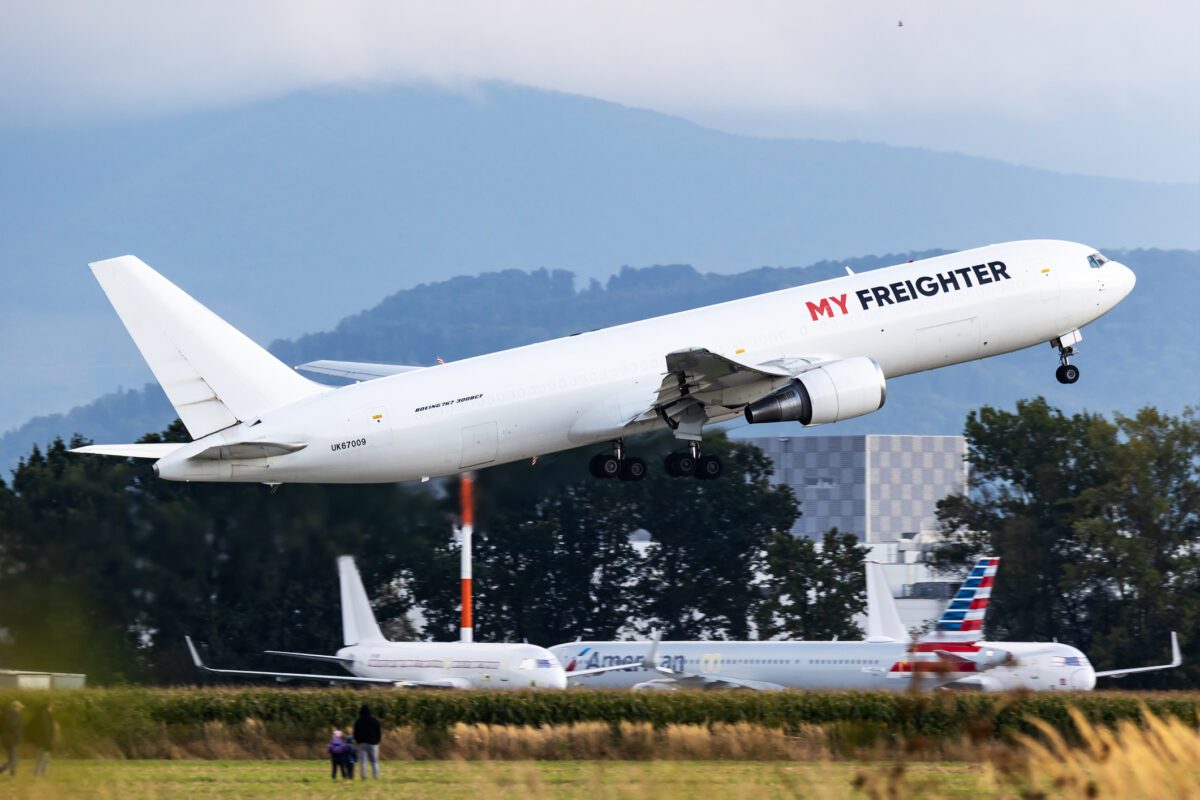
My Freighter has not formally assigned an aircraft to every daily Liège rotation, but the Boeing 767-300 freighter is the backbone of the airline’s cargo operation and the aircraft most closely associated with its LGG services.
The carrier’s official fleet information lists nine Boeing 767-300 freighters and one Boeing 757 freighter. It does not list an active Boeing 747-200F.
That makes the original claim that My Freighter currently operates Boeing 767-300Fs and Boeing 747-200Fs outdated.
My Freighter did operate a Boeing 747-200 freighter earlier in its development, but the airline’s present fleet strategy is centered on the smaller and more economical twin-engine Boeing 767.
The 767 is well suited to the Europe–Central Asia market because it provides widebody cargo capacity without the fuel consumption and trip cost of a four-engine Boeing 747.
Boeing lists the factory-built 767-300F with a maximum structural payload of approximately 52.5 metric tons and a range of about 3,255 nautical miles at maximum payload. Exact capabilities vary among converted aircraft and depend on fuel, routing, weather and individual aircraft specifications.
My Freighter operates a mixture of converted Boeing 767-300ER freighters. These aircraft began their lives as passenger jets before receiving reinforced floors, large main-deck cargo doors, cargo-handling systems and other modifications required for dedicated freight operations.
Their main decks can accommodate palletized cargo and containers, while the lower holds provide additional space for smaller unit-load devices.
The 767 Offers the Right Balance of Capacity and Frequency
A Boeing 747 freighter offers considerably more payload and volume, but operating one profitably requires a large and consistent amount of cargo.
The Boeing 767 allows My Freighter to offer more frequent flights with less capacity on each departure. That is useful when the objective is daily connectivity rather than moving the greatest possible amount of freight on only one or two weekly flights.
Seven Boeing 767 departures can provide more scheduling flexibility than a smaller number of very large 747 services.
Freight forwarders can select a departure closer to the time their cargo is ready rather than holding shipments in a warehouse while waiting for the next flight. My Freighter can also adjust the amount and type of cargo accepted on each rotation without relying on a single extremely large weekly movement.
The aircraft is particularly suitable for express parcels, e-commerce, automotive components, perishables, dangerous goods and general freight.
My Freighter also markets capacity for vehicles and oversized shipments, although the Boeing 767’s main-deck door and fuselage dimensions place tighter limits on extremely large cargo than those of the Boeing 747F.
The Fleet Has Expanded Rapidly
My Freighter has added Boeing 767 capacity at a fast pace.
Cargo Aircraft Management, part of Air Transport Services Group, delivered another Boeing 767-300 freighter to My Freighter in April 2026 under a six-year lease.
That delivery brought the number of CAM-owned aircraft placed with the Uzbek carrier to nine. ATSG described the Boeing 767 as central to My Freighter’s strategy of increasing capacity between Asia, Europe, Africa and the Middle East.
The additional aircraft provide the capacity needed to move Liège Airport (LGG) toward daily operations.
A daily round trip requires more than simply having one aircraft available. My Freighter must account for scheduled maintenance, crew duty limits, loading time, customs procedures and delays elsewhere in the network.
Operating nine Boeing 767 freighters gives the airline more flexibility to protect its schedule when an individual aircraft becomes unavailable.
The single Boeing 757 freighter can supplement the operation on lower-volume or shorter routes, but it does not offer the same main-deck capacity as the 767.
Frankfurt and Maastricht Form Part of a Wider European Buildout
Liège Airport (LGG) is only one element of My Freighter’s expanding European network.
In March 2026, the carrier launched several weekly Boeing 767-300F cargo routes linking Asia and Central Asia with Frankfurt Airport (FRA).
The schedule included Hanoi Noi Bai International Airport (HAN)-Tashkent Airport (TAS)-Frankfurt Airport (FRA), Bangkok Suvarnabhumi Airport (BKK)-Tashkent Airport (TAS)-Frankfurt Airport (FRA), Almaty Airport (ALA)-Tashkent Airport (TAS)-Frankfurt Airport (FRA) and a standalone Tashkent Airport (TAS)-Frankfurt Airport (FRA) service.
These routes demonstrate how My Freighter uses Tashkent Airport (TAS) to combine cargo from multiple Asian markets before sending it to Europe.
The airline also operates through Maastricht Aachen Airport (MST), although its presence there did not begin in 2026.
My Freighter launched twice-weekly Boeing 767 cargo operations at Maastricht Airport (MST) in August 2025, connecting the Dutch airport with Shanghai, Tashkent and Almaty. Cargo included e-commerce, automotive shipments, general freight and flowers.
It later expanded the Maastricht network with additional Asian capacity, including a new Hong Kong International Airport (HKG) operation in early 2026.
Liège’s move to daily frequency represents a larger commitment because it gives My Freighter a consistent primary gateway in Western Europe while retaining access to Frankfurt Airport (FRA), Maastricht Airport (MST) and other cargo airports.
Interline Partnerships Expand the Network Beyond My Freighter’s Aircraft
My Freighter is also broadening its reach through commercial partnerships.
The airline signed cargo interline agreements with Air Canada Cargo and Singapore Airlines Cargo in July 2026. Those arrangements allow shipments to move across the networks of multiple airlines under coordinated cargo documentation and routing.
The partnerships improve My Freighter’s access to North America, the Asia-Pacific region and additional European markets without requiring the Uzbek airline to operate its own aircraft to every destination.
My Freighter has also expanded its cooperation with ECS Group, improving cargo distribution through European gateways that include Liège Airport (LGG), Maastricht Airport (MST), Basel Airport (BSL), Tallinn Airport (TLL) and Paris Charles de Gaulle Airport (CDG).
This gives the daily LGG service value beyond the airports served directly by My Freighter.
A shipment can arrive at Liège by truck or partner airline, transfer to a My Freighter Boeing 767, travel through Tashkent Airport (TAS) and then continue by air or road to its final Central Asian destination.
That combination of dedicated freighters, interline agreements and road-feeder services is essential for serving countries where individual city pairs may not support nonstop widebody flights.
Turkmenistan Has Been Part of the Network Since 2024
My Freighter’s connection with Turkmenistan began in February 2024, when the airline operated its first commercial cargo flight to Türkmenabat International Airport (CRZ).
Türkmenabat is located in eastern Turkmenistan near the Uzbek border, making it a practical entry point for freight moving between the two countries.
The new daily Liège Airport (LGG) schedule improves the frequency with which European cargo can enter My Freighter’s broader Central Asian system.
It does not necessarily mean that Türkmenabat Airport (CRZ) will receive a daily Boeing 767 flight from Belgium. Cargo may move through Tashkent Airport (TAS) before continuing to Turkmenistan by a separate flight or surface transportation.
That distinction matters because cargo airlines often advertise network coverage rather than a nonstop flight to every market listed.
Daily Service Changes the Commercial Proposition
Moving from several weekly flights to daily operations can make My Freighter more useful to large freight forwarders.
A customer shipping high-value electronics or urgent industrial components may prioritize speed and schedule reliability over the lowest possible rate. A daily departure gives that customer more options if production is delayed or cargo misses its planned flight.
Perishable shipments also benefit from reduced waiting time. Flowers, fresh food and temperature-sensitive goods lose value when held for extended periods.
E-commerce demand creates a different challenge. Parcel volumes can fluctuate rapidly around shopping events and holidays, requiring airlines to provide frequent capacity while remaining flexible enough to handle peaks.
Liège Airport (LGG) already has extensive experience processing e-commerce and express cargo, while My Freighter can distribute those shipments into markets that remain less directly connected to Western Europe.
Central Asia Is Becoming a More Important Cargo Corridor
My Freighter is positioning itself around the growing movement of goods between China, Southeast Asia, Central Asia and Europe.
Central Asia’s geography creates both an opportunity and a challenge.
The region lies between some of the world’s largest manufacturing and consumer markets, but its major cities are separated from European ports by long road and rail journeys. Air cargo can reduce transit times substantially for products valuable enough to justify the higher transportation cost.
Tashkent Airport (TAS) gives My Freighter a central base from which it can serve surrounding countries while also connecting eastbound flights from China and Southeast Asia with westbound services to Europe.
The daily Liège schedule strengthens that strategy by giving the network a high-frequency anchor at one of Europe’s largest dedicated freight airports.
Bottom Line
My Freighter will increase its cargo operations from Liège Airport (LGG) to a daily schedule beginning in August 2026.
The additional flights will improve access between Europe and Uzbekistan, Kazakhstan, Kyrgyzstan, Tajikistan and Turkmenistan, with Islam Karimov Tashkent International Airport (TAS) expected to remain the center of the airline’s Central Asian network.
The announcement does not confirm a separate daily nonstop flight from LGG to every country listed. Instead, Liège will function as a daily European gateway feeding My Freighter’s combination of onward flights, interline partnerships and road-feeder services.
The airline’s current cargo fleet consists of nine Boeing 767-300 freighters and one Boeing 757 freighter. Its official fleet information does not list an active Boeing 747-200F, making the original fleet description outdated.
The Boeing 767 is well matched to the expansion. It provides approximately 52 metric tons of potential payload capacity without the operating cost or capacity risk of a four-engine Boeing 747.
For My Freighter, the move is another step toward establishing Tashkent Airport (TAS) as a major cargo transfer point between Asia and Europe.
For Liège Airport (LGG), it adds a daily link to one of the fastest-developing air freight networks in Central Asia.
Keep reading FlyMag
Get the Daily Brief in the morning or the Route Watch weekly recap on Fridays. Or both.