Qatar Airways Las Vegas Route Disappeared Before It Even Tookoff
Qatar Airways came remarkably close to giving Las Vegas its first nonstop connection to the Middle East.
In January 2017, the Doha-based carrier announced plans to connect Hamad International Airport (DOH) with what was then called McCarran International Airport and is now Harry Reid International Airport (LAS). The route was scheduled to begin in January 2018 using the Boeing 777-200LR, one of the longest-range commercial aircraft ever produced.
Tickets were placed on sale, flight numbers were assigned and a four-times-weekly schedule was published. Yet less than four months after the announcement—and more than eight months before the inaugural flight—Qatar Airways closed reservations.
Read our stories in your inbox
Two aviation newsletters. Zero fluff.
The Las Vegas service never operated.
The route’s disappearance has subsequently been attributed to the 2017 diplomatic blockade imposed on Qatar by several neighboring countries. The blockade certainly created major financial and operational difficulties for Qatar Airways, but the chronology reveals an important distinction: the airline withdrew the Las Vegas flights before the diplomatic crisis began.
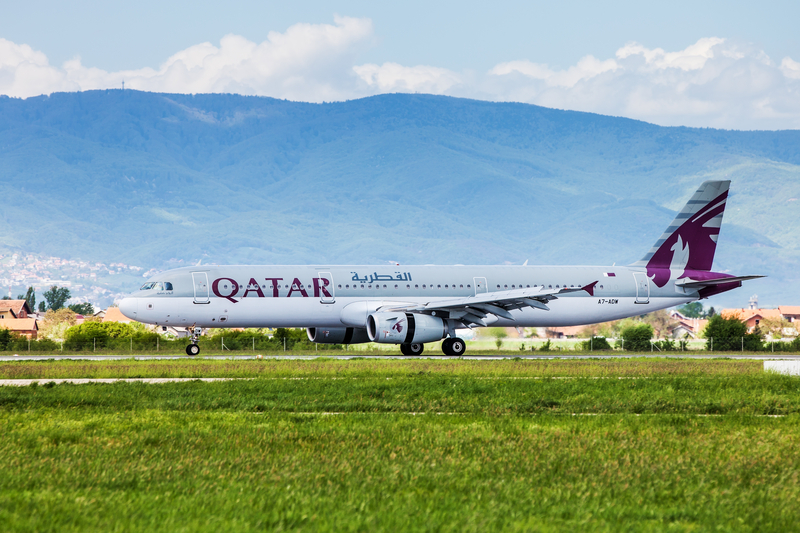
Qatar Airways has never publicly provided a detailed explanation for the decision, leaving the route as one of the airline industry’s more intriguing unlaunched services.
Qatar Airways Had a Complete Las Vegas Schedule
Qatar Airways formally announced the Las Vegas route on January 12, 2017.
Service between Hamad International Airport (DOH) and Harry Reid International Airport (LAS) was scheduled to begin on January 8, 2018. Flights would operate every Monday, Wednesday, Friday and Sunday.
The planned schedule was:
QR737 would leave Hamad International Airport (DOH) at 8:05 a.m. and arrive at Harry Reid International Airport (LAS) at 1:00 p.m.
QR738 would depart Harry Reid International Airport (LAS) at 2:55 p.m. and arrive at Hamad International Airport (DOH) at 5:20 p.m. the following day.
The timetable allowed approximately two hours on the ground in Las Vegas before the aircraft returned to Doha. Qatar Airways described the service as a response to growing passenger demand from markets east of Doha and said Las Vegas would become its 11th destination in the United States.
It also would have made Qatar Airways the first of the three major Gulf network carriers—Qatar Airways, Emirates and Etihad Airways—to operate scheduled passenger service to Las Vegas.
The Boeing 777-200LR Was the Logical Aircraft
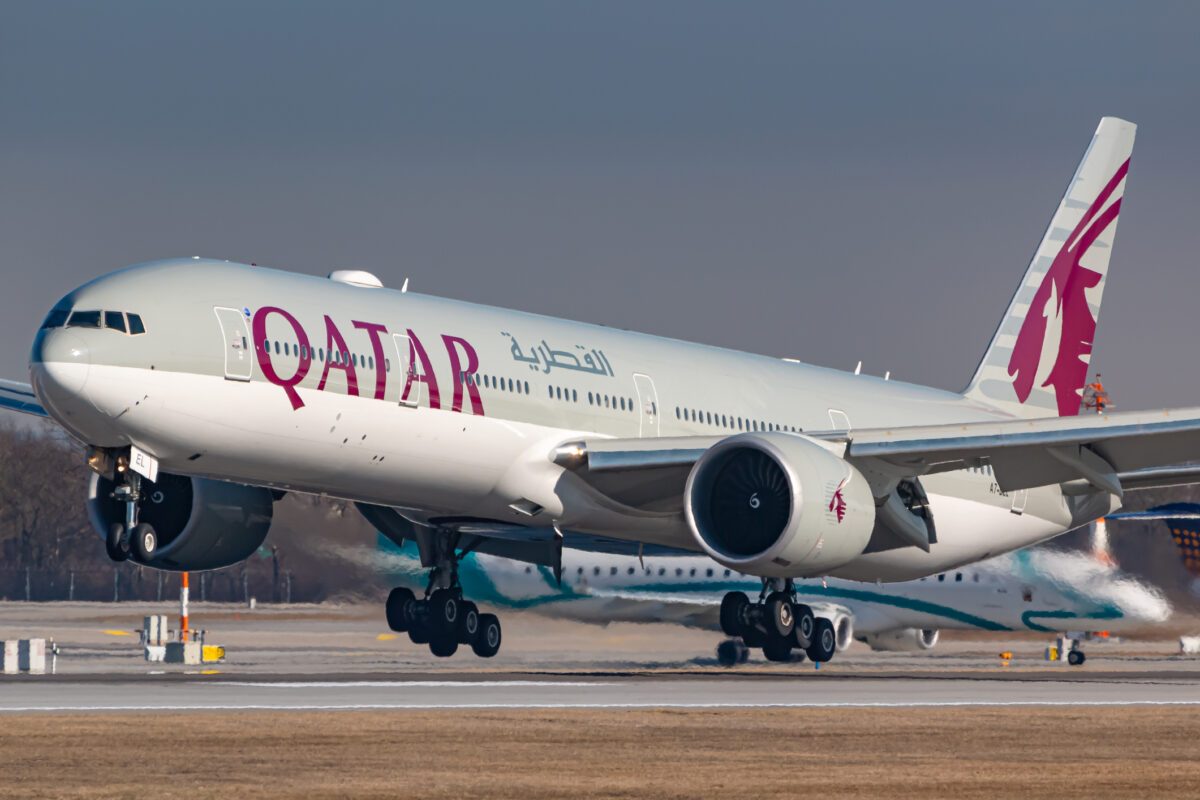
Qatar Airways planned to operate the route with the Boeing 777-200LR, the ultra-long-range version of Boeing’s original 777 family.
The great-circle distance between Hamad International Airport (DOH) and Harry Reid International Airport (LAS) is approximately 7,060 nautical miles, or just over 8,100 statute miles. That would have placed the route among the longest commercial flights operating at the time.
According to Boeing’s published specifications, the 777-200LR has a maximum range of approximately 8,500 nautical miles. It was specifically designed for long, thin intercontinental routes that could not support the larger Boeing 777-300ER.
The 777-200LR uses the same General Electric GE90 engine family as the 777-300ER but has a shorter fuselage, auxiliary fuel capacity and the extended raked wingtips also found on the 777-300ER. Its combination of range and relatively modest capacity made it the natural aircraft for a nonstop Doha-Las Vegas flight.
Qatar Airways continues to operate the type today, with its remaining 777-200LRs configured for either 272 or 276 passengers. The precise configuration planned for Las Vegas was not disclosed.
The aircraft could perform the sector, but technical capability does not guarantee favorable economics. Carrying the fuel required for a 15- to 17-hour flight increases operating weight and fuel burn, while the revenue generated by cargo can become constrained by payload requirements.
Las Vegas also presents a demanding operating environment during the summer. Harry Reid International Airport (LAS) sits more than 2,000 feet above sea level, and extreme temperatures reduce aircraft takeoff performance. Its long runways help mitigate that issue, but a fully loaded ultra-long-haul departure would still require careful payload and performance planning on the hottest days.
Reservations Closed Before the Gulf Blockade
The most important detail in the route’s history is the date on which it disappeared.
Industry schedule reporting showed that Qatar Airways closed reservations for Doha-Las Vegas on April 27, 2017. The service remained described as postponed rather than formally canceled, but flights were no longer available for booking.
That happened more than five weeks before the Gulf diplomatic crisis began.
Saudi Arabia, the United Arab Emirates, Bahrain and Egypt severed diplomatic relations with Qatar on June 5, 2017. Those countries also closed their airspace to Qatar-registered aircraft and prohibited Qatar Airways from serving their airports.
Qatar Airways lost access to important regional markets and was forced to reroute many flights through Iranian, Turkish and Omani airspace. The restrictions increased flight times, fuel consumption and operating costs on parts of the network.
However, the blockade cannot have been the original reason Qatar Airways removed Las Vegas from sale because the airline had already done so on April 27.
The diplomatic crisis may have eliminated any remaining chance of an early revival. Once the blockade began, Qatar Airways had to reorganize its network, find replacement markets for displaced capacity and absorb higher operating costs. Launching another ultra-long-haul route with uncertain demand would have become less attractive.
That is different from saying the blockade caused the route to be withdrawn.
Las Vegas Was a Difficult Market Despite Its Size
Harry Reid International Airport (LAS) is one of the busiest airports in the United States. It handled nearly 55 million passengers in 2025 and offered nonstop connectivity to more than 170 markets.
Yet total passenger volume only tells part of the story.
Las Vegas is primarily an origin-and-destination airport built around leisure travelers, conventions, entertainment and special events. It is not a major connecting hub for American Airlines, Alaska Airlines or another Qatar Airways partner.
That would have left the Doha route heavily dependent on passengers beginning or ending their journeys in Las Vegas, together with inbound travelers connecting through Hamad International Airport (DOH).
Qatar Airways could have attracted traffic from India, Pakistan, Africa, Southeast Asia and the Middle East. However, filling a Boeing 777-200LR is not enough by itself. An ultra-long-haul route must also produce sufficient premium-cabin revenue and cargo demand to cover its high operating costs.
Las Vegas has substantial luxury and convention traffic, but it does not generate the same consistent corporate demand as New York, Washington, Chicago, Houston or the San Francisco Bay Area. Leisure-heavy markets can also be highly seasonal and more sensitive to price.
A four-times-weekly schedule reduced Qatar Airways’ initial capacity exposure, but it also made the service less attractive to business travelers and passengers requiring flexible departure dates.
The Route Had Limited Partner Feed in 2017
Qatar Airways’ most successful U.S. gateways generally benefit from extensive connecting traffic.
Dallas Fort Worth International Airport (DFW) is American Airlines’ largest hub. Chicago O’Hare International Airport (ORD), Miami International Airport (MIA), New York John F. Kennedy International Airport (JFK) and Los Angeles International Airport (LAX) also provide substantial onward connectivity.
Seattle-Tacoma International Airport (SEA), which joined Qatar Airways’ network in 2021, benefits from Qatar Airways’ partnership with Alaska Airlines. That relationship allows Qatar Airways passengers to connect across Alaska’s domestic network.
Those partnership advantages were much weaker at Harry Reid International Airport (LAS) when the Las Vegas route was announced in 2017. Alaska Airlines had not yet joined the oneworld alliance, and its Qatar Airways codeshare relationship did not exist.
American Airlines served Las Vegas, but LAS was not one of its hubs. Much of the airport’s domestic capacity was—and remains—operated by airlines that had no meaningful commercial relationship with Qatar Airways.
A Doha-Las Vegas flight would therefore have had considerably less connecting feed than Qatar Airways’ services to DFW, ORD, JFK or SEA.
One-Stop Service Reduced the Need for a Nonstop Flight
Qatar Airways can still carry Las Vegas passengers without operating directly to Harry Reid International Airport (LAS).
Travelers can connect to Qatar Airways flights through Los Angeles International Airport (LAX), San Francisco International Airport (SFO), Seattle-Tacoma International Airport (SEA), Dallas Fort Worth International Airport (DFW) and other U.S. gateways.
The airline’s partnerships with Alaska Airlines and American Airlines make many of those itineraries available on a single ticket, with checked baggage transferred through to the final destination.
That is less convenient than a nonstop flight, but it allows Qatar Airways to serve the Las Vegas market without committing a widebody aircraft to a route exceeding 7,000 nautical miles.
It also enables the airline to consolidate passengers onto established services that already benefit from stronger local demand, premium traffic, cargo volumes and domestic connections.
From a network-planning perspective, carrying a Las Vegas passenger over an existing West Coast gateway can be considerably less risky than operating an independent Doha-Las Vegas route.
Qatar Airways Now Serves 11 U.S. Airports—With a 12th Returning
As of July 2026, Qatar Airways operates nonstop service from Hamad International Airport (DOH) to 11 U.S. destinations:
Atlanta Hartsfield-Jackson International Airport (ATL), Boston Logan International Airport (BOS), Chicago O’Hare International Airport (ORD), Dallas Fort Worth International Airport (DFW), Houston George Bush Intercontinental Airport (IAH), Los Angeles International Airport (LAX), Miami International Airport (MIA), New York John F. Kennedy International Airport (JFK), San Francisco International Airport (SFO), Seattle-Tacoma International Airport (SEA) and Washington Dulles International Airport (IAD).
Philadelphia International Airport (PHL) is scheduled to return on August 1, 2026, bringing the network back to 12 U.S. passenger destinations. Qatar Airways’ summer 2026 network plan also includes additional capacity in several U.S. markets.
Las Vegas remains absent.
The airline has not publicly announced a new launch date or indicated that Harry Reid International Airport (LAS) is under active consideration.
Las Vegas Has Expanded Its Long-Haul Network Without a Gulf Carrier
The failure of Qatar Airways’ route did not prevent Las Vegas from building a substantial international network.
Harry Reid International Airport (LAS) has nonstop service to major European markets, including London Heathrow Airport (LHR), London Gatwick Airport (LGW), Amsterdam Airport Schiphol (AMS), Frankfurt Airport (FRA), Dublin Airport (DUB), Zurich Airport (ZRH) and Paris Charles de Gaulle Airport (CDG).
Korean Air also provides nonstop service to Seoul Incheon International Airport (ICN), currently the airport’s only scheduled passenger route to Asia. The airport describes the Seoul service as operating daily.
However, Harry Reid International Airport (LAS) still has no nonstop passenger service to Doha, Dubai, Abu Dhabi or another Gulf hub.
For travelers between Las Vegas and the Middle East, South Asia or much of Africa, a connection remains necessary.
Could Qatar Airways Reconsider Las Vegas?
A future Doha-Las Vegas route is technically more practical than it was in 2017.
Qatar Airways now has access to highly efficient Airbus A350-900 and A350-1000 aircraft, which could offer lower fuel consumption and trip costs than the Boeing 777-200LR. Its partnership with Alaska Airlines could also provide more domestic feed at Harry Reid International Airport (LAS) than was available nine years ago.
Las Vegas has continued to grow as an international destination, supported by conventions, professional sports, major concerts and events such as Formula One.
The underlying commercial challenges nevertheless remain.
The route would still exceed 7,000 nautical miles, require an aircraft for more than 30 hours per round trip and depend heavily on connecting leisure traffic. Qatar Airways must compare that opportunity with deploying the same aircraft to markets capable of supporting daily service, stronger premium demand or greater cargo revenue.
A seasonal operation or service timed around major events might reduce some of that risk. A permanent year-round route would require a much stronger demand case.
Bottom Line
Qatar Airways’ proposed service between Hamad International Airport (DOH) and Harry Reid International Airport (LAS) was a genuine and advanced route plan. It had a launch date, published flight numbers, a four-times-weekly schedule and an assigned Boeing 777-200LR.
But the airline closed reservations on April 27, 2017—more than a month before the Gulf blockade began.
The blockade undoubtedly damaged Qatar Airways’ network and may have prevented the Las Vegas route from being reconsidered during the following years. It was not, however, the event that originally caused the service to disappear from sale.
Qatar Airways never publicly disclosed the precise reason. The most credible explanation is that the airline reconsidered the commercial case for committing a scarce ultra-long-range aircraft to a leisure-heavy destination with limited partner feed and uncertain premium demand.
Nearly a decade later, Las Vegas remains one of the largest U.S. markets without nonstop service from a Gulf carrier.
Keep reading FlyMag
Get the Daily Brief in the morning or the Route Watch weekly recap on Fridays. Or both.