No Middle Seat: United Adds Table-Equipped Economy Plus Row to Its A321XLRs
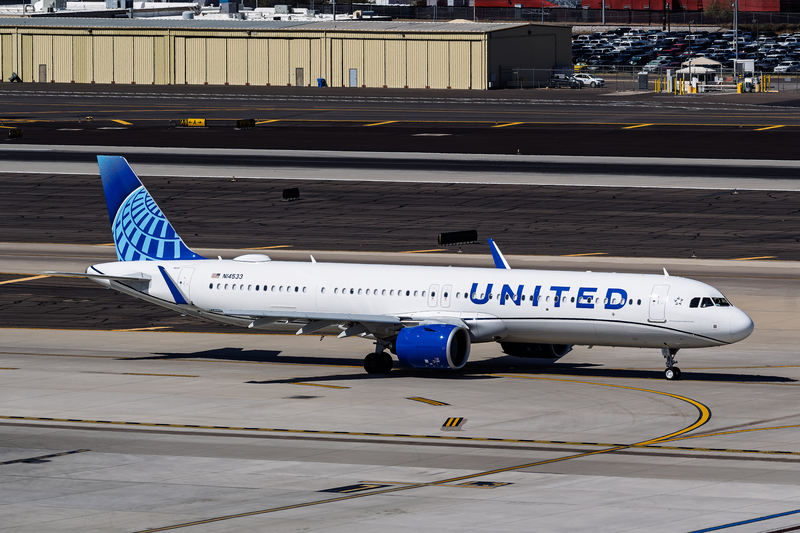
United Airlines is introducing a new Economy Plus seating option that will replace the middle seats in one row of its Airbus A321XLRs with permanently installed shared tables.

Each side of the single-aisle cabin will have a window seat and an aisle seat separated by a large table extending across the space normally occupied by the middle passenger. The arrangement will give four customers in the selected row more lateral room while retaining the additional legroom already offered throughout United Economy Plus.
United expects to install the feature on all 50 Airbus A321XLRs it has ordered. Seats in the modified row will become available for purchase later in 2026, although the airline has not announced the price, exact row number, or whether access will be included with any elite-status or fare benefits. (United Airlines)
The unusual configuration is part of United’s broader effort to divide the economy cabin into increasingly distinct products. Rather than moving every passenger seeking more space into Premium Plus or Polaris, the airline is creating another intermediate option for travelers willing to pay for extra comfort without purchasing a premium-economy seat.
United Will Replace Two Middle Seats With Tables
The modified Economy Plus row will retain the normal six-position 3-3 footprint found on an Airbus A321, but only the window and aisle positions will be available to passengers.
The middle position on each side of the aisle will contain a permanently fixed table stretching between the armrests. United says the table will have a soft, leather-like covering and two molded indentations for cups.
That means the row will accommodate four passengers rather than six:
| Position | Cabin use |
|---|---|
| Left window seat | Available to passengers |
| Left middle position | Permanently installed table |
| Left aisle seat | Available to passengers |
| Right aisle seat | Available to passengers |
| Right middle position | Permanently installed table |
| Right window seat | Available to passengers |
Unlike an ordinary empty middle seat, the space cannot suddenly be assigned to another traveler when the flight fills. The physical table makes the middle position unavailable for seating and ensures that the additional shoulder and elbow room remains protected throughout the flight.
The table is intended to be shared by the window and aisle passengers. It should provide a useful place for drinks, phones, small tablets, headphones, or other lightweight personal items, although United has not yet released detailed rules covering what passengers will be permitted to place on it during taxi, takeoff, landing, or turbulence.
The Extra Space Is Lateral, Not Additional Legroom
United describes the new arrangement as providing more room to stretch out, but the principal improvement will be additional width and elbow space rather than a further increase in seat pitch.
Passengers in the row will receive the same three inches of additional legroom offered in the rest of the A321XLR’s Economy Plus section. The blocked middle position does not move the row ahead or create more distance from the seats in front.
The improvement comes from removing the person who would normally occupy the middle seat.
Window passengers should find it easier to use the inside armrest without competing for space, while aisle passengers gain additional shoulder clearance from the customer beside them. Both passengers will also have access to the shared table rather than relying entirely on the smaller tray table attached to the seat in front.
That distinction will matter when United begins selling the product. Customers should understand that they are purchasing a standard-width Economy Plus seat with additional space beside them—not a wider seat or a Premium Plus-style recliner.
This Is More Than Simply Blocking an Unsold Seat
Airlines occasionally leave a middle seat unassigned for operational, weight, accessibility, or customer-service reasons. That is not what United is doing.
The table is a permanent cabin fixture. The middle position is being repurposed as shared passenger space and cannot be sold when demand is strong.
This gives customers greater certainty than purchasing an aisle or window seat and hoping the middle remains empty. It also allows United to market the row as a separate product rather than providing additional space only when a flight happens to be lightly booked.
The airline has not announced whether the four seats will receive a special product name beyond Economy Plus. They may appear as a distinct seat category during booking or simply carry a higher seat-selection price on the A321XLR seat map.
United says it will release pricing and additional product information before sales begin later in 2026.
United Has Not Identified the Exact Row
United has confirmed that every A321XLR will contain one modified Economy Plus row, but it has not disclosed where that row will be located.
Its position could materially affect the passenger experience.
A row near the front of the Economy Plus cabin might provide quicker boarding and deplaning. A position near an emergency exit could combine the open middle seat with even greater legroom, although installing a fixed table in an exit row could present additional certification and access considerations.
A row near a lavatory, galley, or the aircraft’s rear snack bar might experience more foot traffic and noise. The absence of a middle passenger would remain valuable, but some seats could be more desirable than others depending on their location.
United has also not published the final seat map showing whether the new tables affect the previously reported count of 36 Economy Plus seats.
Earlier cabin plans placed 150 passenger seats on the A321XLR, including 20 United Polaris suites, 12 Premium Plus seats, 36 Economy Plus seats, and 82 standard Economy seats. United’s latest announcement does not clarify whether that total already accounts for the two middle positions converted into tables or whether the final sellable capacity will be adjusted. (One Mile at a Time)
The precise capacity should therefore be confirmed when United publishes the final commercial seat map.
The A321XLR Will Be United’s Most Premium Narrowbody
United has designed its Airbus A321XLR around long international routes that are too thin for a large Boeing 787 but require more range and premium seating than a conventional domestic narrowbody can provide.
The aircraft will have 32 seats in its two premium cabins:
| Cabin | Planned seats |
| United Polaris | 20 |
| United Premium Plus | 12 |
| Economy Plus and United Economy | Approximately 118 |
| Previously published total | 150 |
The 20 Polaris seats will convert into fully flat beds and provide direct aisle access from every position. Each suite will also include a privacy door, giving United a dedicated long-haul business-class product designed specifically for the narrow A321 fuselage.
Premium Plus will contain 12 recliner-style seats in a 2-2 arrangement. It will be United’s first true international premium-economy cabin installed on a single-aisle aircraft.
The remaining section will use the conventional 3-3 A321 economy layout, apart from the special four-passenger Economy Plus row.
Economy Plus With an Open Middle Is Not Premium Plus
The new seating option creates a product between standard Economy Plus and United Premium Plus, but it should not be confused with the airline’s premium-economy cabin.
Premium Plus passengers will receive larger recliner seats arranged four across rather than six across. The seats offer greater width, more recline, additional leg support, and a physically separate cabin.
The table-equipped Economy Plus row will retain standard economy seats. The principal improvements will be the empty middle position, shared surface, and three additional inches of pitch compared with United Economy.
| Feature | Economy Plus table row | Premium Plus |
| Layout | 2-table-2 within a 3-3 footprint | 2-2 |
| Seat type | Standard economy seat | Wider premium-economy recliner |
| Middle passenger | None | Not applicable |
| Shared table | Yes | No |
| Direct aisle access | Aisle seats only | Aisle seats only |
| Additional legroom | Three inches over Economy | Substantially more than Economy |
| Cabin service | Economy-based product | Premium-economy service |
The new row could appeal to customers who value personal space but cannot justify the substantially higher fare normally required for Premium Plus.
It may also be attractive when Premium Plus is sold out. United can offer another premium-priced option without giving the customer a business-class seat, enhanced meal service, larger recliner, or separate cabin.
The Arrangement Resembles European Business Class
The concept will be familiar to travelers who frequently fly within Europe.
Many European airlines operate short-haul business class using standard 3-3 economy seats while leaving the middle position empty. Some carriers install a removable or foldable table over the unused middle seat.
The approach gives business-class passengers more shoulder room while allowing the airline to change the size of the premium cabin according to demand.
United’s version is different in several important ways.
The tables will be permanently installed rather than moved as the cabin boundary changes. Only one row will receive the feature, and the passengers will still be traveling in Economy Plus rather than Polaris or Premium Plus.
United therefore is not introducing European-style business class to the United States. It is borrowing one element of that product—the guaranteed open middle position—and using it to create a higher-value economy seat.
United expects to be the only U.S. airline offering this specific table-equipped Economy Plus arrangement when it launches. The airline is also considering installing similar seating on additional aircraft types.
Pricing Will Determine Whether the Product Works
United has not announced how much more the four seats will cost.
The airline could treat them as ordinary Economy Plus positions with an additional seat-selection premium. It could also introduce a separate bundled product that includes priority boarding, preferred baggage handling, additional MileagePlus benefits, or other services.
Pricing will need to reflect the meaningful comfort advantage without approaching Premium Plus levels.
A customer may be willing to pay a moderate amount to guarantee that no one will sit directly beside them on a seven- or eight-hour flight. The same customer may reject the product if the price comes close to a larger Premium Plus recliner with better service.
United can also vary the price according to the route, flight length, demand, booking date, and number of remaining seats.
The product will be scarce by design. Only four seats will be available on each aircraft, allowing United to charge a premium when demand is strong without converting a large portion of the cabin.
That scarcity may be particularly valuable on business-heavy routes from Newark Liberty International Airport (EWR) and Washington Dulles International Airport (IAD), where some travelers receive Economy Plus access through elite status or corporate agreements but may still pay extra for guaranteed lateral space.
United Is Trading Two Seats for Higher Revenue From Four
Each table-equipped row removes two potentially sellable middle seats.
United must therefore earn enough additional revenue from the four remaining positions to compensate for the two customers it can no longer carry.
The calculation may be favorable on the A321XLR because the aircraft is designed for long, thinner routes where premium demand matters more than maximizing the absolute number of economy seats.
Middle seats also tend to be the least desirable positions in a six-abreast cabin. United may be giving up two relatively difficult-to-sell seats while creating four of the most desirable economy positions on the aircraft.
If the premium collected from the four remaining seats exceeds the revenue the airline would normally receive from the two middle positions, the modification can improve revenue while also raising customer satisfaction.
United has not released its financial assumptions or expected price premium, so the economic benefit cannot yet be calculated.
The Product Fits United’s Premium Strategy
United has increasingly divided its cabins into products aimed at different willingness-to-pay levels.
A passenger on the A321XLR may be able to choose among:
- An enclosed Polaris suite with a fully flat bed
- A wider Premium Plus recliner
- Economy Plus with a guaranteed open middle position
- Conventional Economy Plus
- Standard United Economy
- Basic Economy fare restrictions within the economy cabin
The additional choice allows United to generate more revenue from customers who do not purchase business class but are willing to pay for specific comfort improvements.
The table row follows United’s announcement of the United Relax Row, which will allow passengers to convert a group of Economy seats on selected Boeing 777 and Boeing 787 aircraft into a couch-like sleeping surface. That product is expected to become available in early 2027.
Both concepts repurpose existing economy-cabin space rather than installing an entirely new conventional cabin.
The strategy recognizes that passengers value different types of comfort. One traveler may prioritize legroom, another may want an empty adjacent seat, while a family may prefer a flat surface that allows a child to sleep.
United can price each product separately rather than providing the same economy experience to every passenger.
The Staffing Explanation Is Not Confirmed
Some early reports suggested United may be blocking the two middle seats primarily to remain at or below a flight-attendant staffing threshold.
Federal regulations generally require two flight attendants for aircraft with 51 to 100 passenger seats. Above 100 seats, another flight attendant is required for each additional group—or partial group—of 50 seats. (14 CFR §121.391)
That rule has fueled speculation that a precise 150-seat configuration might reduce the minimum number of required cabin crewmembers compared with an aircraft certified with slightly more capacity.
United’s own announcement undercuts the claim that crew reduction is the principal purpose of the table row.
The airline says it plans to operate the A321XLR with five flight attendants on most transatlantic flights, consistent with its current practice on the Boeing 757-200 being replaced. United has not said that the open middle seats were introduced to remove a flight attendant or reduce cabin labor costs.
Regulatory minimums also do not necessarily determine actual airline staffing. An operator may schedule additional crewmembers because of cabin layout, emergency-exit responsibilities, service requirements, labor agreements, flight duration, or the complexity of an international operation.
The new product should therefore be evaluated primarily as a passenger-space and revenue initiative unless United provides evidence of a separate staffing objective.
The A321XLR Will Replace Some Boeing 757-200 Flying
United ordered 50 A321XLRs in 2019 to replace portions of its aging Boeing 757-200 fleet and support additional long-range narrowbody routes.
The airline’s 757-200s are configured with 176 seats, including 16 lie-flat Polaris seats, 42 Economy Plus seats, and 118 standard Economy seats. (United’s Boeing 757-200 seat map)
The A321XLR will carry fewer passengers overall but substantially more premium seating.
United says the new aircraft will have 32 Polaris and Premium Plus seats—16 more premium positions than the Boeing 757s it replaces. The reduction in total capacity is therefore not simply a limitation of the smaller aircraft. It reflects a deliberate decision to devote more cabin floor space to higher-value products.
| Aircraft | Total capacity | Lie-flat business | Premium economy |
| Boeing 757-200 | 176 | 16 | 0 |
| Airbus A321XLR | Approximately 150 | 20 | 12 |
The A321XLR will allow United to maintain lie-flat business-class service on routes that cannot consistently support a Boeing 767 or 787. It can also open destinations that were uneconomical with the older and less fuel-efficient 757.
The table-equipped Economy Plus row adds another premium element to an aircraft already designed around higher-yield international traffic.
United’s First A321XLR Has Already Arrived
United received its first A321XLR in June 2026.
The aircraft, registered N64321, flew from Airbus’ Hamburg-Finkenwerder facility to Tampa International Airport (TPA) on June 3. The airplane was sent to Tampa for additional work before beginning passenger service. (AeroTime)
United expects to use the aircraft on domestic flights during fall 2026. Those initial services will allow pilots, flight attendants, ground employees, maintenance personnel, and dispatchers to gain operational experience before the jet begins longer international missions.
International A321XLR service is expected to begin by early 2027, although United has not included specific routes in its table-row announcement.
The aircraft is designed for routes of as much as 4,700 nautical miles and flights lasting up to 11 hours. That places destinations across Western Europe, northern South America, Central America, and the Caribbean within reach of several United hubs. (Airbus A321XLR)
A Single-Aisle Aircraft Will Operate Widebody-Length Flights
The additional personal space will be especially valuable because the A321XLR is intended to remain airborne far longer than a typical domestic Airbus narrowbody.
A passenger could spend seven, eight, or more hours in the same Economy Plus seat while crossing the Atlantic. The aircraft has only one aisle, limiting passengers’ ability to move around the cabin when carts are in use.
Removing the middle passenger does not turn the seat into a widebody product, but it can make a long narrowbody flight noticeably more comfortable.
A window passenger gains more breathing room without losing access to the fuselage-side view. The aisle passenger has greater freedom to adjust position without immediately entering another customer’s space.
Couples may find the arrangement particularly appealing. Two travelers can reserve the window and aisle positions on the same side and use the table jointly, effectively creating a small two-person section.
Solo travelers may also value it, although they will share the table with an unknown passenger. The configuration guarantees an empty middle position but does not provide complete privacy or sole control of the surface.
Every Seat Will Have a Large Entertainment Screen
The open-middle row will be part of a substantially upgraded economy cabin.
Every A321XLR seat will have an individual 4K OLED entertainment screen with Bluetooth connectivity. United lists 19-inch screens in Polaris, 16-inch displays in Premium Plus, and 13-inch screens in Economy Plus and Economy.
The aircraft will also feature larger overhead bins designed to accommodate a rollaboard bag for each passenger and a self-service snack bar at the rear of the Economy cabin.
Those features represent a major passenger upgrade over many of the Boeing 757s the A321XLR will replace.
The new screens allow passengers to connect compatible wireless headphones rather than relying only on a traditional wired headset. The larger bins may also reduce gate-checking and boarding delays caused by insufficient carry-on space.
The snack bar will give Economy passengers access to selected food and beverages between scheduled cabin-service periods. That could be useful on flights lasting eight or nine hours, particularly when carts and crewmembers are not continuously moving through the cabin.
The Fixed Table Will Have Some Practical Limitations
The table creates useful additional space, but its design may also introduce minor complications.
The two passengers must share the surface. Disagreement could arise if one customer spreads out a laptop, food container, cables, and other belongings while the second passenger only has access to a small portion.
The table does not appear to include a divider establishing separate left and right areas beyond the two cup indentations.
Passengers will also have to keep the surface clear when instructed by the crew. Because it is permanently fixed, it cannot function like an ordinary tray table that folds away during takeoff or landing.
United has not explained whether the table will contain storage, device holders, charging connections, or restrictions on laptop use.
The absence of a middle passenger may also make it slightly more difficult for a window customer to attract the attention of the aisle passenger when leaving the row. The extra distance is beneficial for comfort but still must be crossed when the window traveler needs access to the aisle.
Those are relatively minor concerns, but they show why passenger feedback during the first months of domestic operation will be valuable.
United Could Expand the Concept to Other Aircraft
United says it is evaluating whether similar table-equipped rows could be installed on other aircraft types.
The A321XLR provides a controlled starting point because it is a new fleet with a common cabin configuration. United can introduce the product on all 50 aircraft without modifying hundreds of existing airplanes immediately.
If the seats generate strong demand and sufficient additional revenue, possible expansion candidates could include United’s premium-configured A321neo Coastliner fleet or selected Boeing aircraft used on longer domestic and international flights.
Retrofitting an existing airplane would require additional engineering, certification, aircraft downtime, and modifications to the seat map. The economics may differ from installing the tables during the production or initial completion of a new aircraft.
United will also need to determine whether customers prefer the fixed table to other alternatives, such as selling the entire three-seat section to two passengers, using a removable console, or creating more conventional premium-economy rows.
The A321XLR program will provide real-world data on seat-selection demand, willingness to pay, passenger satisfaction, and operational durability before United makes a broader fleet decision.
Bottom Line
United Airlines will introduce a special Economy Plus row with permanently open middle positions on all 50 of its Airbus A321XLRs.
The middle space on each side of the aisle will contain a fixed table with a soft covering and two cup indentations. Four passengers—two window and two aisle customers—will occupy a row that would normally seat six.
The arrangement will provide more elbow and shoulder room, but it will not increase seat width or offer more pitch than the other Economy Plus rows. Passengers will receive the same three inches of additional legroom already included with the product.
United has not announced the row number, price, loyalty benefits, or final seat map. The seats will go on sale later in 2026, with the airline promising more details before bookings open.
The product occupies a deliberate position between conventional Economy Plus and United Premium Plus. It offers substantially more personal space than a normal economy row without the larger recliner, separate cabin, or enhanced service of premium economy.
United’s A321XLR will be one of the most premium-heavy single-aisle aircraft in the U.S. market. The jet will have 20 lie-flat Polaris suites, 12 Premium Plus seats, individual 4K OLED screens at every position, larger overhead bins, and a rear Economy snack bar.
The aircraft will begin domestic flying during fall 2026 before entering international service by early 2027. With a published range of up to 4,700 nautical miles, it will replace selected Boeing 757-200 routes and allow United to open long, lower-volume markets that do not require a widebody.
Claims that the open middle positions were created primarily to reduce flight-attendant staffing remain unconfirmed. United says it expects to use five flight attendants on most transatlantic A321XLR services, matching its practice on the Boeing 757.
The commercial logic is more straightforward: United is giving up two unpopular middle seats and attempting to create four economy positions customers will pay considerably more to reserve.
Whether the idea succeeds will depend largely on pricing. At a reasonable premium, a guaranteed open middle position could become one of the most desirable economy options on United’s long-haul narrowbody fleet. If the cost approaches Premium Plus, many passengers may prefer the genuinely larger seat and enhanced service of the separate premium-economy cabin.
For now, United is turning one of the least desirable parts of the economy cabin—the middle seat—into a new source of space, comfort, and potentially significant ancillary revenue.