Natchez Returns to the Airline Map as United Express Opens Daily Houston Service
For Natchez, Mississippi, the arrival of a 50-seat regional jet is far more than a ceremonial ribbon-cutting. It is the restoration of scheduled airline service to a community that has been off the commercial aviation map for more than three decades.

United Express, operated by SkyWest Airlines, has launched daily service between Natchez-Adams County Airport / Hardy-Anders Field (HEZ) and Houston George Bush Intercontinental Airport (IAH), giving southwest Mississippi and the broader Miss-Lou region a direct link into one of United Airlines’ major connecting hubs. Local reports confirm that HEZ welcomed commercial air service back on July 1, 2026, with once-daily flights to IAH.
The route may be modest in size, but its implications are significant. For travelers in and around Natchez, the new HEZ-IAH service means no longer defaulting to long drives to Louis Armstrong New Orleans International Airport (MSY), Jackson-Medgar Wiley Evers International Airport (JAN), Baton Rouge Metropolitan Airport (BTR), or other regional gateways before even starting a trip. It also gives local businesses, tourism operators, film production interests, and river-cruise-related travel a faster connection to United’s domestic and international network through Houston (IAH).
A Small Airport Rebuilt for Scheduled Jet Service
Natchez-Adams County Airport (HEZ) had to move quickly to become airline-ready. A 10,000-square-foot aircraft hangar was converted into a modern passenger terminal in roughly four months, according to local reporting. The project included the infrastructure required for scheduled commercial service: passenger processing, Transportation Security Administration screening, airline operations, and the other terminal functions expected by today’s travelers.
That is not a minor conversion for a small airport. For HEZ, the move meant transforming a general aviation facility into a Part 139 Class I certificated airport capable of handling scheduled commercial passenger service. The airport has a 6,500-foot runway with an existing Instrument Landing System, an important operational detail for a regional jet route that must perform reliably across varying weather and visibility conditions.
The airport’s runway length is more than adequate for the Bombardier CRJ200 serving the route, particularly on a relatively short sector to Houston (IAH). AirNav data lists the primary runway at HEZ as 6,500 by 150 feet, while the airport also has a secondary 5,000-foot runway.
Why the CRJ200 Makes Sense at HEZ
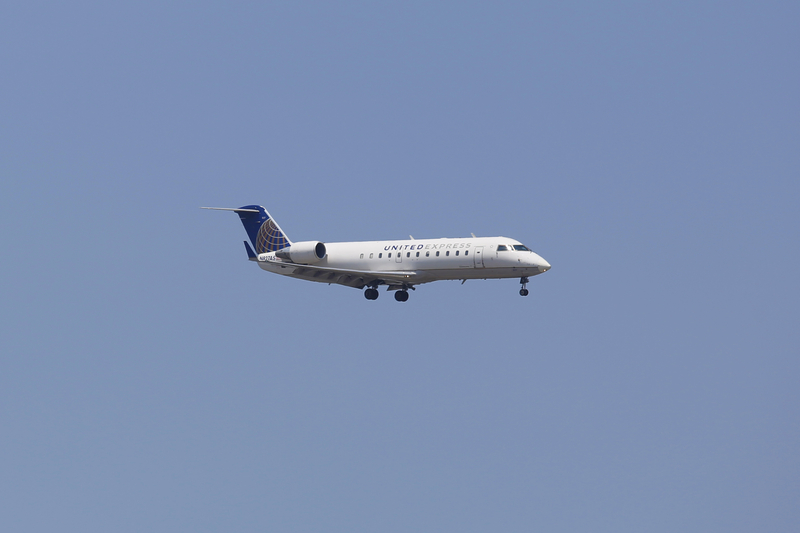
The aircraft selected for the route is the Bombardier CRJ200, operated by SkyWest Airlines under the United Express brand. SkyWest’s fleet data lists the CRJ200 as a 50-passenger aircraft operated for United Airlines and Delta Air Lines, and United’s own CRJ200 seat map shows a 50-seat, all-economy, 2-2 cabin configuration.
From a passenger comfort standpoint, the CRJ200 is not United’s most glamorous regional aircraft. It does not offer the larger cabin feel of an Embraer E175 or the premium-heavy layout of United’s CRJ550. However, for a new small-community route like Natchez (HEZ) to Houston (IAH), the CRJ200 is a practical tool. It provides enough capacity to make daily service viable without flooding the market with more seats than the region can immediately support.
That matters. Small-community air service is often not won at launch; it is won over the first 12 to 24 months as load factors, local booking behavior, corporate travel support, and inbound visitor demand prove whether the market can sustain the aircraft. Local officials and consultants have already emphasized that filling seats will be critical to keeping the service long term.
The HEZ-IAH stage length is also well suited to the CRJ200. Airportia lists the Natchez-to-Houston sector at about 265 miles, with an average flight time of roughly 51 minutes. That makes the route a short hub-feeder mission rather than a long regional-jet segment.
Houston Gives Natchez One-Stop Reach
The choice of Houston George Bush Intercontinental Airport (IAH) is central to the route’s value. IAH is one of United’s major hubs and a logical southern gateway for Natchez-area traffic. From Houston, passengers can connect across the United network, including major domestic business markets, western U.S. destinations, Mexico, Central America, and long-haul international service.
For Natchez travelers, the most important change is not merely the nonstop flight to Houston. It is the ability to start the journey at HEZ, clear TSA locally, and connect at IAH without another security screening. Natchez officials specifically highlighted that “sterile-to-sterile” benefit when announcing the service, calling it a major improvement for travelers in southwest Mississippi and the Miss-Lou region.
At launch, local reporting listed the Houston-to-Natchez flight as departing IAH at 11:55 a.m. and arriving HEZ around 1:10 p.m., with the return flight departing HEZ at 1:45 p.m. and arriving IAH at 3:05 p.m. As always with regional schedules, travelers should check United directly before booking because flight numbers, timings, and operating patterns can shift after launch.
A Route Built on Risk Mitigation and Local Support
The Natchez route did not happen by accident. Local officials have been working for years to restore commercial service, and the launch was supported by public funding designed to reduce the airline’s startup risk.
Local reporting says United and SkyWest were attracted in part by a $950,000 risk-mitigation package, including a $750,000 federal grant and $200,000 in city-county funding. The money is intended to help offset potential early losses while the market develops.
That structure is common in small-community air service development. The U.S. Department of Transportation’s Small Community Air Service Development Program is designed to help underserved communities improve air service and address airfare or connectivity challenges. Importantly, SCASDP is separate from the Essential Air Service program, which means this is not simply a traditional EAS-style replacement route.
For aviation planners, the key question now becomes whether the community can convert airport enthusiasm into actual bookings. Natchez officials have projected more than 10,000 passengers during the first 12 to 18 months, but the long-term success of the route will depend on local travelers choosing HEZ instead of driving to MSY, JAN, BTR, or other airports.
More Than a Convenience Route
The return of scheduled airline service gives Natchez a new transportation asset at a time when the city is leaning into tourism, business travel, film production, and river cruise growth. Local leaders have framed the service as an economic development tool, not just a travel convenience. KNOE reported that officials expect the new route to support tourism, filmmaking, oil and gas-related travel, and broader business connectivity.
That is the real significance of HEZ returning to the scheduled airline system. A daily CRJ200 to Houston will not make Natchez a large commercial airport overnight. But it changes the region’s access equation. It shortens the first leg of a trip, reduces the need for long airport drives, gives inbound visitors a cleaner path into southwest Mississippi, and places Natchez back inside the network logic of a major U.S. carrier.
The airport also returns with a different kind of service than it had in the past. Natchez previously saw scheduled airline activity from carriers such as Southern Airways, Trans-Texas Airways, Royale Airlines, and, briefly in the 1990s, Lone Star Airlines service to Dallas/Fort Worth International Airport (DFW). The new United Express service is notable because it gives HEZ scheduled 50-seat jet service into a global hub rather than a small turboprop link into a limited regional network.
Bottom Line
United Express service between Natchez-Adams County Airport (HEZ) and Houston George Bush Intercontinental Airport (IAH) marks a major step for one of Mississippi’s smaller aviation markets. Operated by SkyWest with the 50-seat Bombardier CRJ200, the route gives Natchez its first scheduled commercial flights in more than 30 years and restores the region’s direct access to the national air transportation system.
The real test begins now. The terminal is open, the aircraft is scheduled, and the community has its hub connection. For HEZ, the challenge is no longer attracting an airline. It is proving that Natchez and the surrounding region can support daily commercial air service well beyond the launch celebration.