Air China Opens Beijing-Venice Nonstop
Air China has launched a new nonstop route between Beijing and Venice, adding a strategically important China–Italy link and giving Northeast Italy direct access to the Chinese capital without a connection through another European or Asian hub.

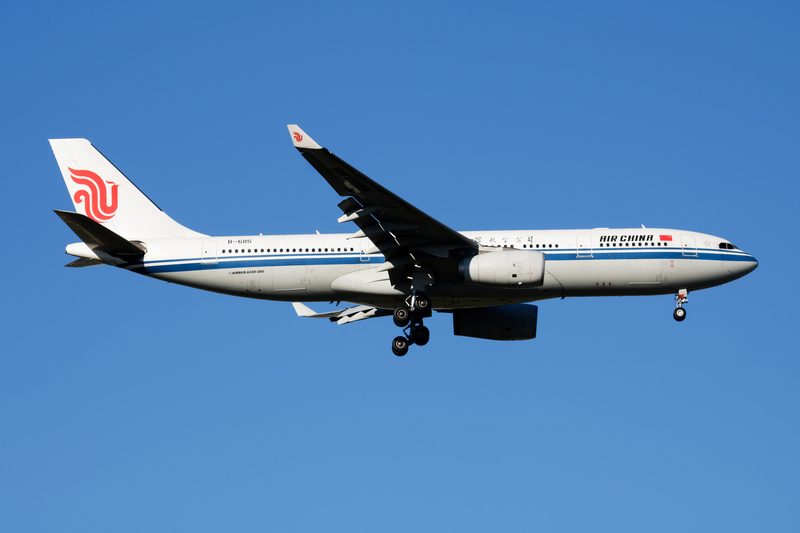
The new service connects Beijing Capital International Airport (PEK) with Venice Marco Polo Airport (VCE). Flights operate four times weekly, on Tuesdays, Thursdays, Saturdays, and Sundays, using the Airbus A330-200.
The launch is significant for both airports. For Venice (VCE), it adds another long-haul Asian route and strengthens Marco Polo’s role as the intercontinental gateway for Venice, Veneto, Friuli-Venezia Giulia, Trentino-Alto Adige, and the wider Northeast Italy catchment. For Air China, it expands an already deep European network and gives the Star Alliance carrier a third major Italian city in its network alongside Rome and Milan.
The route also arrives as China and Italy mark 40 years of direct air links, dating back to the launch of Beijing–Rome service in 1986.
Four Weekly Flights Between Beijing And Venice
Air China’s new Beijing (PEK)–Venice (VCE) service operates as CA973 westbound and CA974 eastbound.
CA973 departs Beijing Capital (PEK) at 14:15 and arrives at Venice Marco Polo (VCE) at 19:15 local time. The return, CA974, leaves Venice (VCE) at 21:30 and lands back in Beijing (PEK) at 13:30 the following day.
That schedule is well designed for both sides of the market. The afternoon departure from Beijing gets passengers into Venice in the evening, allowing travelers to reach hotels or onward ground connections the same night. The late-evening departure from Venice gives Italy-originating passengers a full day before flying overnight to Beijing, where they arrive early enough for onward connections across Air China’s domestic and international network.
The planned flight time is around 11 hours westbound from Beijing to Venice and around 10 hours eastbound from Venice to Beijing, depending on routing and winds. That puts the route firmly in long-haul widebody territory, but still well within the capabilities of the Airbus A330-200.
The Aircraft: Airbus A330-200
Air China is using the Airbus A330-200 on the Beijing (PEK)–Venice (VCE) route.
The A330-200 is a long-range twin-aisle aircraft and one of the most flexible widebodies in the Airbus product line. It was developed as the shorter, longer-range version of the A330 family, offering airlines a useful balance of range, passenger capacity, cargo space, and operating economics.
Airbus lists the A330-200 with typical seating of around 220 to 260 passengers, depending on configuration, and range up to 8,150 nautical miles. Air China operates multiple A330 cabin layouts across the family, including A330-200 versions with Business Class and Economy Class cabins. The aircraft type is well suited to a route such as Beijing–Venice because it offers enough capacity for tourism, business, visiting-friends-and-relatives traffic, and cargo without requiring the larger seat count of a Boeing 777-300ER, Airbus A350-900, or Boeing 787-9.
For passengers, the A330-200 also offers the advantage of a widebody cabin. Economy seating on A330 aircraft is typically arranged in a 2-4-2 layout, which is often preferred by travelers compared with the 3-3-3 or 3-4-3 layouts found on many newer long-haul widebodies. For couples, families, and leisure passengers, those two-seat side pairs can be especially attractive on an overnight eastbound sector.
Operationally, the A330-200 gives Air China a proven long-haul platform. It is not the newest aircraft in the fleet, but it is dependable, capable, and widely used on medium- and long-haul routes where range and capacity need to be balanced carefully.
Why Venice Matters
Venice is one of Europe’s strongest tourism brands, but the route is not only about sightseeing.
Venice Marco Polo Airport (VCE) serves a much broader economic region than the city of Venice itself. The airport’s catchment includes Veneto, one of Italy’s most important industrial and export regions, as well as cities such as Padua, Treviso, Vicenza, Verona, and parts of the wider Northeast.
That matters for China traffic. Northeast Italy has strong manufacturing, design, luxury goods, machinery, fashion, furniture, wine, tourism, and trade ties with Asia. A nonstop Beijing (PEK)–Venice (VCE) flight can support business travel, cargo, tourism, cultural exchange, and family travel in a region that previously relied heavily on connecting hubs.
Before this route, many passengers between Venice and Beijing had to connect through airports such as Frankfurt (FRA), Munich (MUC), Vienna (VIE), Istanbul (IST), Doha (DOH), Dubai (DXB), Paris Charles de Gaulle (CDG), Amsterdam (AMS), or other European and Middle Eastern hubs. Air China’s nonstop removes that extra stop and gives travelers a direct path into China’s capital.
For Venice Airport, the route also improves its position as Italy’s third major intercontinental gateway. Venice has long been a powerful long-haul leisure destination, but adding direct Beijing service strengthens its case as a business and Asia-connectivity airport as well.
Air China’s Italy Network Now Has Three Strategic Pillars
With Venice (VCE), Air China now has a stronger three-city structure in Italy.
Rome Fiumicino (FCO) remains the historic and political gateway, with Air China’s China–Italy flying dating back to Beijing–Rome service in 1986. Milan Malpensa (MXP) serves Italy’s financial, business, fashion, and industrial center. Venice (VCE) now adds Northeast Italy, one of the country’s most export-oriented and tourism-heavy regions.
That gives Air China a more balanced Italian footprint. Rome captures capital-city, cultural, diplomatic, and tourism flows. Milan captures business, fashion, trade, and northern Italian demand. Venice captures high-value tourism, Northeast Italy business links, cruise traffic, and regional demand that may not want to backtrack through Milan or Rome.
The new Venice route also follows the recent launch of Air China’s Beijing Daxing (PKX)–Milan (MXP) service, showing that the airline is not only returning capacity to Europe, but also diversifying the Chinese gateways and Italian cities it serves.
For Italy, the expansion is useful because direct air links to China support inbound tourism, commercial exchange, and cargo movement. For Air China, Italy offers multiple distinct demand pools rather than one single national market.
Beijing Capital Gives Venice Access To A Large Chinese Network
The Beijing end of the route is equally important.
Beijing Capital International Airport (PEK) remains one of Air China’s most important hubs and a major gateway for China’s domestic and international air network. From PEK, Air China can connect passengers to cities across China, Northeast Asia, Southeast Asia, and other long-haul markets.
That connectivity matters because the Venice route is unlikely to rely only on local Beijing–Venice passengers. It can draw traffic from across Air China’s network, including passengers from cities such as Chengdu, Chongqing, Xi’an, Hangzhou, Guangzhou, Shenzhen, Wuhan, Wenzhou, Xiamen, Harbin, Shenyang, and other points that can connect through Beijing.
Venice Airport’s earlier route materials also pointed to passenger flows from Chinese regions including Beijing, Zhejiang, and Fujian. That makes sense. The Venice catchment includes a sizable Chinese community in Northeast Italy, and visiting-friends-and-relatives traffic can help support the route beyond pure tourism.
For Italian-originating passengers, Beijing (PEK) also offers onward access within China that cannot easily be matched by a simple point-to-point route. A nonstop to Beijing becomes much more valuable when it connects into the domestic Chinese network.
Tourism Demand Should Be Strong In Both Directions
The tourism logic is obvious.
For Chinese travelers, Venice is one of Europe’s most recognizable destinations. The city’s canals, Piazza San Marco, the Rialto Bridge, Murano, Burano, the Lido, historic palaces, museums, luxury hotels, and cruise connections give it global appeal. Venice also works well as part of a wider Italian itinerary that includes Verona, Florence, Milan, Rome, the Dolomites, Lake Garda, and other northern Italian destinations.
For Italian and European travelers, Beijing is one of Asia’s most important cultural and political capitals. The city offers access to the Great Wall of China, the Forbidden City, Tiananmen Square, the Temple of Heaven, the Summer Palace, hutong neighborhoods, museums, cuisine, and high-speed rail connections to other Chinese cities.
The nonstop flight makes these trips easier. Long-haul leisure passengers often choose destinations based not only on price, but on convenience. A nonstop route can move a market from “interesting but complicated” to “practical.”
That is especially true for group travel, tour operators, senior travelers, and families, where avoiding a connection can materially improve the journey.
Cargo And Trade Could Be Important
The A330-200’s belly cargo capacity could also play a meaningful role.
Northeast Italy is a major export region, and cargo flows between Italy and China include fashion, luxury goods, machinery, manufacturing components, design products, pharmaceuticals, wine, food products, and e-commerce-related shipments. While a passenger A330 is not a dedicated freighter, belly cargo can still improve route economics, especially on long-haul services where passenger yields vary by season.
A direct Beijing (PEK)–Venice (VCE) flight can also reduce logistics complexity for time-sensitive goods. Cargo that previously moved by truck to Milan (MXP), Frankfurt (FRA), Vienna (VIE), or another hub may now have a direct passenger-belly option from Venice.
That does not mean the route will be cargo-led. Venice–Beijing is clearly a passenger service. But on long-haul routes, cargo often helps close the revenue gap, especially outside peak tourism periods.
A Route That Fits The China–Europe Recovery Pattern
Air China’s Venice launch also fits a broader pattern in China–Europe aviation.
Chinese carriers have been rebuilding and expanding European capacity as outbound Chinese travel recovers and as China’s airlines retain routing advantages on some Europe–Asia corridors. European airlines have been more cautious on some China routes because of operating costs, airspace restrictions, and weaker business demand in certain markets.
That creates openings for Chinese carriers to add service into European cities where demand exists but nonstop links have been limited. Venice is a logical example. It is globally famous, commercially relevant, and regionally important, but it does not have the same long-haul service depth as larger European hubs.
Air China’s broader European network now covers 25 destinations with nearly 260 weekly China–Europe flights. Adding Venice gives the airline another point in a region where inbound tourism, cultural ties, and business flows all matter.
Why The Schedule Works
The schedule is commercially sensible for a four-weekly route.
A 14:15 departure from Beijing (PEK) allows passengers to connect into PEK from other Chinese cities earlier in the day. The 19:15 arrival at Venice (VCE) gives passengers time to clear immigration, collect bags, and reach hotels the same evening. That is particularly important in Venice, where final transfers may involve water taxis, buses, trains, or onward travel to other cities in the region.
The return departure from Venice (VCE) at 21:30 is also useful. It allows travelers to spend a nearly full day in Venice or the surrounding region before heading to the airport. The 13:30 next-day arrival in Beijing gives Air China opportunities for onward domestic and regional connections later in the day.
For a long-haul route operating four times weekly, good timing matters. Frequency is not daily, so each flight needs to be as useful as possible for both point-to-point passengers and connecting travelers.
Competitive Position
Air China will be the only airline operating nonstop between Beijing (PEK) and Venice (VCE).
That gives the carrier a clear nonstop advantage. Other airlines can still compete through one-stop routings, and in some cases those connections may be cheaper or tied to different loyalty programs. But a nonstop widebody flight from Venice to Beijing is a powerful product in a market that did not previously have direct capital-to-region access.
Venice also already has another mainland China link through China Eastern’s Shanghai Pudong (PVG) service. That means VCE now has direct service to both Beijing and Shanghai, China’s two most internationally important aviation and business centers.
For Venice Airport, that is a significant step. Having both Beijing (PEK) and Shanghai (PVG) on the map gives the airport a much stronger China proposition for tourism boards, businesses, cargo shippers, and regional economic-development agencies.
The Star Alliance Angle
Air China is a Star Alliance member, and that gives the Venice route additional relevance.
At Beijing (PEK), Air China can feed passengers across its own network and through Star Alliance partners. In Europe, Star Alliance connectivity through Lufthansa Group, Austrian Airlines, SWISS, Brussels Airlines, and other partners may help support sales and frequent-flyer demand, depending on itinerary and partnership rules.
Venice itself is not a Star Alliance hub, but it is a strong origin-and-destination airport. That means the route’s success will depend more on local and regional demand than on alliance feed at VCE. Still, the alliance structure helps business travelers and frequent flyers who want mileage earning, interline handling, and broader network recognition.
For Air China, the route strengthens the airline’s European network without depending entirely on a mega-hub model.
Bottom Line
Air China’s new Beijing (PEK)–Venice (VCE) nonstop is a meaningful addition to the China–Italy market.
The route operates four times weekly on Tuesdays, Thursdays, Saturdays, and Sundays with an Airbus A330-200. Flights run as CA973 from Beijing Capital to Venice Marco Polo and CA974 from Venice back to Beijing, with timings that support both tourism and onward connections.
For Venice, the service is a major long-haul network win. It gives Northeast Italy a direct link to China’s capital and strengthens Marco Polo Airport’s role as an intercontinental gateway. For Air China, the route adds a third strategic Italian city and builds on a China–Italy aviation relationship that began with Beijing–Rome service in 1986.
The aircraft choice is sensible. The A330-200 offers the range and widebody capacity needed for an 11-hour route without overcommitting the much larger capacity of a 777-300ER or similar high-gauge aircraft.
The bigger significance is connectivity. Venice now has direct links to both Beijing and Shanghai, giving one of Europe’s most important tourism regions much stronger access to China. For business, tourism, family travel, cargo, and cultural exchange, that makes the new Air China route more than a seasonal headline. It is a new bridge between Northeast Italy and one of Asia’s most important aviation hubs.