Challenge Group Adds 777-300ERSF Capacity From Liège To Mumbai And Shanghai
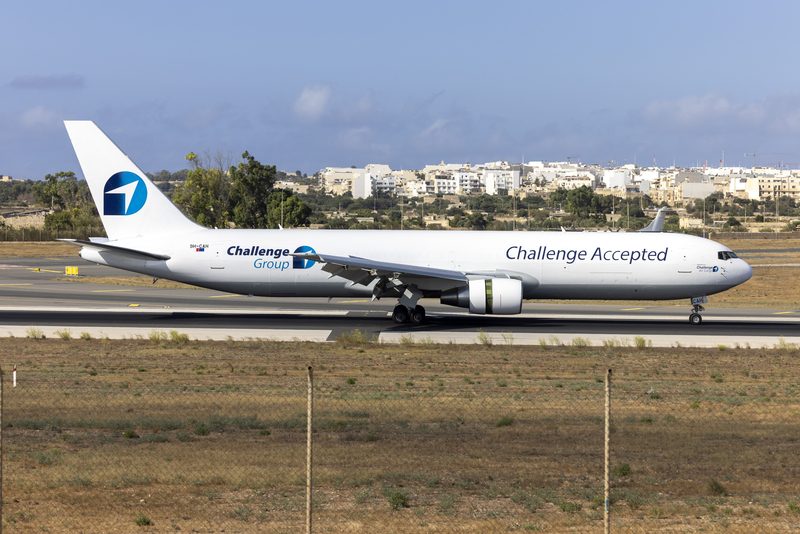
Challenge Group is expanding its Asia cargo network from Liège Airport (LGG).
From July 2, 2026, the group will upgrade its existing Liège (LGG)–Mumbai (BOM) operation and launch a new Liège (LGG)–Shanghai Pudong (PVG) freighter service.
Both routes will use the Boeing 777-300ERSF, also known as the “Big Twin.”
Read our stories in your inbox
Two aviation newsletters. Zero fluff.
The move gives Challenge Group more long-haul freighter capacity into two of Asia’s most important cargo markets.
It also strengthens Liège (LGG) as the group’s main European cargo platform.
Mumbai Gets A Larger Aircraft
The Mumbai route is not entirely new.
Challenge Group already serves Liège (LGG)–Mumbai (BOM) with Boeing 767 freighters.
The change is the aircraft and capacity.
From July 2, the route will move from three weekly Boeing 767 flights to two weekly Boeing 777-300ERSF flights.
That may look like fewer frequencies. But the 777-300ERSF offers far more payload and volume than the 767.
For customers, the upgrade should mean more available capacity on each flight. It also gives the carrier a better aircraft for dense, high-volume cargo moving between India and Europe.
Shanghai Adds A New China Link
The second route is new.
Challenge Group will launch Liège (LGG)–Shanghai Pudong (PVG) service three times weekly.
Shanghai is one of the world’s most important manufacturing and export markets. It is also a major hub for electronics, pharmaceuticals, e-commerce, industrial goods, and high-value air freight.
The new PVG service deepens Challenge Group’s China network.
It also complements the group’s existing Liège (LGG)–Zhengzhou (CGO) operation, which already runs 10 times weekly.
That gives Challenge Group two major mainland China cargo points from Liège.
The New Route Plan
| Route | Change | Frequency | Aircraft |
|---|---|---|---|
| Liège (LGG) – Mumbai (BOM) | Upgraded from Boeing 767 to 777-300ERSF | 2x weekly | Boeing 777-300ERSF |
| Liège (LGG) – Shanghai Pudong (PVG) | New route | 3x weekly | Boeing 777-300ERSF |
Both routes are aimed at long-haul, high-volume cargo.
They also support flows beyond Europe.
Challenge Group says the services will improve cargo movements between Asia, Europe, the United States, and South America.
Why The 777-300ERSF Matters
The aircraft is the key part of the story.
The 777-300ERSF is a passenger-to-freighter conversion of the Boeing 777-300ER.
Israel Aerospace Industries developed the conversion with AerCap Cargo. The aircraft received its Supplemental Type Certificate in 2025.
IAI says the 777-300ERSF can carry up to 105 tons of payload. It also offers 25% more cargo volume than the 777-200F production freighter.
That makes it a major tool for high-volume cargo routes.
For Challenge Group, the aircraft gives more lift than the 767 and better twin-engine economics than older four-engine freighters.
A Strong Fit For India And China
India and China are not just large markets. They are cargo-heavy markets.
Mumbai (BOM) is a major gateway for pharmaceuticals, automotive components, chemicals, textiles, machinery, valuables, and express freight.
Shanghai (PVG) is one of Asia’s largest air cargo airports. It supports technology, e-commerce, industrial exports, healthcare products, and high-value manufacturing.
Both markets fit the 777-300ERSF.
The aircraft has the volume and payload needed for dense cargo flows. It can also handle complex shipments that require reliable long-haul lift.
That includes pharmaceuticals, life sciences cargo, technology, industrial equipment, and project cargo.
Liège Is Built For This Type Of Flying
Liège Airport (LGG) is one of Europe’s most important cargo airports.
The airport describes itself as Europe’s leading airport specializing in air cargo. It also says it handled 1,325,000 tons of cargo in 2025.
The airport operates 24/7 with no curfew.
That matters for freight.
Cargo customers often need late-night, early-morning, and time-sensitive departures. A curfew-free airport gives airlines more flexibility than airports with strict night limits.
Liège (LGG) also specializes in cargo categories such as pharmaceuticals, perishables, express parcels, e-commerce shipments, medical supplies, humanitarian goods, live animals, and oversized cargo.
That fits Challenge Group’s business model well.
Challenge Has Its Own Handling Base At Liège
Challenge Group is not just using Liège as a departure point.
It has deep infrastructure there.
Challenge Handling is based at Liège (LGG). The company says it has around 30,000 square meters of online warehouse space and 11,000 square meters of offline warehouse space.
It also has temperature-controlled storage, automated ULD systems, high-security clearance, and Europe’s largest-capacity high loader.
The facility is certified for IATA CEIV Pharma, Live Animals, Lithium Batteries, and ISO 9001:2015.
That gives Challenge Group more control over the cargo chain.
For shippers, that can mean better handling, fewer handoffs, and stronger temperature-control options.
A Wider Logistics Play
This is not only an airline route announcement.
Challenge Group describes itself as an end-to-end air cargo and logistics provider.
Its business includes airlines, air cargo sales, handling, road feeder services, aircraft leasing, parts, and line maintenance.
That integrated structure matters.
A freighter route is valuable only if cargo can move efficiently before and after the flight.
The new Mumbai (BOM) and Shanghai (PVG) services will connect into Challenge Group’s wider road feeder and logistics network. That should help move shipments beyond Liège to other European markets.
It also supports onward cargo flows to the Americas.
Why The Mumbai Upgrade Is Important
The Mumbai change may be more important than it first appears.
Moving from Boeing 767 to Boeing 777-300ERSF capacity changes what Challenge Group can carry.
The 767 is a useful medium-widebody freighter. It works well on routes where demand is steady but not enormous.
The 777-300ERSF is a much larger aircraft.
That allows Challenge Group to take bigger shipments, heavier loads, and more volume on each departure.
For India-Europe cargo, that can be useful. Demand from India has been strong in areas such as pharmaceuticals, engineering goods, textiles, electronics, and time-sensitive manufacturing.
A larger aircraft gives Challenge Group more flexibility in that market.
Shanghai Expands The China Network
Shanghai (PVG) gives Challenge Group a second major China point alongside Zhengzhou (CGO).
That is strategically useful.
Zhengzhou is a major manufacturing and logistics hub in central China. Shanghai is a global trade and export center on China’s east coast.
The two markets are different enough to complement each other.
Adding PVG gives forwarders and shippers more options. It also helps Challenge Group serve customers that rely on Shanghai’s industrial, technology, and logistics base.
For a cargo operator, that network depth matters.
Better Links To The Americas
Challenge Group says the new routes will help cargo flows between Asia, Europe, the U.S., and South America.
That is an important point.
Liège (LGG) sits at the center of Challenge Group’s network. Cargo can arrive from Asia, move through LGG, and continue onward by air, truck, or other logistics services.
The same works in reverse.
Shipments from Europe or the Americas can be consolidated and moved to India or China.
This kind of network is valuable for freight forwarders. They need predictable capacity and multiple routing options, especially when supply chains are disrupted.
The Cargo Mix Is High Value
The routes are likely to support several high-value sectors.
Pharmaceuticals and life sciences are obvious examples. These shipments often require temperature control, careful handling, and reliable transit times.
Technology cargo is another major category. Electronics and components often move by air because speed matters.
Industrial equipment and project cargo also fit the 777-300ERSF. The aircraft’s large volume and payload can support shipments that are too urgent for ocean freight or too complex for smaller freighters.
This is where Challenge Group’s Liège handling infrastructure becomes important.
The route is not just about capacity. It is about controlled, specialized cargo movement.
Fleet Modernization Behind The Growth
Challenge Group has been investing in larger and newer freighter capability.
In 2025, the group announced its 777-300ERSF conversion program. It described the aircraft as a major step in its fleet expansion plan.
Challenge said the aircraft would help open new markets and support more efficient long-haul cargo services.
That is now becoming visible in the network.
The Mumbai and Shanghai routes show the 777-300ERSF moving from fleet plan to commercial strategy.
For Challenge Group, the aircraft is not just a replacement tool. It is a growth aircraft.
Bottom Line
Challenge Group is expanding its Asia cargo network from Liège (LGG) with larger Mumbai (BOM) capacity and a new Shanghai (PVG) route.
From July 2, 2026, the existing Liège–Mumbai service will move from three weekly Boeing 767 flights to two weekly Boeing 777-300ERSF flights.
At the same time, Challenge Group will launch three weekly Liège–Shanghai Pudong flights, also using the 777-300ERSF.
The move gives the group more capacity in India and China, two of the world’s most important cargo markets.
It also strengthens Liège Airport’s role as a 24/7 European cargo hub.
For Challenge Group, this is a clear network and fleet statement. The 777-300ERSF gives it more payload, more volume, and more flexibility on long-haul trade lanes.
For shippers, the value is simple: more direct freighter capacity between Asia and Europe, with stronger onward connections to the U.S. and South America.
Keep reading FlyMag
Get the Daily Brief in the morning or the Route Watch weekly recap on Fridays. Or both.