Turkish Airlines Eyes Three More U.S. Cities As Istanbul’s Long-Haul Reach Keeps Growing
Turkish Airlines is again signaling that its U.S. network is not finished growing.
The Istanbul-based Star Alliance carrier already serves one of the broadest U.S. networks of any non-U.S. airline, linking Istanbul Airport (IST) with 14 American gateways. The carrier’s current U.S. map includes Atlanta (ATL), Boston (BOS), Chicago O’Hare (ORD), Dallas/Fort Worth (DFW), Denver (DEN), Detroit (DTW), Houston Intercontinental (IAH), Los Angeles (LAX), Miami (MIA), Newark (EWR), New York (JFK), San Francisco (SFO), Seattle (SEA), and Washington Dulles (IAD).
Now, three more cities are again in focus: Minneapolis-St. Paul (MSP), Philadelphia (PHL), and Orlando (MCO).
Read our stories in your inbox
Two aviation newsletters. Zero fluff.
None of the three routes has been formally placed on sale, and Turkish Airlines has not yet published launch dates, schedules, or aircraft assignments. That distinction is important. These are not confirmed new services in the same way Denver (DEN), Detroit (DTW), or Seattle (SEA) were once announced and loaded for sale. They are targets within a broader U.S. growth plan.
Still, the interest is significant. Turkish Airlines has been unusually successful at building long-haul connectivity through Istanbul (IST), and the carrier’s U.S. expansion strategy is no longer limited to the largest coastal markets. Denver (DEN), Detroit (DTW), and Seattle (SEA) showed that Turkish is willing to enter strong inland and secondary intercontinental markets when its connecting network can support them.
Minneapolis (MSP), Philadelphia (PHL), and Orlando (MCO) would each serve a different purpose in that strategy.
Turkish Already Has A Large U.S. Footprint
Turkish Airlines’ U.S. network has grown substantially over the past decade.
What began as a more traditional set of major-market links has expanded into a 14-gateway platform from Istanbul (IST), giving the airline coverage across the East Coast, Midwest, South, Texas, Mountain West, and West Coast. The carrier has used Istanbul’s geographic position to connect U.S. passengers not only to Türkiye, but also to the Balkans, the Caucasus, Central Asia, South Asia, the Middle East, Africa, and parts of Southern and Eastern Europe.
That is the real power of Turkish Airlines’ U.S. model. Local Istanbul demand is only one piece of the equation. The airline’s strength is its ability to carry passengers beyond Istanbul (IST) to markets that may be underserved by U.S. and European competitors.

This is especially relevant in cities without nonstop service to the Gulf, Africa, South Asia, or large parts of the eastern Mediterranean. Turkish can enter a U.S. market with one nonstop to Istanbul (IST), then offer dozens of onward destinations with relatively efficient routings.
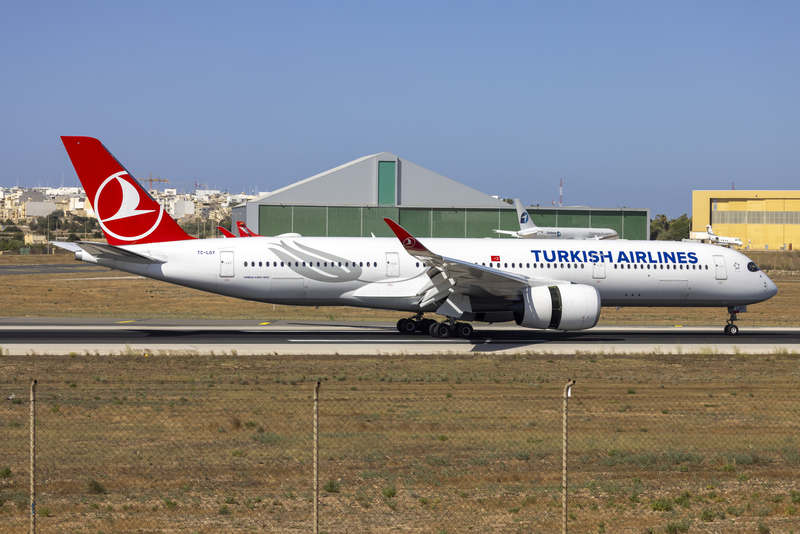
The airline’s widebody fleet makes that possible. Turkish’s Airbus A350-900 and Boeing 787-9 are both well suited to long, thin U.S. routes. The A350-900 offers long range, a modern carbon-fiber structure, Rolls-Royce Trent XWB engines, and a quieter cabin environment. The Boeing 787-9 gives Turkish another efficient twin-engine widebody with a 1-2-1 Business Class cabin and 3-3-3 Economy layout. Both aircraft are useful for U.S. expansion because they provide range and premium product without the capacity burden of a larger Boeing 777-300ER.
Minneapolis Would Be A Very Turkish Airlines Route
Minneapolis-St. Paul International Airport (MSP) would be one of the more interesting additions to Turkish Airlines’ U.S. network.
At first glance, MSP may seem less obvious than Orlando (MCO) or Philadelphia (PHL). It is not a coastal gateway, and it is already dominated by Delta Air Lines. But that is exactly why Turkish may find it attractive. Minneapolis (MSP) is a large metropolitan market with strong corporate traffic, a major hub structure, and meaningful international demand that is not fully covered by nonstop service.
The route’s real strength would likely be beyond Istanbul (IST). Turkish Airlines has one of the world’s strongest networks to Africa, the Middle East, Central Asia, South Asia, and the Balkans. From Minneapolis (MSP), that could make Istanbul (IST) a highly useful connecting point to cities such as Nairobi (NBO), Addis Ababa (ADD), Cairo (CAI), Jeddah (JED), Dubai (DXB), Delhi (DEL), Mumbai (BOM), Mogadishu (MGQ), Athens (ATH), and Johannesburg (JNB).
Africa is especially important in the MSP discussion. Turkish has built an unusually deep African network, and that is one of the areas where it can differentiate itself from European and Gulf competitors. A nonstop MSP–IST flight would not simply be a way to reach Istanbul. It would be a one-stop bridge from the Upper Midwest to dozens of markets that are difficult to reach efficiently today.
The likely aircraft would be either the Airbus A350-900 or Boeing 787-9. A three- or four-weekly schedule would be a logical starting point, allowing Turkish to test the market without committing daily capacity immediately. The route would also be long enough to justify the airline’s newer premium cabins, particularly for passengers connecting onward to Africa, the Middle East, or South Asia.
The main challenge is competition and timing. Minneapolis (MSP) is a powerful Delta hub, and any new long-haul entrant has to work around established corporate contracts, loyalty behavior, and domestic feed limitations. Turkish would not have the same local hub feed that Delta enjoys. It would need to rely on local demand, Star Alliance connectivity where available, interline feed, and its own global network strength beyond Istanbul (IST).
Philadelphia Is Smaller Than It Looks, But Still Strategic
Philadelphia International Airport (PHL) is a different kind of opportunity.
PHL is a major U.S. airport and an American Airlines hub, but it has not attracted the same breadth of Middle Eastern and Eastern Hemisphere long-haul service as New York (JFK), Newark (EWR), Washington Dulles (IAD), or Boston (BOS). That makes it both a challenge and an opportunity for Turkish Airlines.
The challenge is that Philadelphia (PHL) sits between several major long-haul gateways. Travelers in the broader Philadelphia catchment area can drive or take rail to Newark (EWR), New York (JFK), or Washington Dulles (IAD), all of which already have deep international networks. Turkish Airlines alone serves the New York/Newark and Washington markets heavily. That leakage makes the true PHL opportunity difficult to measure from airport-only traffic data.
The opportunity is that a nonstop PHL–IST flight could recapture some of that leakage. Passengers who currently leave the region for more convenient international options might prefer a nonstop Turkish flight from Philadelphia (PHL), especially if their final destination is in Greece, Türkiye, the Balkans, the Middle East, South Asia, or Africa.
Philadelphia would also give Turkish a strong position in a large Northeast market without adding more frequency into already congested New York-area airports. Newark (EWR) and New York (JFK) are strategically important, but they are also slot-constrained and operationally complex. Philadelphia (PHL) offers a different way to reach the same broader region, with less direct airport congestion and a strong local base.
A PHL–IST route would probably not launch daily at first. A three-weekly or four-weekly schedule would be more realistic, likely with a Boeing 787-9 or Airbus A350-900. The 787-9 could be especially suitable if Turkish wants a lower-capacity widebody with strong premium appeal and lower trip cost than a larger aircraft.
Philadelphia’s biggest question is feed. As an American Airlines hub, PHL is tied strongly to oneworld, not Star Alliance. Turkish could still make the route work with local demand and beyond-IST connectivity, but it would not have the same natural domestic feed position that a Star Alliance partner hub might provide.
Orlando Is The Most Obvious Of The Three
Orlando International Airport (MCO) is the least surprising target.
Turkish Airlines has listed Orlando among planned Americas routes in investor materials, and the market has appeared in the airline’s long-term U.S. thinking for years. Unlike Minneapolis (MSP) and Philadelphia (PHL), Orlando (MCO) is not just a speculative network idea. It has been visible in Turkish’s own planning materials.
The route logic is clear. Orlando (MCO) is one of the largest leisure markets in the United States and a major global tourism destination. Walt Disney World, Universal Orlando, the wider Central Florida tourism industry, conventions, cruises through Port Canaveral, and Florida’s large international visitor base all create demand from Europe, the Middle East, Latin America, and beyond.
For Turkish Airlines, the route would not only bring passengers from Türkiye to Florida. It would connect Orlando (MCO) with a vast one-stop network through Istanbul (IST). That could include the Middle East, South Asia, Central Asia, the Balkans, Eastern Europe, the Caucasus, and Africa.
Orlando also fits Turkish’s broader strategy of serving large U.S. markets that may not have the same global nonstop coverage as New York (JFK), Los Angeles (LAX), or Chicago (ORD). Emirates already serves Orlando (MCO) from Dubai (DXB), proving that a long-haul Middle East-to-Central Florida route can exist. Turkish would offer a different network proposition through Istanbul (IST), with particular strength in Europe, Türkiye, Central Asia, and Africa.
MCO is also a large enough local market to support inbound leisure demand. That matters because Orlando is not just a connecting play. It has genuine destination pull.
The likely aircraft would again be the Boeing 787-9 or Airbus A350-900. Both types have the range for IST–MCO and the cabin product needed for a long transatlantic-plus sector. A four-weekly launch would be a sensible starting point, with potential to increase if the route performs.
Why These Cities Fit Turkish’s Broader Strategy
Minneapolis (MSP), Philadelphia (PHL), and Orlando (MCO) are very different markets, but they all fit Turkish Airlines’ U.S. growth logic.
Minneapolis would be a connectivity-led route, especially toward Africa, the Middle East, South Asia, and Greece. Philadelphia would be a leakage-recapture route, aimed at a large Northeast catchment that currently uses other airports for many long-haul options. Orlando would be a tourism and network route, combining Central Florida’s massive leisure demand with Turkish’s global connectivity over Istanbul.
None of these markets needs to be carried by local Istanbul demand alone. That is the point. Turkish Airlines can make long-haul U.S. routes work by layering multiple traffic flows: local U.S.–Türkiye demand, U.S.–Europe connections, U.S.–Middle East travel, U.S.–South Asia traffic, U.S.–Africa demand, and visiting-friends-and-relatives traffic across a very wide geography.
This is where Istanbul Airport (IST) gives Turkish an advantage. IST is positioned between Europe, Asia, the Middle East, and Africa, allowing Turkish to create efficient one-stop routings across a huge number of city pairs. The airline’s network is not only large; it is geographically useful.
That network design is why Turkish can consider U.S. markets that may look marginal to other airlines. A carrier with fewer onward destinations would need far more local demand to justify routes such as MSP–IST or PHL–IST. Turkish can spread the risk across many connecting markets.
Aircraft Availability Will Be Key
The biggest constraint may not be demand. It may be aircraft.
Turkish Airlines has large widebody growth ambitions, including Airbus A350 family aircraft and Boeing 787-9 Dreamliners. But new long-haul routes depend on delivery timing, fleet reliability, crew availability, maintenance capacity, and the ability to support frequency growth on existing routes.
The airline has already added several major U.S. routes in recent years, including Seattle (SEA), Detroit (DTW), and Denver (DEN). Those launches absorbed aircraft time and commercial resources. Expanding into three more U.S. markets would require additional widebody availability or careful reallocation from existing routes.
This matters because Turkish’s U.S. network is already large. Adding a new destination is not just about flying one aircraft to a new city. It requires sales teams, airport handling, lounges or lounge access, cargo support, regulatory approvals, crew planning, marketing, and long-term schedule discipline.
That is why Orlando (MCO) may be the easiest to imagine as the next formal launch. It has appeared in Turkish’s planned-route materials, it is a large and obvious leisure market, and it has a clearer long-term tourism story. Minneapolis (MSP) and Philadelphia (PHL) are more nuanced. They may make sense, but each would require a careful commercial case.
The Star Alliance Angle Is Uneven
Turkish Airlines is a Star Alliance member, but these three proposed markets would not benefit equally from Star feed.
Philadelphia (PHL) is an American Airlines hub, which means Turkish would be entering a heavily oneworld-oriented airport. That does not make the route impossible, but it limits natural alliance connectivity on the U.S. side.
Minneapolis (MSP) is a Delta hub, making it even less naturally aligned with Turkish’s Star Alliance membership. Turkish would have to rely more on local traffic and its beyond-IST network than on alliance feed at MSP.
Orlando (MCO), by contrast, is less dominated by one global alliance hub structure. It is a large leisure airport with many carriers, significant origin-and-destination demand, and strong inbound tourism. That gives Turkish more room to position the route on its own merits.
This is another reason the three routes should not be treated the same. Turkish may want all three, but the commercial foundation differs significantly by market.
What This Means For U.S. Competition
If Turkish eventually launches all three, it would become even more difficult for other non-U.S. carriers to ignore the depth of its American network.
Turkish already competes with European network airlines, Gulf carriers, and U.S. airlines for one-stop traffic between the United States and a wide range of markets. Its advantage is breadth. Lufthansa, Air France-KLM, British Airways, Qatar Airways, Emirates, and Etihad each have their own strengths, but Turkish’s combination of Europe, Africa, Central Asia, the Balkans, the Middle East, and South Asia gives it a distinctive position.
Adding MSP, PHL, and MCO would sharpen that position. Minneapolis would strengthen the airline’s reach in the Upper Midwest. Philadelphia would increase its relevance in the Northeast. Orlando would give it one of the largest unserved U.S. leisure gateways on its route map.
For passengers, the benefit would be more one-stop options through Istanbul (IST). For airports, the appeal is obvious: a Turkish Airlines route brings access to one of the world’s most extensive international networks. For competitors, it would mean more pressure in markets where Turkish can undercut traditional routings with a strong single connection.
Bottom Line
Turkish Airlines is not yet selling flights from Istanbul (IST) to Minneapolis (MSP), Philadelphia (PHL), or Orlando (MCO), so these should be described as targeted or planned routes rather than confirmed launches.
Even so, the strategy is clear. Turkish already serves 14 U.S. gateways and continues to look for markets where Istanbul (IST) can provide powerful one-stop connectivity. Orlando (MCO) appears to be the most advanced candidate because it has been listed in Turkish’s planned-route materials. Minneapolis (MSP) and Philadelphia (PHL) are more speculative, but both fit the airline’s broader ambition to reach more U.S. gateways and deepen its North American presence.
The likely aircraft for any of these routes would be the Airbus A350-900 or Boeing 787-9, both of which give Turkish the range, efficiency, and onboard product needed for long U.S. sectors.
For Turkish Airlines, the opportunity is not simply flying more Americans to Istanbul. It is using Istanbul Airport (IST) as a global bridge between the United States and dozens of markets across Europe, Africa, the Middle East, Central Asia, and South Asia. That is why MSP, PHL, and MCO are worth watching, even before any official launch dates appear.
Keep reading FlyMag
Get the Daily Brief in the morning or the Route Watch weekly recap on Fridays. Or both.