LOT’s 737 MAX Pushes Deeper Into Central Asia With New Warsaw-Almaty Route
LOT Polish Airlines has opened a new Central Asian link from Warsaw Chopin Airport (WAW), launching nonstop service to Almaty International Airport (ALA) in Kazakhstan. On paper, it is another strategic expansion from the Polish flag carrier’s Warsaw hub. In operational terms, however, it is one of the most interesting narrowbody routes now flying from Europe.

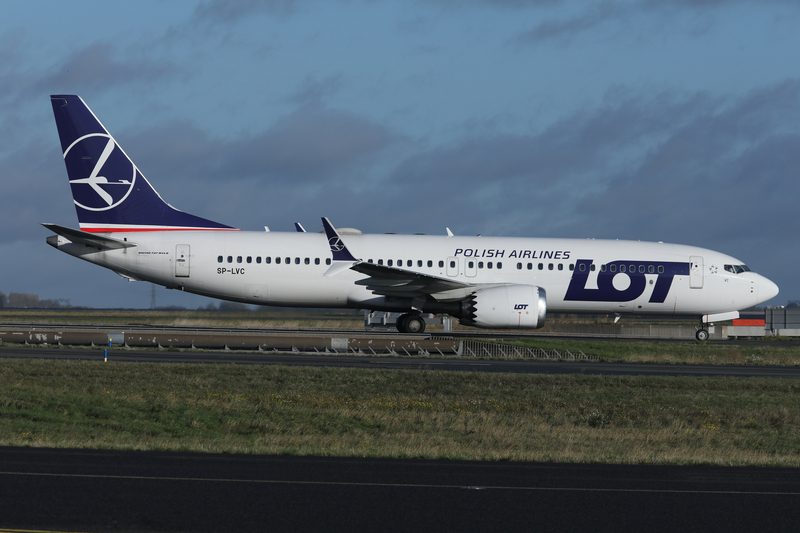
The new Warsaw (WAW)–Almaty (ALA) service began on May 31, 2026, and is operated by the Boeing 737 MAX 8. The route runs four times weekly during the summer season before reducing to three weekly flights in winter, keeping Almaty (ALA) in LOT’s year-round network.
What makes the route stand out is not just the destination. It is the length of the operation, particularly on the westbound return from Almaty (ALA) to Warsaw (WAW). Published schedules put the eastbound flight at around six and a half hours, while the return leg can stretch to roughly seven and a half hours, and in some schedule displays close to seven hours and 40 minutes. That places Almaty (ALA) among the longest Boeing 737 family operations LOT has ever scheduled, and likely its longest by block time.
Read our stories in your inbox
Two aviation newsletters. Zero fluff.
For an airline that also operates Boeing 787 Dreamliners across the Atlantic and to Asia, deploying a 737 MAX 8 on a route approaching eight hours is a significant network decision. It shows how far modern single-aisle aircraft have pushed into territory once reserved almost exclusively for widebodies.
A New Link Between Warsaw And Kazakhstan’s Largest City
LOT’s new service operates as LO197 from Warsaw Chopin Airport (WAW) to Almaty International Airport (ALA), with the return operating as LO198 from Almaty (ALA) to Warsaw (WAW). The outbound flight leaves Warsaw late in the evening, arriving in Almaty the following morning. The return from Almaty departs in the morning and reaches Warsaw in the early afternoon.

The schedule is built around both local demand and connections over LOT’s Warsaw hub. For passengers originating in Kazakhstan, Warsaw (WAW) provides one-stop access to a wide European network, along with LOT’s long-haul services to North America and Asia. For passengers starting in Poland and neighboring European markets, Almaty (ALA) becomes a more accessible nonstop gateway to southeastern Kazakhstan.
Almaty is an important addition because it is not a secondary tourism experiment. It is Kazakhstan’s largest city and remains the country’s financial and commercial center, even after the capital moved to Astana. The city sits at the foot of the Tian Shan mountains and has become a growing market for business travel, tourism, and visiting-friends-and-relatives traffic.
The route also gives LOT a second scheduled destination in Kazakhstan, joining Astana (NQZ). The NQZ code remains a reminder of the city’s former name, Nur-Sultan, but the market itself has become an important part of LOT’s eastward network development. With Almaty (ALA), Astana (NQZ), and Tashkent (TAS) in Uzbekistan, LOT now has a stronger platform in Central Asia than many Western European carriers.
Why The Return Flight Is So Long
The great-circle distance between Warsaw (WAW) and Almaty (ALA) is a little over 4,100 kilometers, or about 2,600 miles. That distance alone does not fully explain the long block time.
The real story is routing. Since the start of the Russia-Ukraine war and the resulting airspace restrictions, European carriers have had to operate many eastbound services using longer routings than they would have flown before 2022. For LOT, a Warsaw (WAW)–Almaty (ALA) flight cannot simply take the most direct track across Belarus, Russia, and Kazakhstan. Instead, the flight must use a more southerly routing that adds distance, complexity, and time.
The return leg is especially demanding. Flying westbound from Almaty (ALA) to Warsaw (WAW), the aircraft faces a combination of routing constraints and less favorable winds. In airline scheduling, the block time is what matters: it drives aircraft utilization, crew planning, fuel planning, turnaround buffers, and passenger expectations.
That is why the Almaty (ALA)–Warsaw (WAW) sector is so notable. The aircraft is not necessarily flying the most distant point on LOT’s narrowbody map in pure great-circle terms, but the scheduled block time puts it at the extreme end of LOT’s Boeing 737 operation.
For route planners, this is where the 737 MAX 8 becomes useful. The aircraft can open a market that likely does not require a Boeing 787 Dreamliner, but still needs more range and efficiency than earlier-generation narrowbodies could comfortably provide.
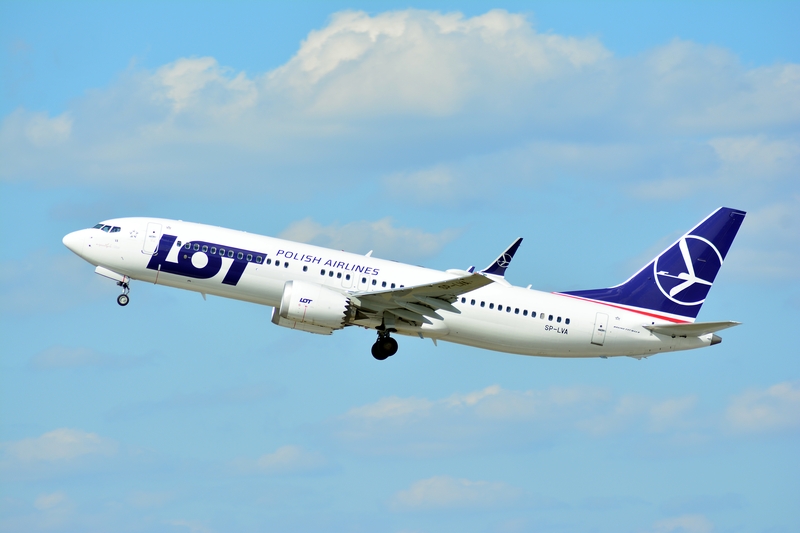
The Boeing 737 MAX 8 Is Doing Widebody-Length Work
LOT’s Boeing 737 MAX 8 is powered by CFM LEAP-1B engines and benefits from the MAX family’s aerodynamic improvements, including advanced winglets and a more efficient wing. LOT lists the aircraft with a cruising speed of 839 km/h, a range of 5,500 km, and a maximum takeoff mass of 76,999 kg.
Those numbers explain why the MAX 8 is viable on Warsaw (WAW)–Almaty (ALA), but they do not make the passenger experience comparable to a widebody. This is still a single-aisle 737 cabin on a flight that can run longer than many transatlantic sectors from the northeastern United States to Western Europe.
LOT’s published 737 MAX 8 configuration lists 186 seats, although some fleet references show certain MAX 8 aircraft with 189 seats. The cabin remains a 3-3 narrowbody layout, and that is important on a route of this length. Even with modern seats, USB power, adjustable headrests, and a refreshed cabin on newer aircraft, this is a very different onboard proposition from LOT’s Boeing 787-8 or 787-9 Dreamliner fleet.
LOT also treats longer MAX routes differently from short European sectors. On mid-haul services such as Almaty (ALA), Astana (NQZ), Tashkent (TAS), Dubai (DXB), and Riyadh (RUH), the airline markets Economy and Premium Economy rather than a traditional long-haul Business Class product. For passengers, that distinction matters. The MAX can perform the mission, but the comfort profile remains closer to a medium-haul narrowbody than a long-haul widebody.
That does not make the aircraft the wrong choice. In fact, it is probably the aircraft that makes the route commercially realistic. A 787 would bring more comfort and cargo volume, but also much more capacity and higher trip cost. The MAX 8 lets LOT serve a long, thin market with a lower-risk seat count while still offering nonstop service.
Central Asia Is Becoming More Important For LOT
Almaty (ALA) also fits into a broader pattern. LOT has been steadily building a network that uses Warsaw (WAW) as a bridge between Central and Eastern Europe, North America, and selected Asian markets. Central Asia is a natural fit for that strategy.
Kazakhstan is the largest economy in Central Asia, and Poland has meaningful trade and diplomatic ties with the region. The Warsaw (WAW) hub gives LOT the ability to connect Almaty (ALA) not only with Poland, but also with cities across Europe and North America. That is a key advantage over a purely point-to-point route.
For Kazakhstan-originating passengers, Warsaw (WAW) can function as an efficient European gateway. For European passengers, Almaty (ALA) offers access to a city with a strong business base and growing tourism profile. The surrounding region includes mountain resorts, high-altitude scenery, and natural landmarks that have become increasingly attractive to leisure travelers looking beyond traditional European holiday markets.
LOT’s Central Asian network now carries additional importance because airline networks between Europe and Asia remain distorted by closed and restricted airspace. Routes that once looked marginal can become more attractive when hub connectivity, limited nonstop competition, and efficient aircraft line up correctly.
In that sense, Warsaw (WAW)–Almaty (ALA) is not just a long 737 flight. It is a route shaped by geopolitics, aircraft technology, and hub strategy.
How Almaty Compares With LOT’s Other Long MAX Routes
Almaty (ALA) now sits at the top of LOT’s longest Boeing 737 MAX 8 flying by scheduled block time. Other Central Asian routes are close behind, especially Astana (NQZ) and Tashkent (TAS), both of which also involve long stage lengths and airspace-sensitive routings.
LOT’s Dubai (DXB) and Riyadh (RUH) flights are also among the carrier’s longest MAX services. Dubai International Airport (DXB) is a major global hub with heavy competition, while Riyadh’s King Khalid International Airport (RUH) gives LOT access to one of the fastest-growing business markets in the Middle East.
Tenerife South Airport (TFS) is another long narrowbody route from Warsaw (WAW), but it is a different type of flying. Tenerife (TFS) is primarily leisure-driven and benefits from strong outbound demand from Poland. Almaty (ALA), Astana (NQZ), and Tashkent (TAS), by contrast, combine business, government, diaspora, and strategic connectivity.
That difference is important. LOT is not simply using the MAX 8 for long holiday flights. It is using the aircraft to build a medium-haul network around markets that are too far for traditional short-haul assumptions but not necessarily large enough for daily widebody service.
A Long Flight In A Narrowbody Cabin
For passengers, the key takeaway is simple: Warsaw (WAW)–Almaty (ALA) is a long flight for a 737.
A nearly eight-hour block time on a single-aisle aircraft changes the passenger experience. Seat selection becomes more important. So does cabin service pacing, catering, lavatory access, and the ability to charge devices throughout the flight. For premium passengers, the difference between LOT’s mid-haul Premium Economy product and a true long-haul Business Class seat is significant.
At the same time, nonstop service has its own value. Avoiding a connection through Istanbul (IST), Doha (DOH), Dubai (DXB), Frankfurt (FRA), or another hub can save time and reduce travel complexity. For many passengers, especially those traveling for business or visiting family, a long nonstop narrowbody flight may still be preferable to a shorter onboard experience split across two sectors.
This is the tradeoff modern narrowbody aircraft have created. The 737 MAX 8 can make routes like Warsaw (WAW)–Almaty (ALA) possible, but airlines and passengers have to accept that the aircraft’s commercial capability has moved faster than the traditional expectations of narrowbody comfort.
Bottom Line
LOT Polish Airlines’ new Warsaw (WAW)–Almaty (ALA) route is one of the carrier’s most interesting narrowbody launches of 2026. It gives LOT a second destination in Kazakhstan, strengthens its Central Asian network, and adds another long-range market to the Warsaw (WAW) hub.
The route is especially notable because of the aircraft. The Boeing 737 MAX 8 allows LOT to serve Almaty (ALA) without committing a widebody, but the westbound return to Warsaw (WAW) pushes the aircraft into unusually long scheduled block times for a 737 operation.
For LOT, this is a smart use of modern single-aisle economics. For passengers, it is a reminder that the line between narrowbody and long-haul flying continues to blur. Almaty (ALA) may not be LOT’s biggest new route, but it is one of the clearest examples of how aircraft range, airspace restrictions, and hub strategy are reshaping European airline networks.
Keep reading FlyMag
Get the Daily Brief in the morning or the Route Watch weekly recap on Fridays. Or both.