Lufthansa 787 Nose-Gear Collapse Recalls British Airways Incident – But The Cause Is Still Unknown
A Lufthansa Boeing 787-9 Dreamliner suffered a nose landing gear collapse at Frankfurt Airport (FRA) on June 4, 2026, while parked at the gate ahead of a scheduled long-haul flight to Los Angeles International Airport (LAX).

The aircraft was being prepared to operate Lufthansa Flight LH450 from Frankfurt (FRA) to Los Angeles (LAX) when the nose gear unexpectedly collapsed. Passengers had not yet boarded, but crew members and ground staff were onboard at the time. Several Lufthansa employees were injured and received medical treatment.
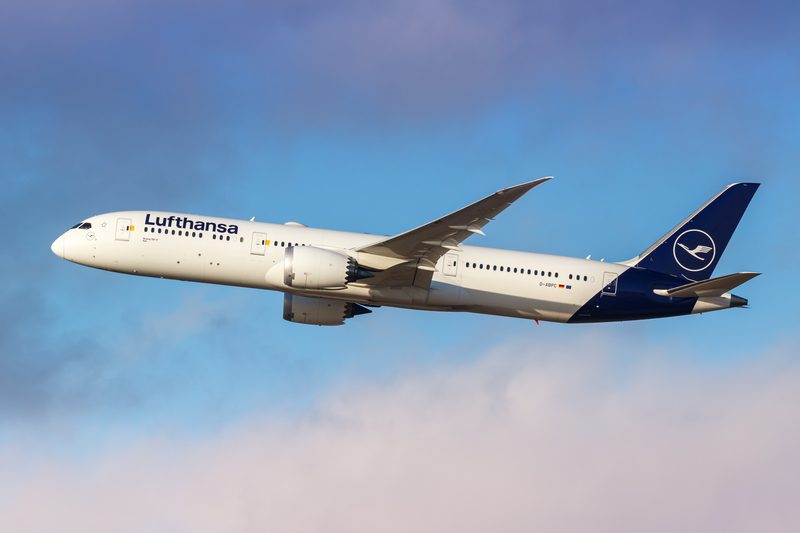
The aircraft involved was D-ABPQ, a Boeing 787-9 named “Herne.” The Dreamliner is one of Lufthansa’s newest long-haul aircraft and is fitted with the airline’s latest Allegris cabin. Lufthansa canceled LH450 and began an investigation with the relevant authorities.
Read our stories in your inbox
Two aviation newsletters. Zero fluff.
The incident immediately drew comparisons to a British Airways Boeing 787-8 nose-gear collapse at London Heathrow Airport (LHR) in June 2021. That earlier event was ultimately traced to a maintenance-related error involving the nose landing gear downlock pin.
For now, however, the Lufthansa case should be treated separately. There is no confirmed evidence that the Frankfurt incident was caused by weight distribution, aircraft loading, or the same maintenance error that affected the British Airways aircraft five years ago.
Lufthansa 787 Drops Onto Its Nose At Frankfurt
The Lufthansa aircraft was parked at Frankfurt Airport (FRA) when the nose landing gear collapsed shortly before the aircraft was due to depart for Los Angeles (LAX).
Images and video from the scene showed the front of the Boeing 787-9 resting low on the apron, with visible damage around the nose gear area and nose gear bay doors. Emergency vehicles quickly surrounded the aircraft, and technical crews began assessing the damage.
Lufthansa said passengers had not yet boarded. That prevented what could have been a far more serious passenger event. The people at risk were crew members and ground personnel who were onboard or working around the aircraft during pre-departure preparations.
Flight LH450 was canceled, and passengers were reaccommodated. The aircraft was removed from service pending inspection and repair.
From an operational standpoint, this is a serious event. A nose gear collapse at the gate can damage the landing gear assembly, nose gear doors, forward fuselage, avionics bays, wiring, structural frames, skin panels, and systems routed through the forward lower fuselage. Even if the damage appears localized, a modern composite widebody such as the Boeing 787 requires a careful engineering assessment before any return to service.
The Aircraft: Lufthansa Boeing 787-9 D-ABPQ
D-ABPQ is a Boeing 787-9 Dreamliner, the longer and higher-capacity member of the 787 family compared with the 787-8.
The 787-9 is designed for long-haul missions such as Frankfurt (FRA) to Los Angeles (LAX), a route of roughly 5,800 miles. It is a twin-engine widebody built with extensive composite materials, modern flight systems, large electronically dimmable windows, a quieter cabin, and improved cabin altitude and humidity compared with older-generation long-haul aircraft.
Lufthansa’s Allegris-equipped 787-9 is configured with 287 seats: 28 in Business Class, 28 in Premium Economy, and 231 in Economy. The aircraft is part of Lufthansa’s long-haul renewal program and is intended to replace older, less efficient widebody aircraft over time.
That makes the damage especially painful for the airline. D-ABPQ is not an aging aircraft near retirement. It is a new-generation long-haul asset tied directly to Lufthansa’s premium product rollout from Frankfurt.
The aircraft’s planned mission to Los Angeles also matters. LH450 is one of Lufthansa’s major U.S. West Coast services, and a 787-9 assigned to that sector is tied up for a long rotation. Losing the aircraft at the gate creates immediate disruption for the Los Angeles schedule and may also affect later long-haul aircraft rotations.
Why A Nose Gear Collapse Is So Serious
The nose landing gear does not carry the same loads as the main landing gear during landing, but it remains a critical aircraft system.
On the ground, the nose gear supports the forward fuselage, provides steering, absorbs taxi loads, and interfaces with towing and pushback operations. It also sits near important aircraft systems, including landing gear doors, hydraulic lines, electrical systems, avionics compartments, and structural members in the forward fuselage.
When a widebody aircraft drops onto its nose, several things can happen at once. The nose gear doors may be torn away. The landing gear strut and drag brace assemblies may be damaged. The forward fuselage can strike the ground. Systems routed through the lower nose area can be affected. The aircraft may also suffer hidden structural damage that is not obvious from exterior images.
That is why recovery is not simply a matter of lifting the nose and replacing a part. The aircraft must be secured, raised carefully, inspected thoroughly, and repaired using manufacturer-approved procedures.
Inflatable lifting bags or pneumatic mats are often used in aircraft recovery because they can raise the fuselage gradually and distribute loads more gently than a single hard lifting point. Similar equipment was used after the British Airways 787 incident at Heathrow (LHR) in 2021.
The British Airways 787 Incident In 2021
The Lufthansa event has naturally been compared with the British Airways Boeing 787-8 nose-gear collapse at London Heathrow (LHR) on June 18, 2021.
That aircraft was G-ZBJB, a British Airways Boeing 787-8 Dreamliner. It was parked at Stand 583 at Heathrow (LHR) and being prepared for a cargo flight to Frankfurt (FRA). During pre-flight maintenance, engineers were addressing fault messages related to the nose landing gear doors.
To conduct the required check, the landing gear downlock pins were installed. These pins are intended to prevent the landing gear from retracting while maintenance procedures are performed. However, when the landing gear lever was selected to the up position as part of the maintenance test, the nose landing gear retracted. The nose of the aircraft struck the ground, causing significant damage to the lower front section of the aircraft.
The UK Air Accidents Investigation Branch later found the cause: the nose landing gear downlock pin had been inserted into the downlock link assembly apex pin bore instead of the correct downlock pin hole.
That distinction sounds technical, but it was crucial. The two holes were close enough that the pin could be inserted into the wrong location. Because the pin was not in the correct hole, it did not prevent the nose gear from retracting when the gear was cycled.
Two people suffered minor injuries: the co-pilot and a member of the cargo loading team.
The AAIB Found A Design Vulnerability
The British Airways investigation did not simply blame an individual engineer.
The AAIB found that the design of the Boeing 787 nose landing gear downlock assembly created an opportunity for error because the two relevant holes were located close together. In practical maintenance terms, that meant a pin intended to make the gear safe could be inserted incorrectly while still appearing to have been installed.
That is an important safety lesson.
Maintenance tasks rely on clear design, proper procedures, adequate training, lighting, access, tooling, labeling, and independent checks. If a system allows a safety-critical item to be inserted into the wrong location, the risk is not only human error. It is a human-factors problem created by the interaction between design and procedure.
The AAIB also noted that a service bulletin and airworthiness directive were available that would have prevented the accident, but the modification had not yet been completed on G-ZBJB.
British Airways’ aircraft was eventually repaired and returned to service, but only after a lengthy period out of operation.
Is The Lufthansa Incident The Same Problem?
It is far too early to say.
The visual result looks similar: a Boeing 787 parked on the ground with its nose gear collapsed. But similar outcomes do not prove identical causes.
The British Airways aircraft was undergoing a specific maintenance check in which the landing gear was intentionally cycled. The AAIB determined that the downlock pin had been inserted incorrectly, allowing the nose landing gear to retract during that procedure.
The Lufthansa aircraft was parked at Frankfurt (FRA) being prepared for passenger service to Los Angeles (LAX). Public reporting has not yet confirmed whether maintenance work was being performed on the nose landing gear, whether the gear was being cycled, whether any downlock pins were installed, whether towing or ground-handling equipment was involved, or whether a mechanical or hydraulic issue occurred.
Those details are essential.
Investigators will need to determine whether the Lufthansa collapse involved maintenance activity, a locking mechanism issue, prior gear damage, hydraulic pressure, sensor or actuator behavior, ground-handling loads, aircraft system commands, or another failure mode.
Until that work is complete, the cause should remain listed as undetermined.
What About A Weight Issue?
There is currently no verified evidence that a weight or balance issue caused the Lufthansa 787 nose gear collapse.
That question may arise because the aircraft was being prepared for a long-haul flight to Los Angeles (LAX), likely with fuel, catering, baggage, and cargo being loaded or planned. A long-haul aircraft’s center of gravity and loading condition are carefully calculated before departure, and the nose gear can experience changing loads during fueling, cargo loading, passenger boarding, and servicing.
But a properly maintained aircraft should not suffer a nose gear collapse simply because it is being prepared for a normal scheduled flight.
Aircraft are designed to withstand ground loads across a wide range of operational loading conditions. If investigators consider weight distribution, they will do so as part of a broader technical review that includes aircraft configuration, loading state, fuel state, ground servicing, maintenance status, gear lock condition, and system behavior.
At this stage, “weight issue” is speculation. It should not be presented as a likely cause.
The better framing is that investigators will examine the aircraft’s loading condition along with maintenance history, landing gear system data, previous landings, and the physical condition of the nose gear assembly.
What Investigators Will Likely Examine
A nose gear collapse while an aircraft is stationary is unusual, and the investigation will likely be detailed.
Investigators and Lufthansa’s engineering team will likely focus on the nose landing gear assembly, locking mechanisms, drag braces, actuator systems, hydraulic lines, gear bay doors, sensors, proximity switches, maintenance records, recent defect reports, and aircraft system messages.
They will also review ground handling activity. That includes whether the aircraft was being pushed, towed, serviced, fueled, loaded, connected to ground power, or undergoing any maintenance procedure at the time of the collapse.
Flight data and maintenance data may help show the condition of the landing gear system before the event. Prior landing loads and previous defect messages may also be relevant, especially if the aircraft had any history of nose gear or gear-door indications.
The damaged components themselves will be critical. Investigators will look for fracture surfaces, deformation, impact marks, hydraulic behavior, locking position, and whether the gear failed structurally or retracted because it was no longer locked.
That distinction matters. A gear can collapse because something breaks under load. It can also collapse because a locking mechanism releases or a maintenance procedure allows retraction. The outcome may look similar, but the safety implications are different.
Recovery And Repair Could Take Time
The aircraft is likely to be out of service for a meaningful period.
Before repair can begin, the aircraft must be lifted and stabilized without causing further damage. The nose structure and gear bay must then be inspected. Engineers will need to determine whether the damage is limited to replaceable gear components and doors or whether the forward fuselage structure was affected more deeply.
If the 787’s composite structure suffered significant damage, repairs could become complex. Composite repairs require approved methods, controlled materials, specialized inspection, and manufacturer support. Even metallic structural components in the landing gear attachment area require careful assessment.
The British Airways 787-8 involved in the 2021 Heathrow incident was out of service for months. That does not mean D-ABPQ will follow the same timeline, because the damage and cause may differ. But it shows that nose gear collapses on widebody aircraft are not quick fixes.
For Lufthansa, the loss of a new 787-9 is operationally inconvenient. The airline is still building its Allegris long-haul product and deploying new Dreamliners from Frankfurt (FRA) to destinations including Los Angeles (LAX), New York JFK (JFK), Cape Town (CPT), Hong Kong (HKG), and other long-haul markets. Removing one of those aircraft from the rotation reduces flexibility.
Why The 787 Comparison Matters
The comparison between Lufthansa’s D-ABPQ and British Airways’ G-ZBJB is useful, but only if handled carefully.
Both incidents involved Boeing 787 aircraft parked on the ground. Both involved the nose landing gear retracting or collapsing. Both damaged the forward section of the aircraft. Both occurred before passenger operations rather than during landing.
But one case has a completed investigation, and the other does not.
The British Airways case is known. It was a maintenance-related inadvertent nose gear retraction caused by the downlock pin being inserted in the wrong location. The Lufthansa case is unknown. Investigators have not yet determined whether it involved maintenance, mechanical failure, system malfunction, ground handling, prior damage, loading condition, or some other factor.
That is why the correct conclusion is not that the Lufthansa incident proves a recurring 787 defect. The correct conclusion is that the 2021 BA event provides investigators with a relevant precedent to examine.
It gives them a known failure pathway to rule in or rule out.
A Rare Event For A Modern Widebody
Nose gear collapse at the gate is rare on a modern long-haul aircraft.
Landing gear systems are designed with redundancy, mechanical locks, hydraulic safeguards, warning systems, and maintenance procedures intended to prevent exactly this kind of event. When a parked aircraft drops onto its nose, investigators treat it seriously because it implies that one or more layers of protection did not perform as expected.
The fact that no passengers were onboard reduces the human consequences, but it does not reduce the technical significance. Several employees were injured, the aircraft was damaged, and one of Lufthansa’s newest widebodies is now out of service.
For Boeing, the incident also arrives in a sensitive environment. The 787 program has faced delivery pauses and quality-control scrutiny in recent years, although those prior production issues have not been linked to this event. Boeing has said it is supporting Lufthansa.
The investigation will need to stay focused on evidence rather than broader assumptions about the program.
Bottom Line
Lufthansa Boeing 787-9 D-ABPQ suffered a nose landing gear collapse at Frankfurt Airport (FRA) on June 4, 2026, while parked at the gate before operating LH450 to Los Angeles (LAX). Passengers had not yet boarded, but crew and ground staff were onboard, and several Lufthansa employees were injured.
The incident recalls the British Airways Boeing 787-8 G-ZBJB accident at London Heathrow (LHR) on June 18, 2021, when the aircraft’s nose landing gear retracted during maintenance. In that case, the UK AAIB found that the nose landing gear downlock pin had been inserted into the wrong hole, and that the design of the assembly created an opportunity for that error.
The Lufthansa case is not yet explained. There is currently no confirmed evidence of a weight-balance problem, and it would be premature to assume the same cause as the British Airways incident.
What is clear is that a nose gear collapse on a parked Boeing 787 is highly unusual, technically serious, and likely to require a careful investigation and extended repair work. For Lufthansa, the timing is especially unfortunate: the damaged aircraft is a nearly new Allegris-equipped Dreamliner meant to support the airline’s long-haul renewal from Frankfurt.
Until investigators release findings, the most responsible conclusion is simple: the visual similarity to the British Airways case is worth noting, but the cause of the Lufthansa collapse remains unknown.
Keep reading FlyMag
Get the Daily Brief in the morning or the Route Watch weekly recap on Fridays. Or both.